 JHR Tech Ltd
What it looks like
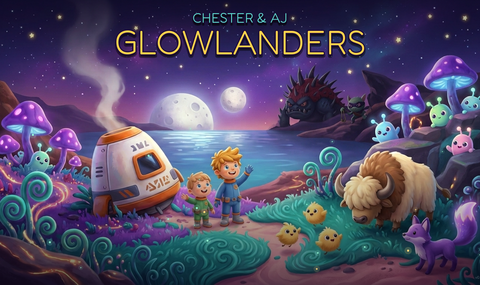
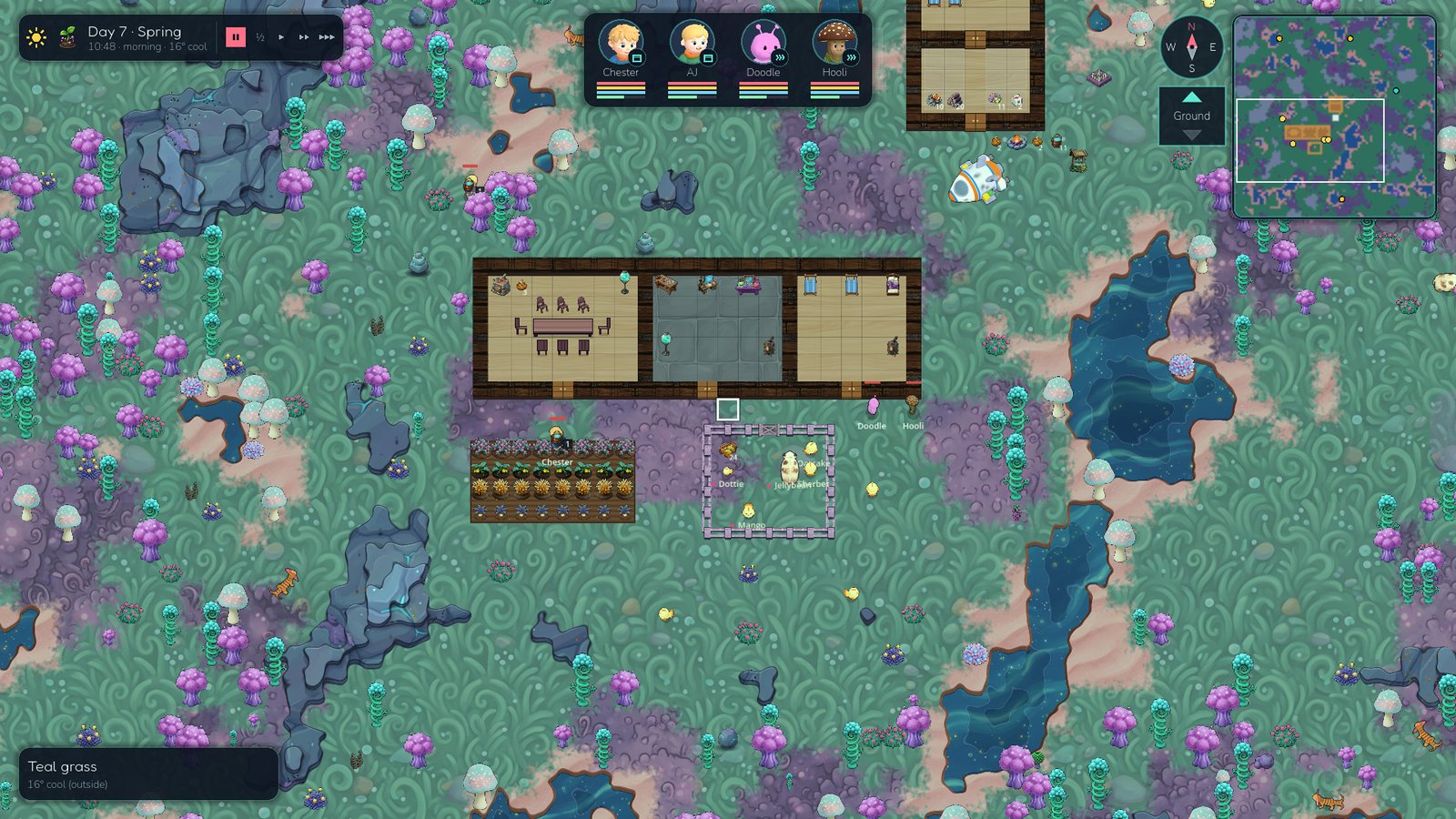
A colony on an alien planet
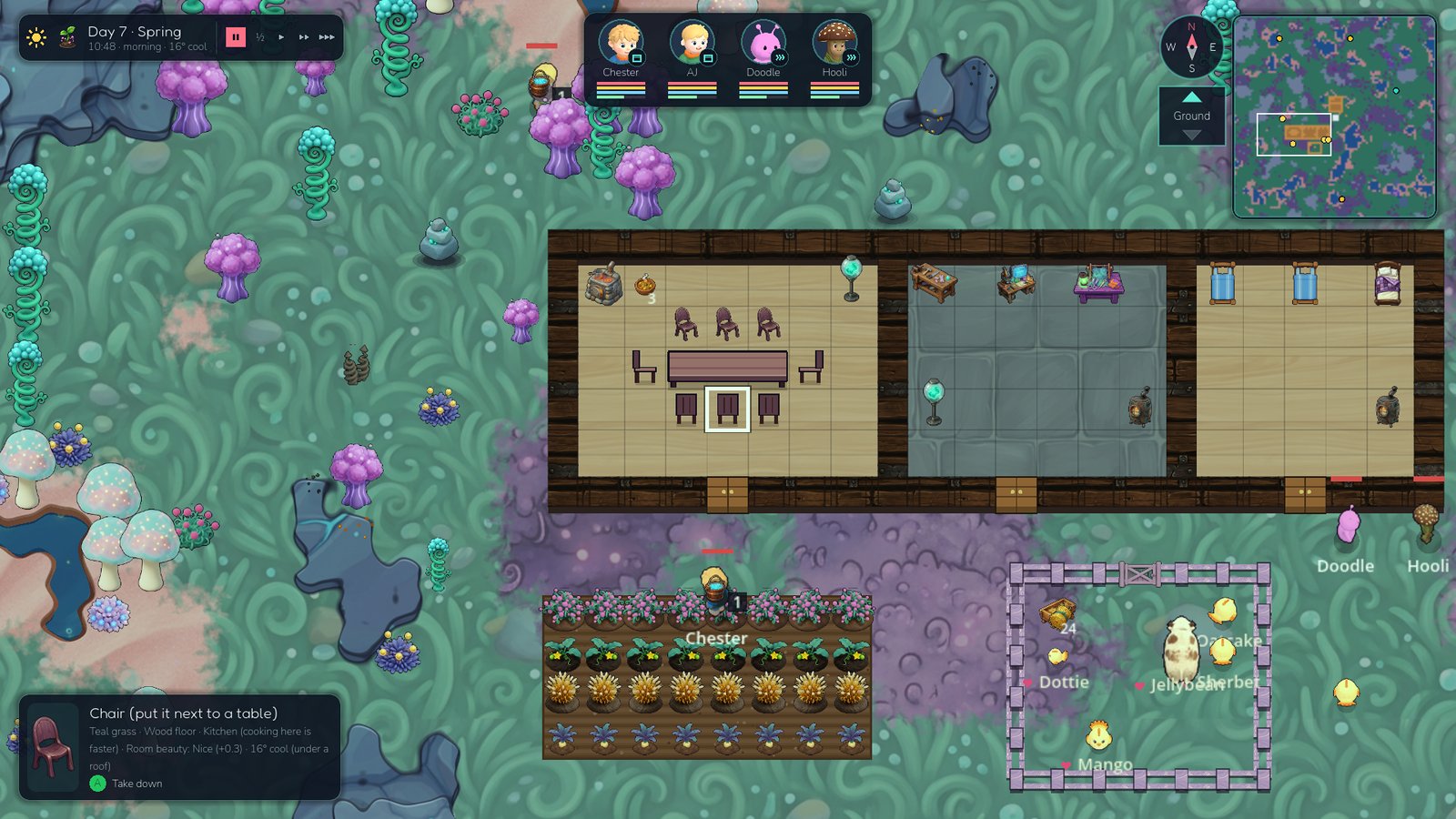
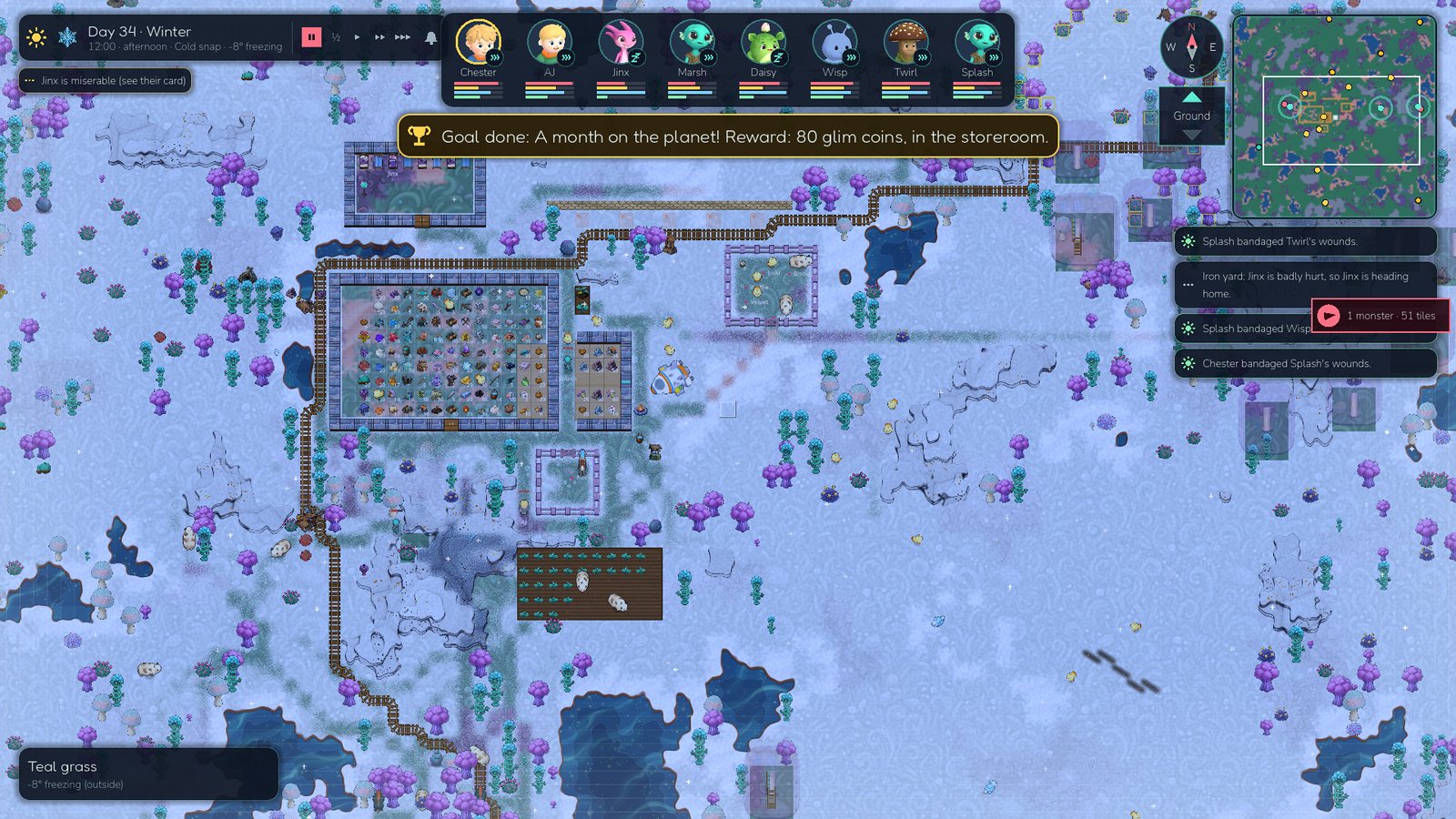
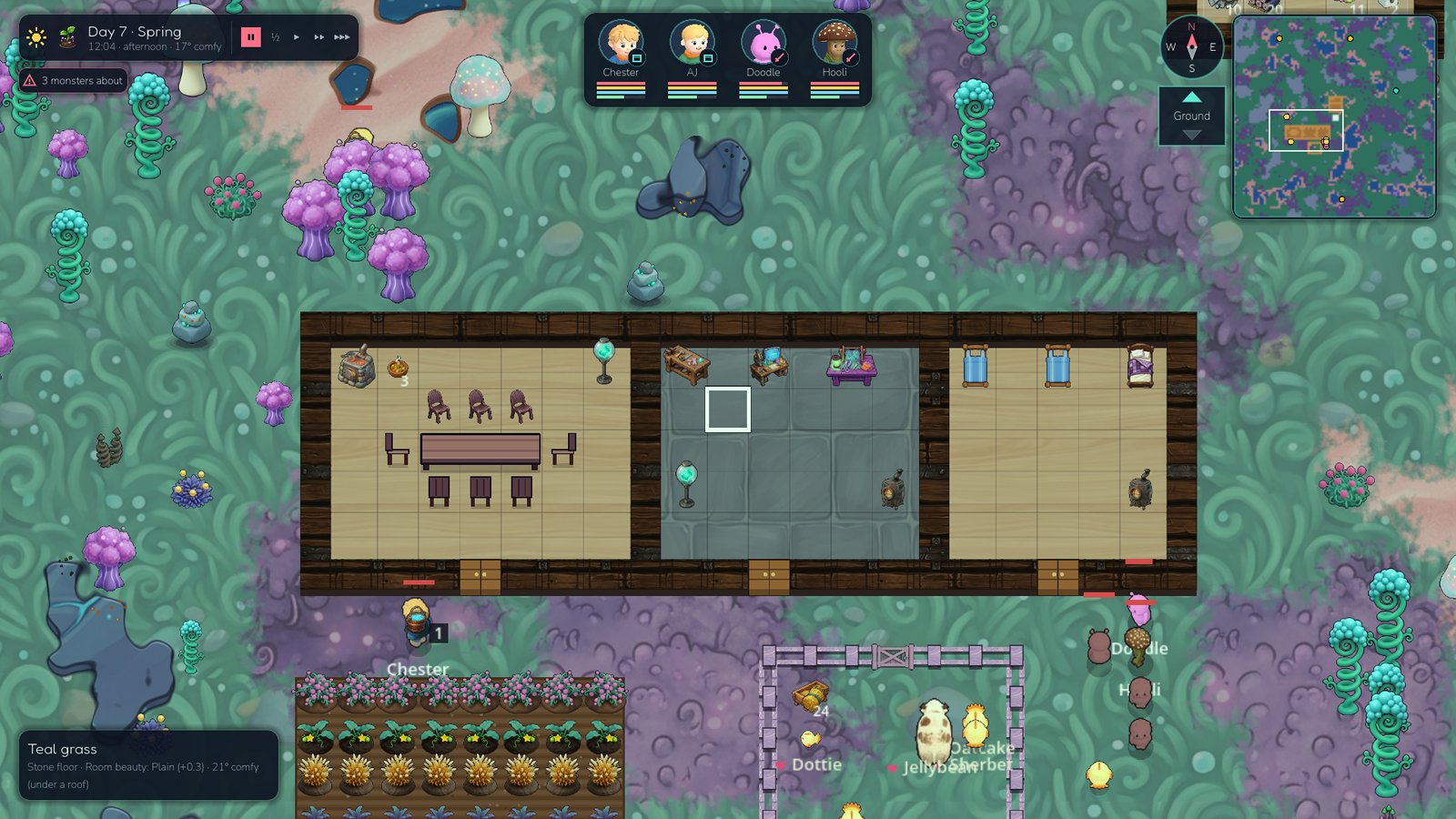
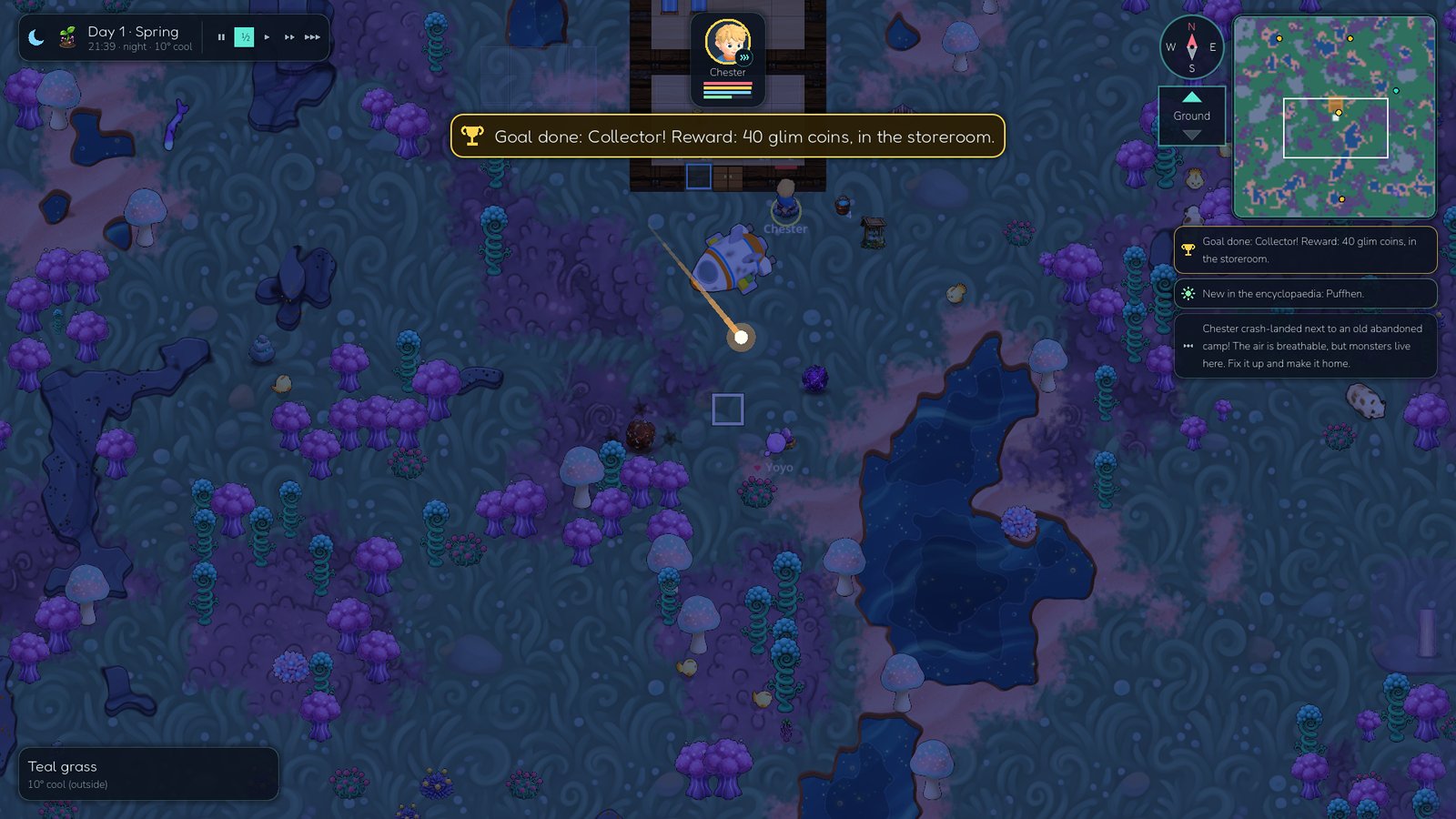
All screenshots are from the game itself. Tap one to see it full size.
The goal
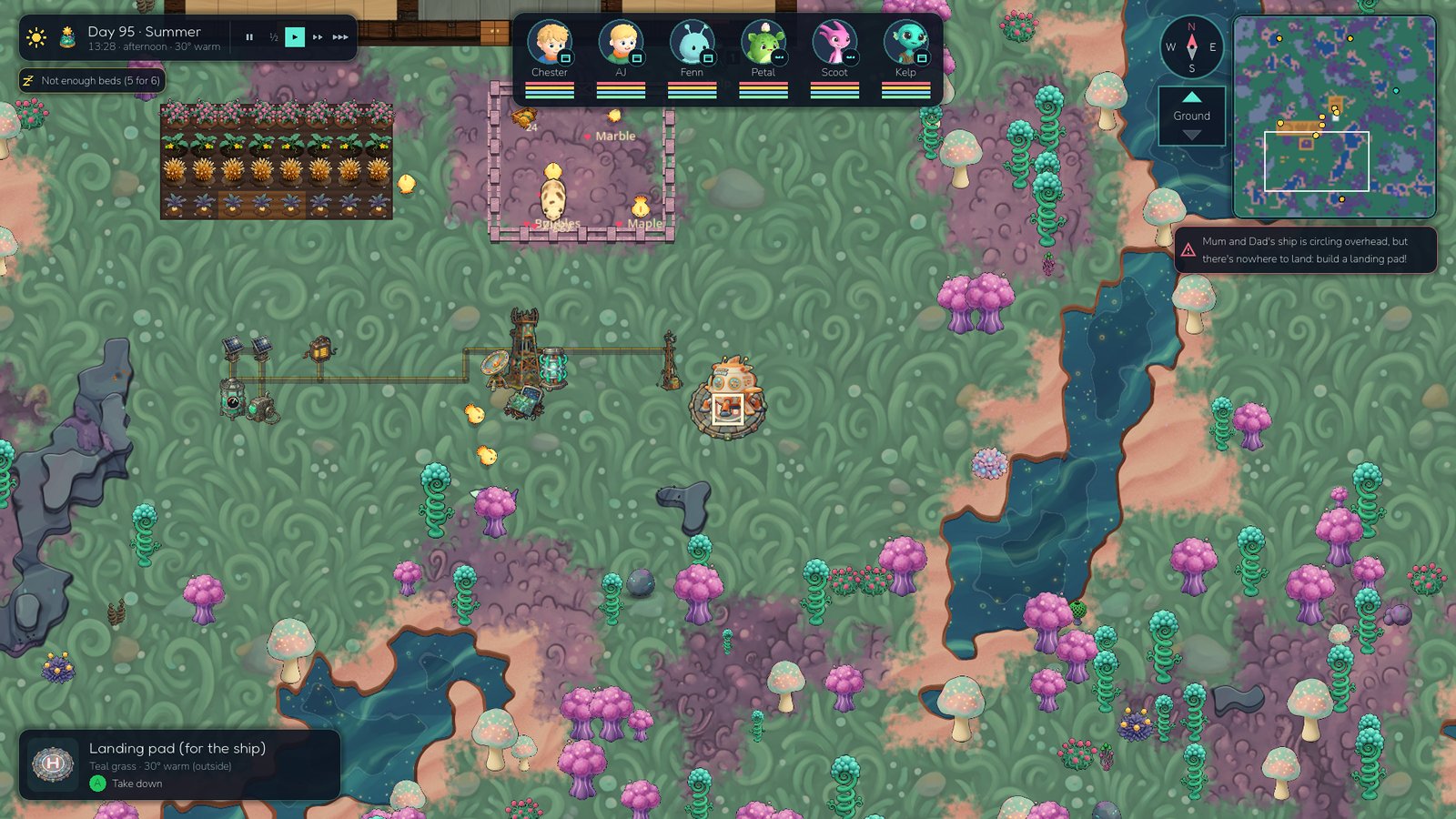
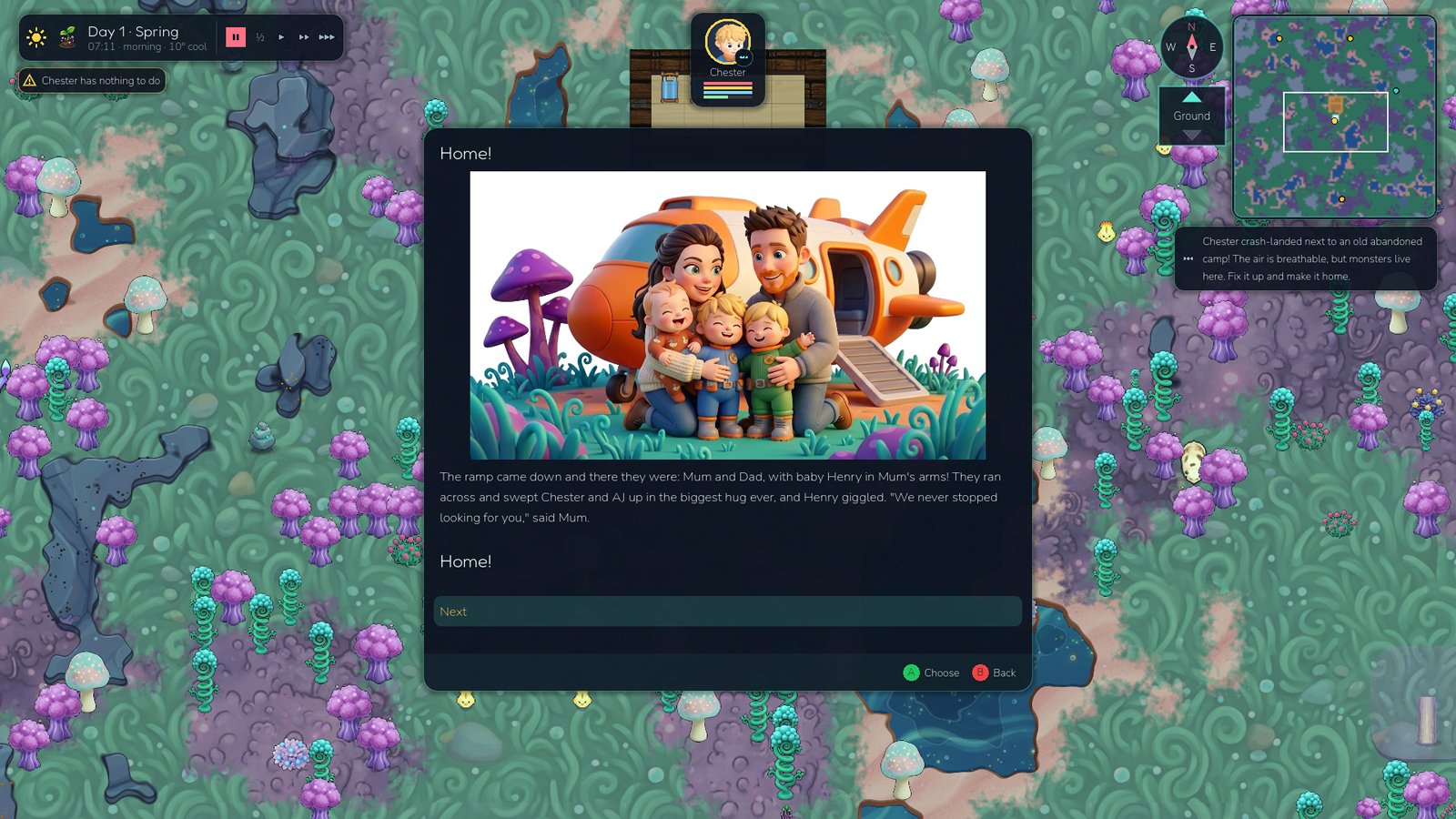
Call Mum and Dad, and fly home
Every colony is working towards one big thing: a rescue beacon strong enough to reach home.
Research the way home
Radio, then star charts (made by stargazing at the telescope, one clear night at a time), then a long-range signal. It's the last row of the research tree.
Build the beacon
A frame of stone, iron and glass, with a power core, a dish and a navigation computer built beside it, from rare finds like star iron, starshards and parts salvaged from the crash pod, plus a radio mast to hear the answer. All of it needs power.
A colony worth leaving
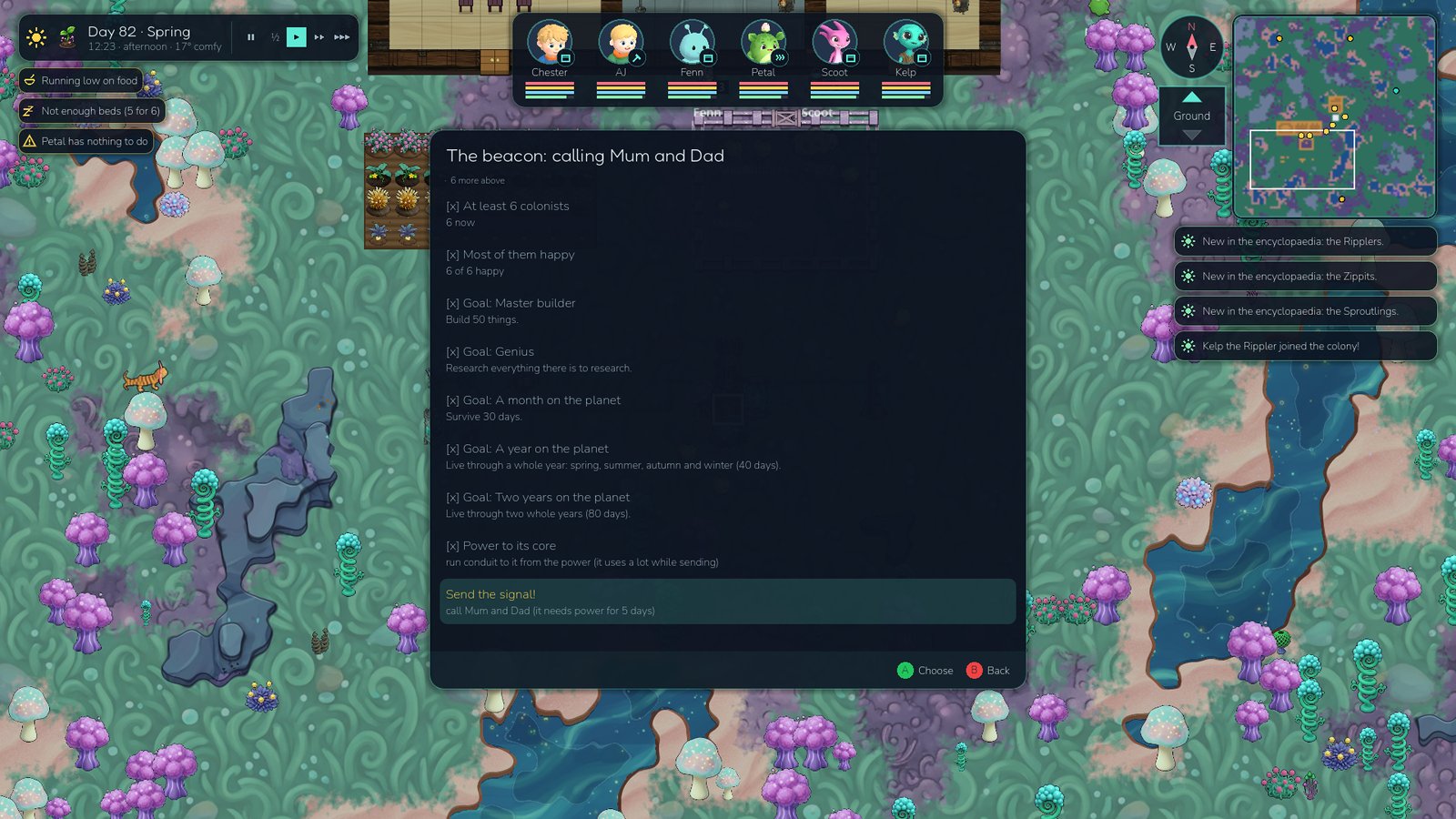
The beacon's checklist wants a proper colony first: enough colonists, most of them happy, and some of the big goals done.
Send the signal
Sending takes days, the beacon has to stay powered the whole time, and the signal draws raids, so the colony has to hold out.
They answered!
Mum and Dad hear it. Their ship is on its way, about ten days out, and needs a landing pad ready for it.
Go home, or stay
When the ship lands, the ending pages tell the story of the family back together, and you choose: fly home, or stay on the planet you made your own.
Colonists
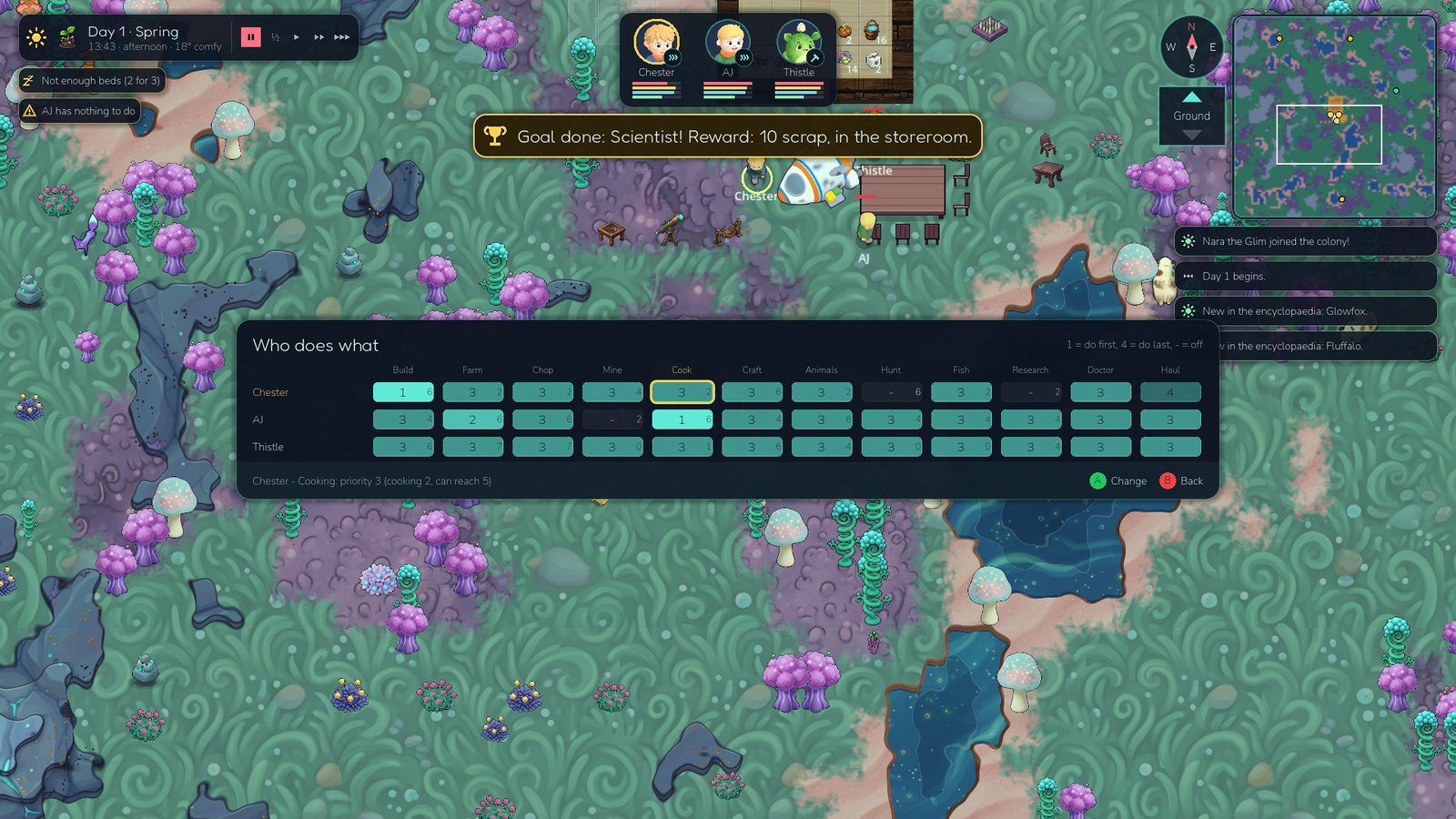
People with skills, moods and jobs
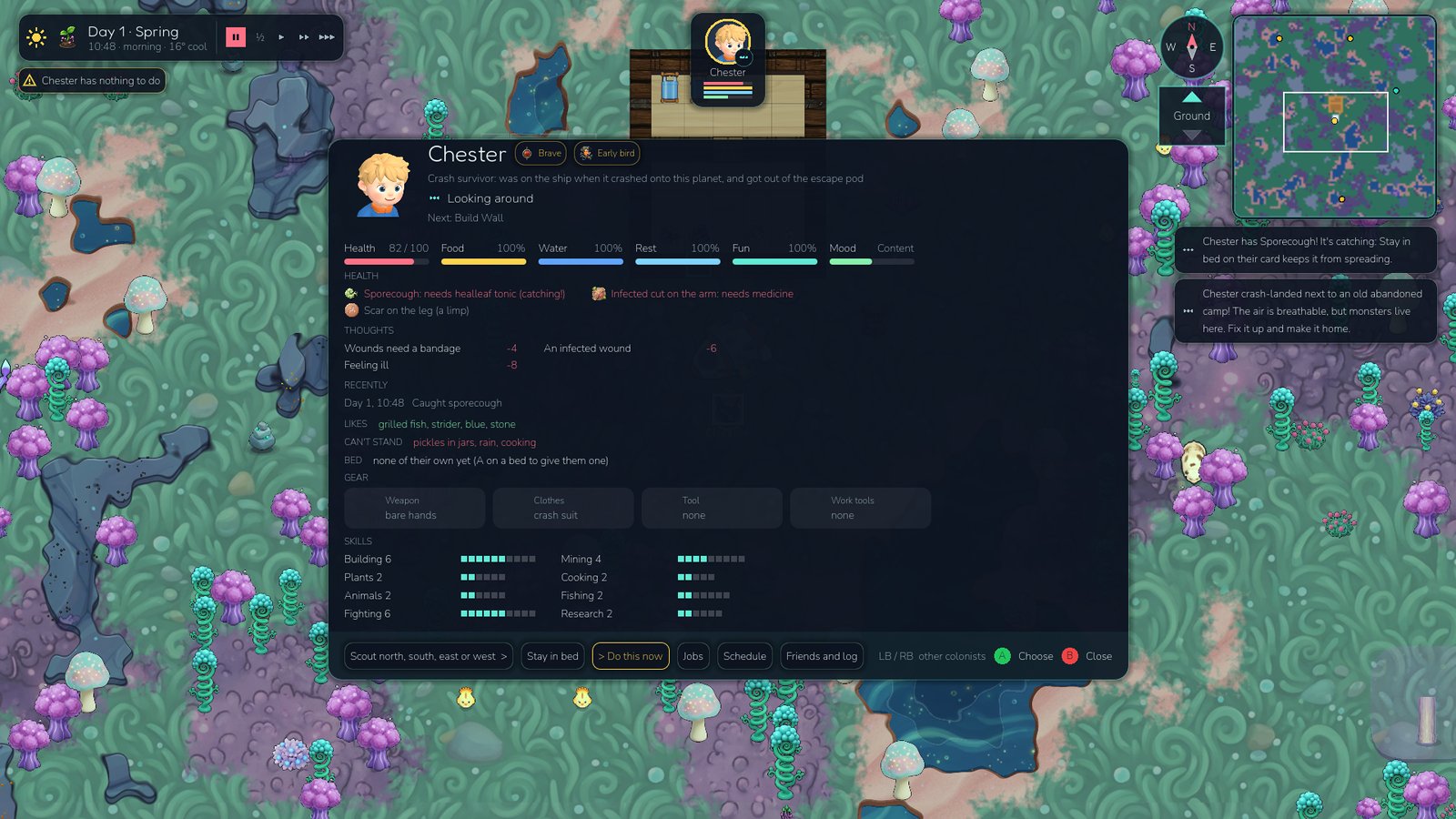
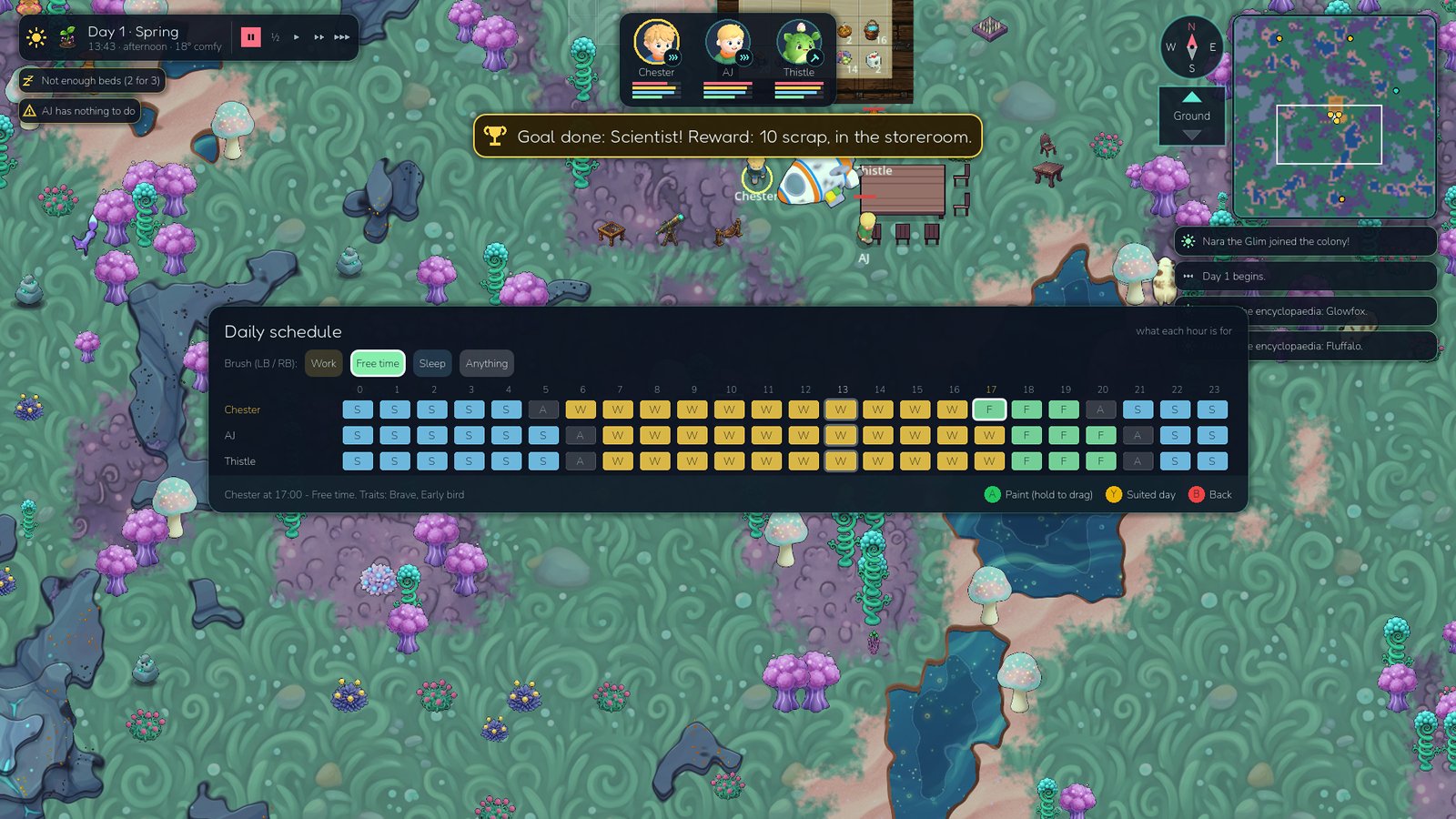
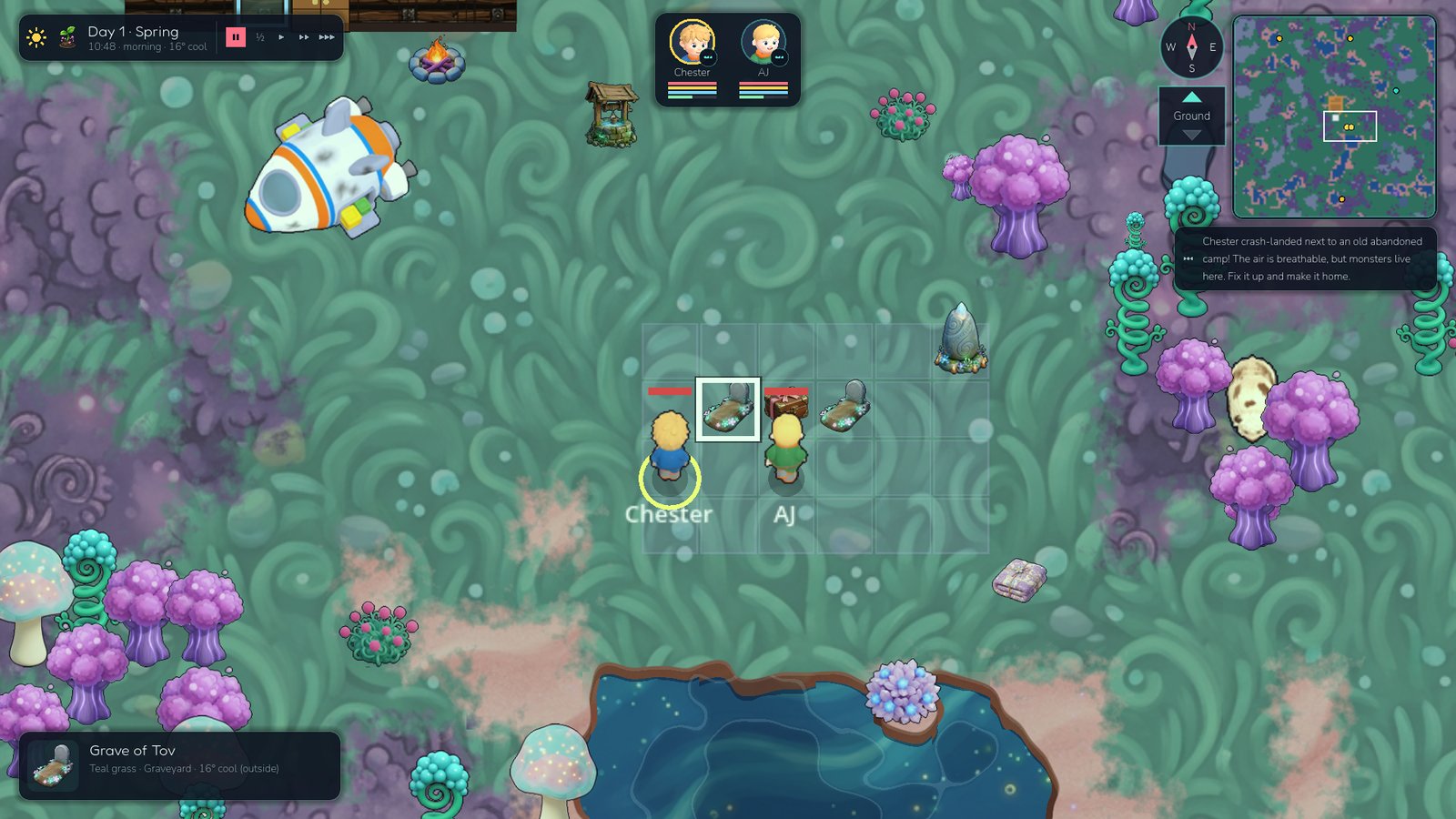
Skills that grow
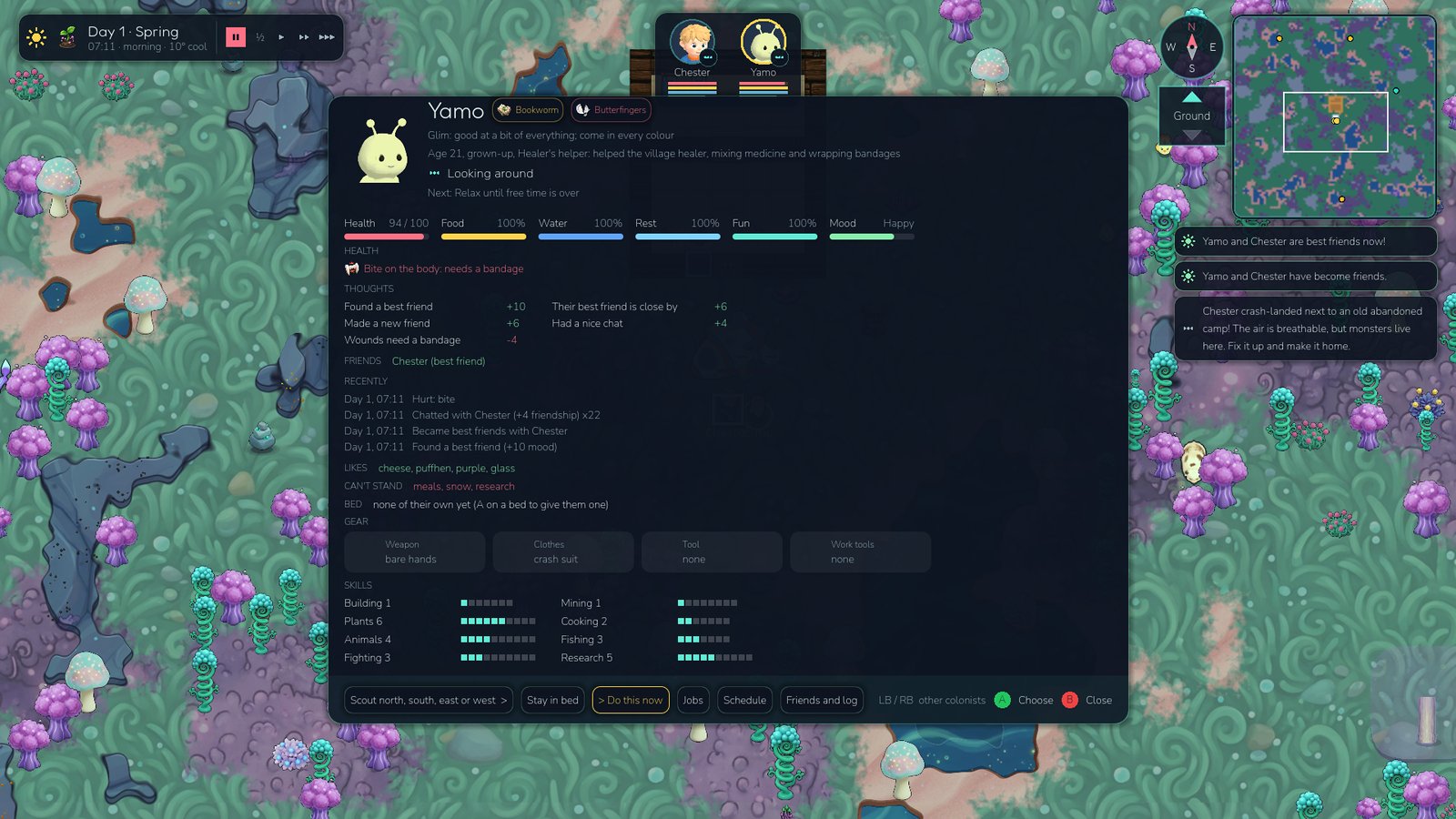
Eight skills from 0 to 10: building, mining, plants, cooking, animals, fishing, fighting and research. Practice slowly raises them, up to each colonist's own ceiling.
Mood
A good meal at a table, a comfy bed or a glow storm cheers people up; sleeping on the ground, rain or the cold brings them down. Happy colonists work faster.
New friends
Six kinds of alien visitors wander in and ask to join, each with their own strengths. Survivors of the crash turn up in the first week to help.
Gear
Clubs, crystal spears and iron swords, slings, bows, crossbows and scrap blasters, leather vests, hide armour, iron mail, fur coats and wool jumpers. Colonists pick up the best kit by themselves, or you hand it to them, and carry a set of iron tools (faster mining, chopping and digging) as well as their weapon.
Traits
Everyone has one or two of 21 traits that really matter: Green fingers plants faster, Brave hits harder, a Night owl works late, a Big eater gets hungry sooner, and a Gloomy one needs cheering up.
Schedules and fun
A daily schedule for sleep, work and free time, and a fun bar that runs down. In free time colonists sit by the fire, play games, look at the stars or chat with a friend.
Injuries and doctors
Bites, cuts and bruises land on a body part: a hurt leg slows walking, a hurt arm slows work. Doctors bandage people in bed, and the badly hurt go to bed rest by themselves.
Sickness, infections and scars
Spore clouds bring Sporecough, Glowfever and Shiver flu, and the catching ones spread to anyone close by. A wound left unbandaged can get infected; a bad one leaves a scar that slows that part for good. Healleaf tonic cures it, and Stay in bed keeps the sick apart.
Fitness
A weight bench builds Strength (harder hits, carrying more) and a powered treadmill builds Stamina (walking faster). It builds up with regular workouts and fades slowly if they stop.
A pet that picks you
Hatch a strange egg from a meteor crater and out comes a Cometkin, a fluffy lilac alien that bonds with one colonist, follows them about, helps them fight and carries little things to storage.
Graveyards and funerals
Someone who dies is wrapped in a soft blanket, carried to the graveyard and laid to rest under a named headstone, with their belongings in a keepsake box. Everyone gathers for a funeral that evening, grieving friends visit the grave, and a memorial stone comforts them.
Building a home
From a crashed pod to a proper home
You point at the map with a cursor and give orders; the colonists decide who does what, and do it.
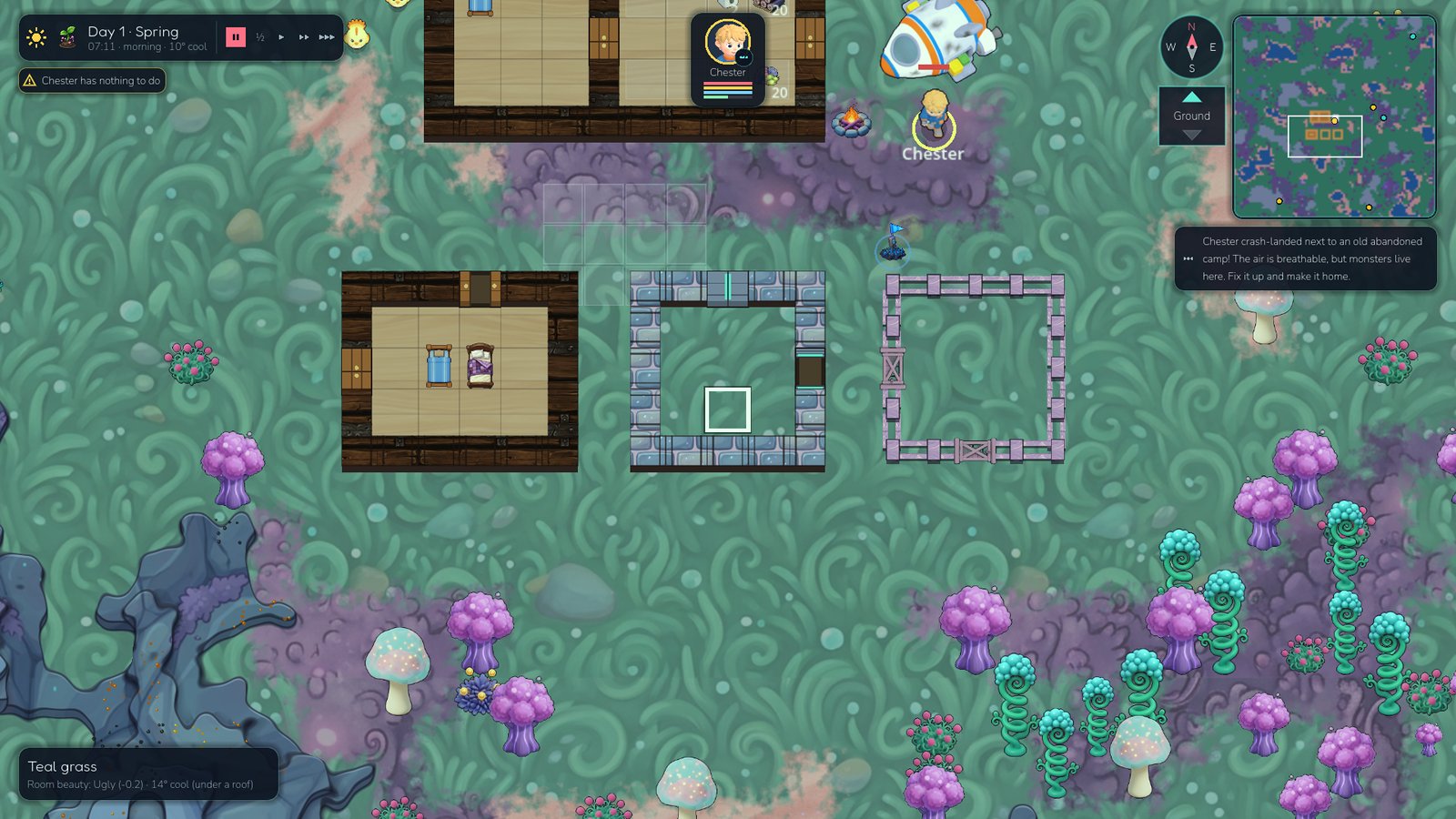
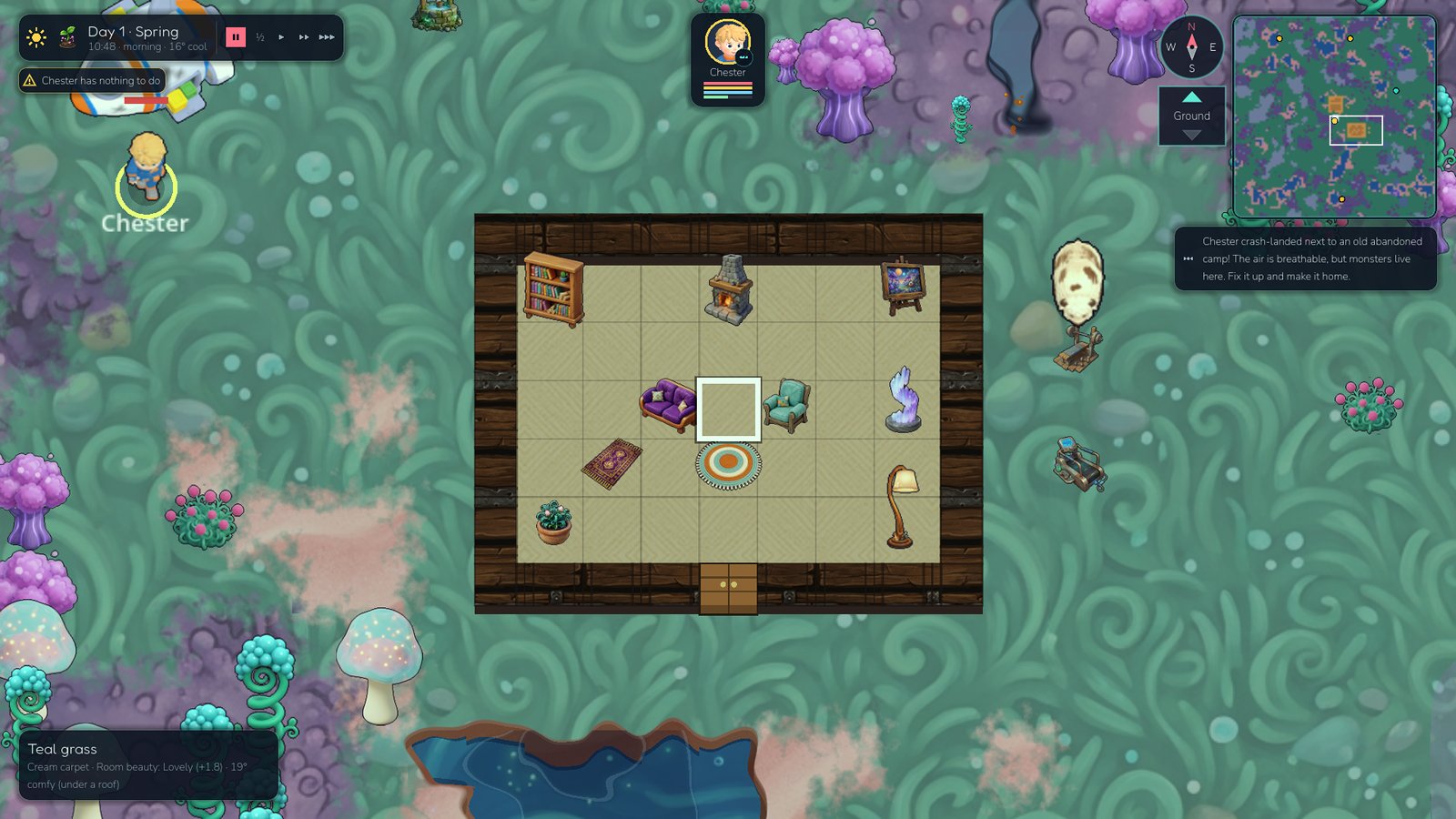
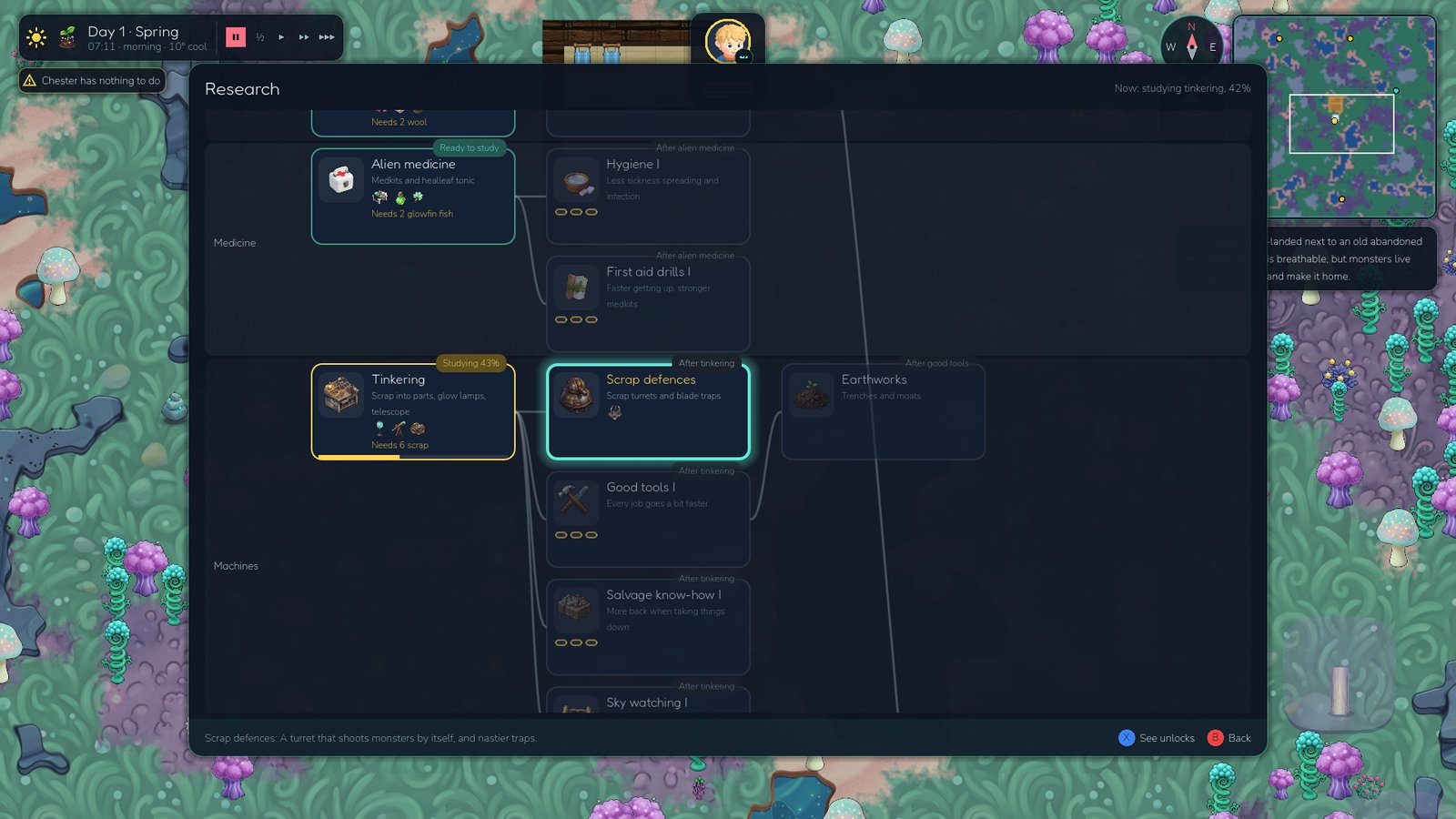
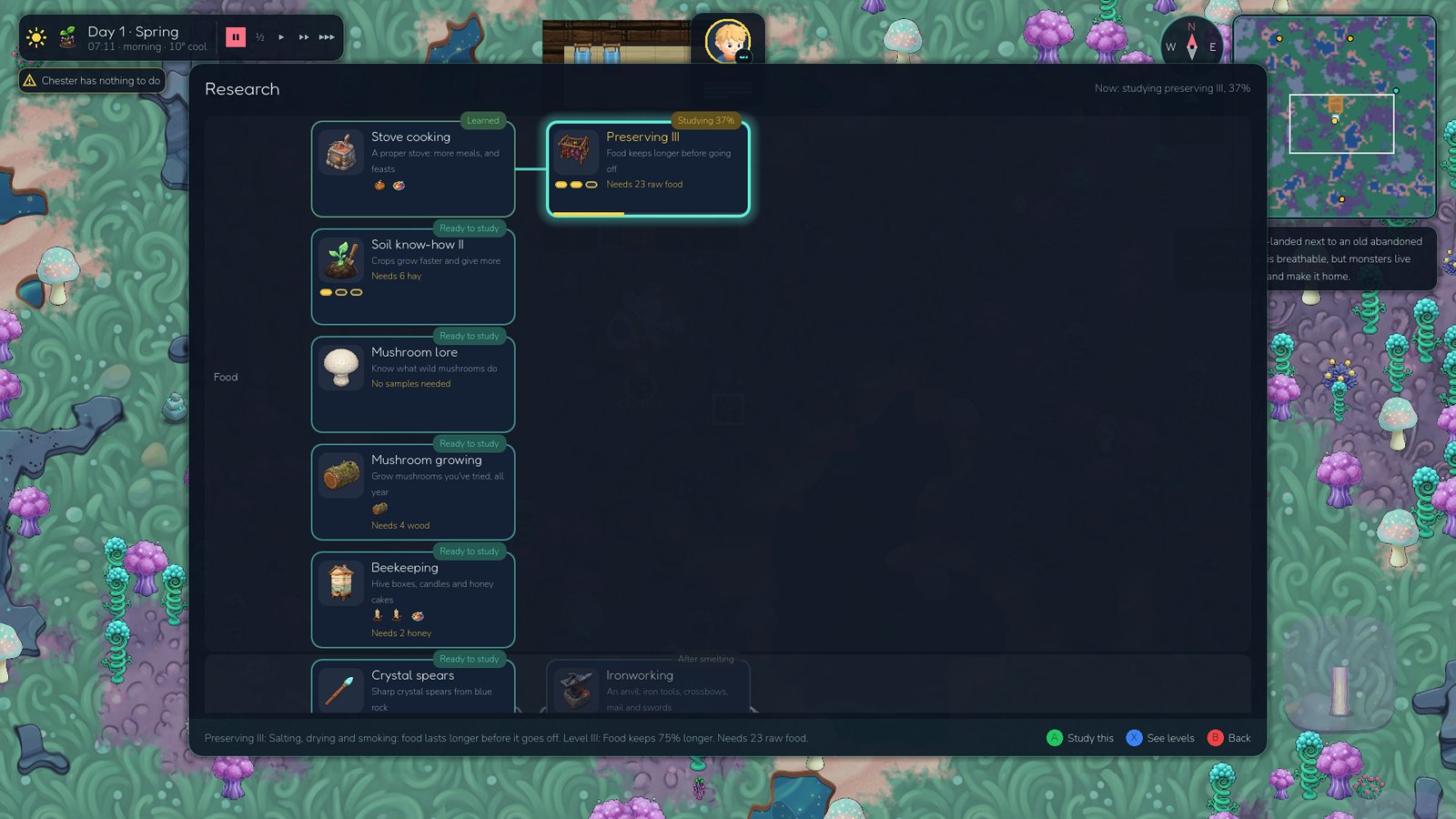
Build anything, one tile at a time
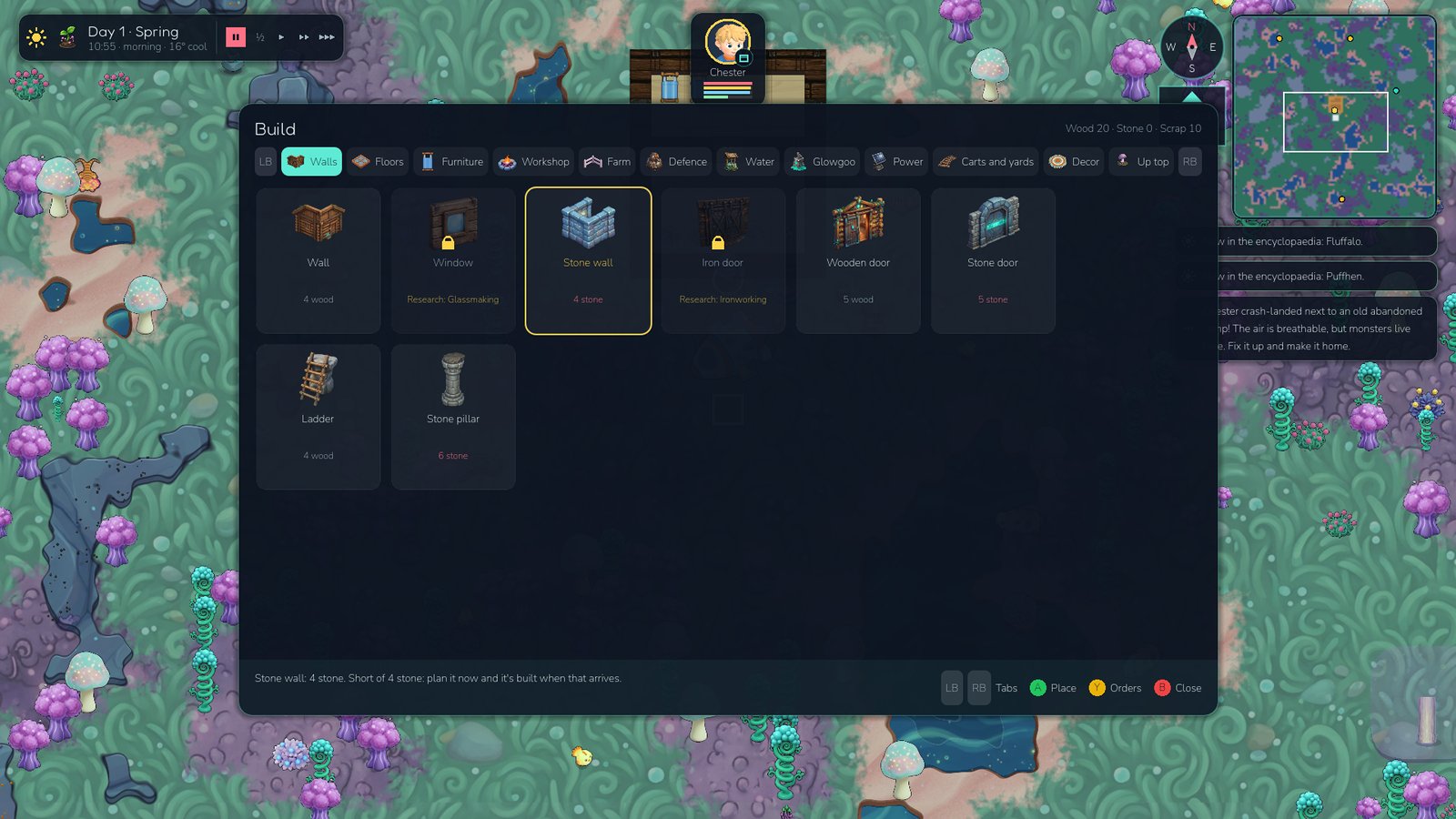
Walls, sliding wooden and stone doors, windows and glass roofs, floors and carpets, beds, tables and chairs, a fireplace, stoves, workbenches, a smelter, a research bench, a loom, a medicine table, lamps, heaters, stone pillars, ladders, docks and bridges, barricades, sandbags, traps and turrets. Plan big things with a box and colonists fetch the materials, clearing trees and bushes out of the way first; animals wander out before the walls go up.
Rooms that mean something
Closed rooms get a roof by themselves. Name a room a kitchen (faster cooking), bedroom (better sleep) or storeroom. Paint "No roof" inside walls for a garden.
Nice rooms
Every room is rated Ugly, Plain, Nice or Lovely from its floor, carpets, rugs, paintings, plants, crystal sculptures and furniture, less any clutter lying about. Sleeping, eating or relaxing somewhere lovely cheers people up.
A fireplace
Built indoors, it keeps the room warm, cooks meals like a campfire and is a cosy spot to sit by. The old camp's campfire stays outside.
Things to do for fun
A games table for two, a telescope for clear nights, a bookshelf to read at (both now and then help the research), a hammock swing, and an armchair and a sofa to curl up in.
Storage that knows its place
Choose what each storage patch takes and how important it is: food goes to the larder with a cool box, wood to the woodpile, and haulers move things up to better spots by themselves. Quick picks set a patch to things that keep (stone, ore, coins: fine outside) or things that go off or get damaged (food, wood, cloth, hides: keep them under a roof). Haulers bring in what's out in the rain first, never take more than there's room for, and tidy part stacks into full ones.
Workstations and bills
Each station has a list of things to make: meals and stews, weapons and clothes, metal bars, medkits, cloth. Some keep a stock topped up by themselves. Colonists work from the tile in front of the station.
Research
The research bench opens a research tree: every topic is a card in rows by theme, with pictures of what it unlocks and the samples to carry over, joined by lines to what it leads to. Learn crystal spears and glass early, then electricity, goo pumping and the ground scanner. Bonus topics make the whole colony better, with three levels each: fairer traders, food that keeps longer, faster work, bigger loads and a night watch that spots raiders before they arrive.
Salvage and trade
Pry scrap off the crashed ship, mine ore from the mountains, and trade with friendly Glim traders for coins and supplies. Now and then a trader brings a tame frill lizard, bristleboar or fluffalo to sell.
Iron and gold
Seams of iron, coal and gold wind through the mountains. Smelt the ore into bars, hammer iron into tools, crossbows, mail, swords, doors and a faster iron stove at the anvil, and gold into statues, lamps and jewellery. Hides from the animals in a pen make leather.
Save and load
Three save slots and a daily autosave, and "Save and exit" from the game menu so you can carry on next time.
Power, water and glowgoo
Keep the lights on and the water running
Make power from the sun, the wind or glowgoo, draw and pump water, and run it all through one bundle of conduit.
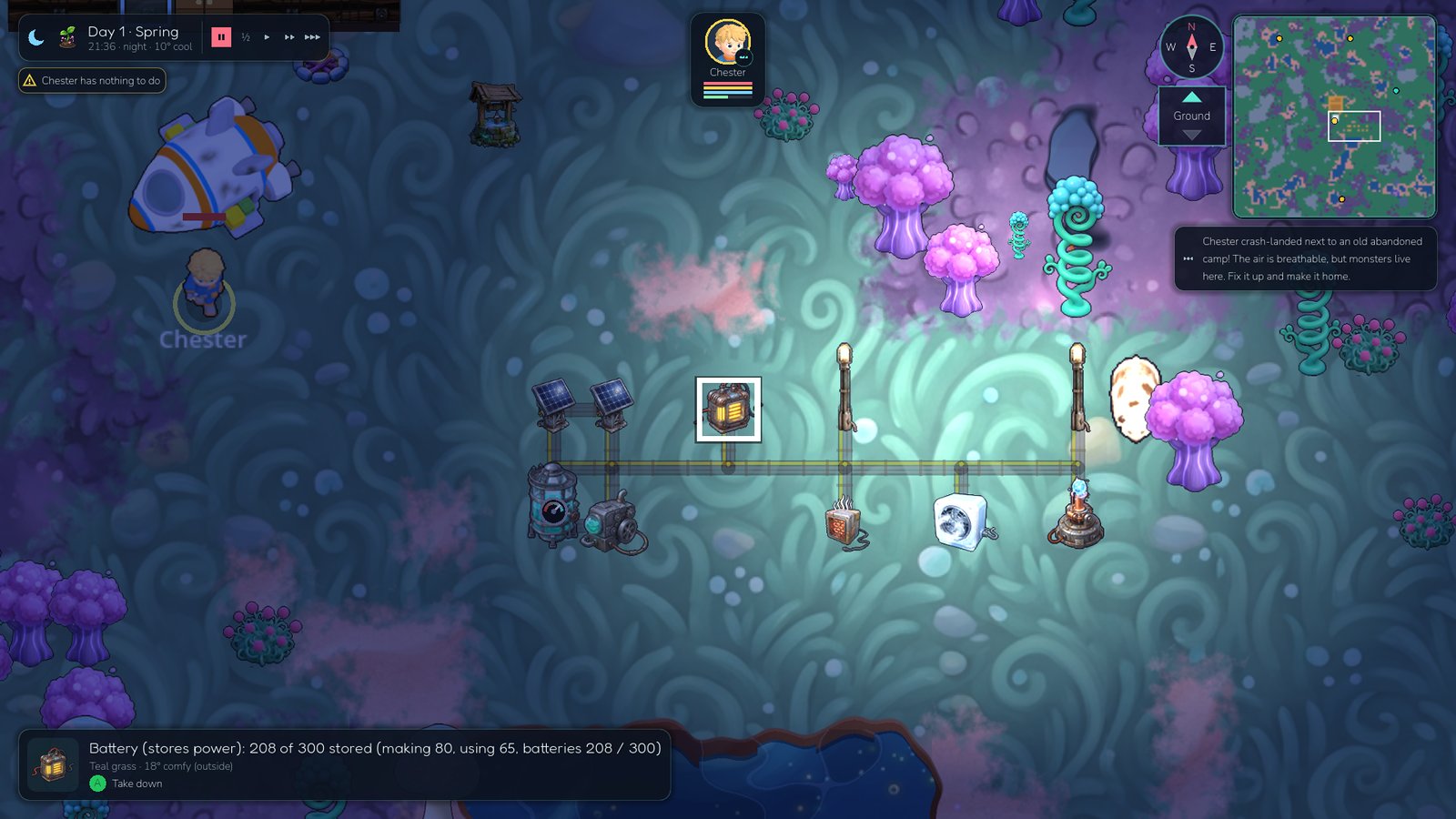
Power
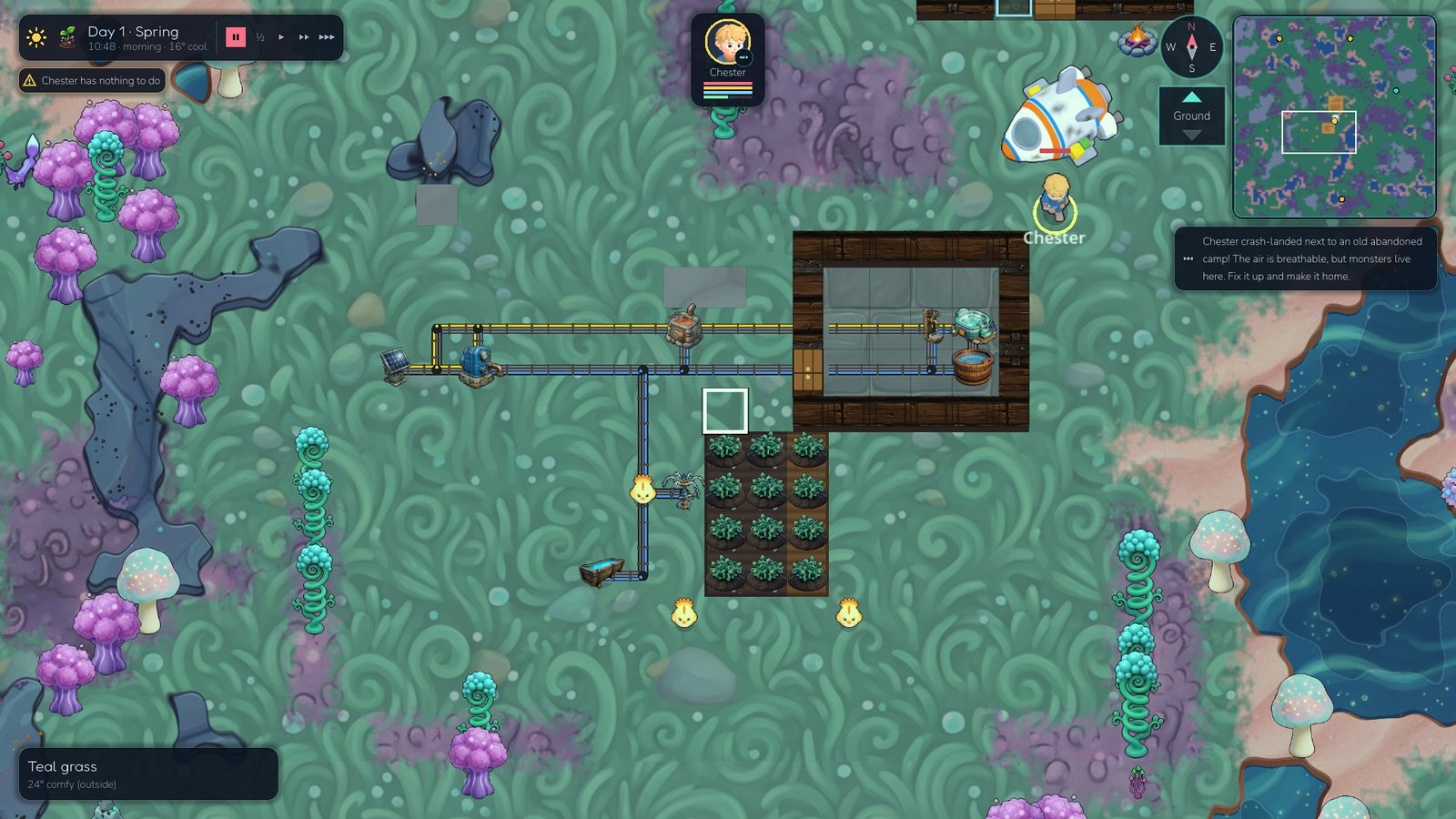
Solar panels (less on cloudy days, none at night), wind turbines (most in a storm) and goo generators make power; conduit joins them up; batteries keep the lights on after dark. It runs electric lamps, heaters, coolers that keep food fresh, zap turrets, a treadmill, and a faster stove and research bench.
Conduit
One thing to lay for power, glowgoo and water: a bundle with a yellow, a green and a blue strand. Each strand lights up along the way something's flowing in it and stays grey where it's empty, so you can see at a glance what reaches where. Runs that don't touch stay separate.
Air conditioner
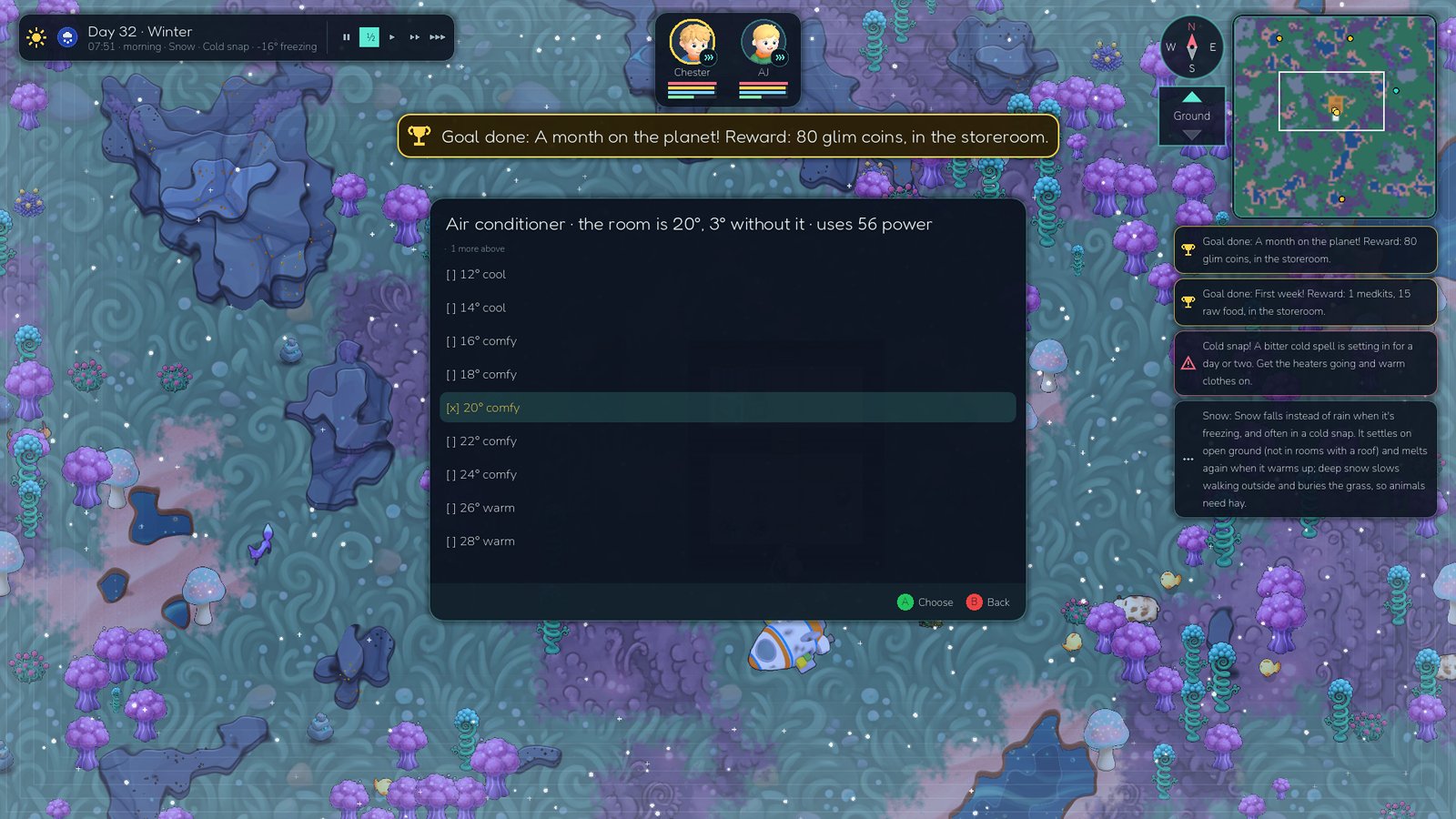
An electric unit that warms or cools the room it's in to the temperature you set. The further off the room would be, the more power it uses, and it only works in a room with a roof.
Glowgoo
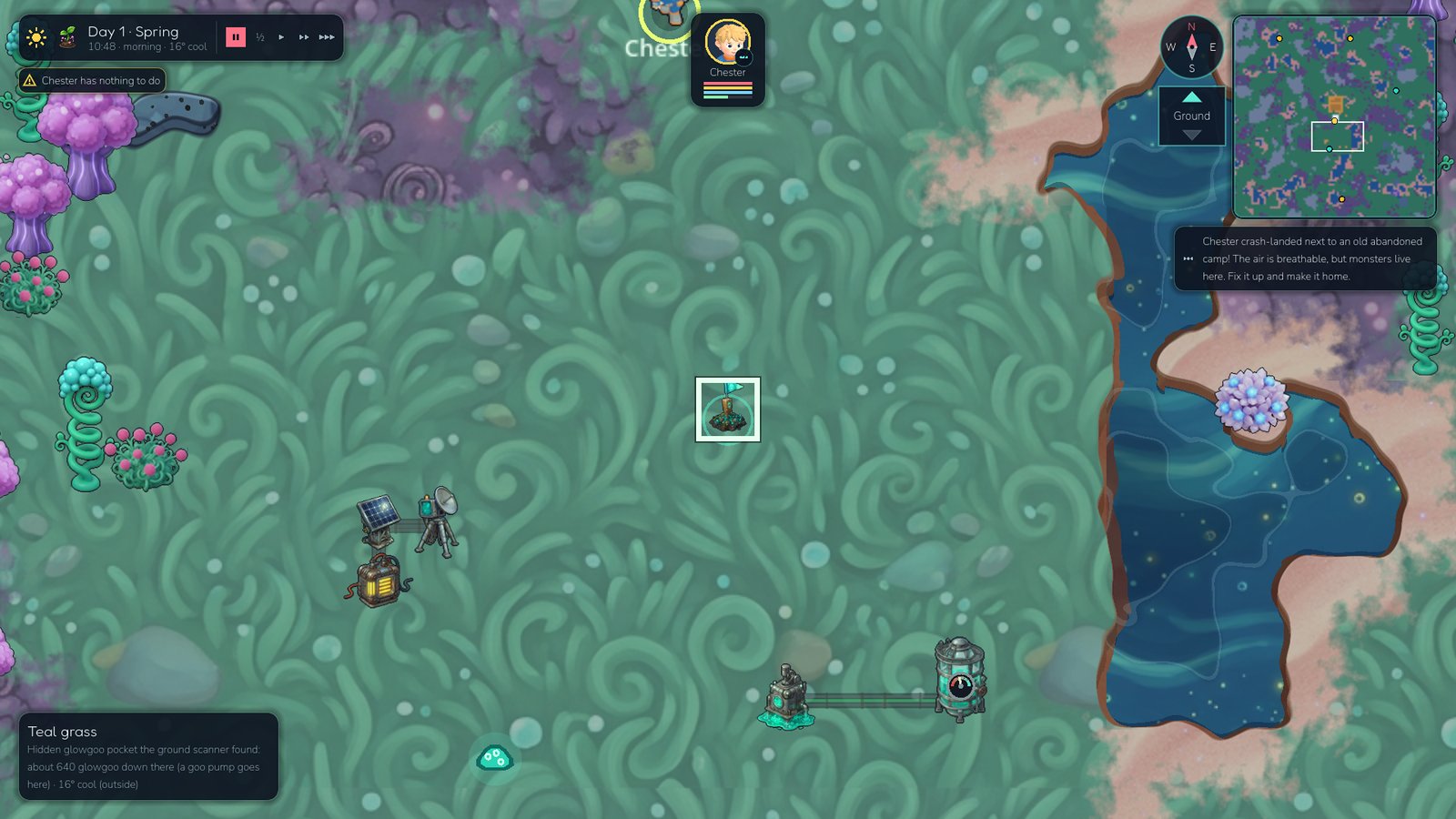
The first underground resource: glowing slime that bubbles up in seeps. Pump it along conduit into tanks (each with a little fuel-gauge dial), burn it in generators and goo lamps, or refine it into fuel, gel sheets and barrels to trade.
Ground scanner
Not every glowgoo pocket shows on the surface. A researched, powered ground scanner slowly scans further out, plants a survey stake on each hidden pocket it finds so a pump can go there, and shows how much goo every pocket holds.
Wells and thirst
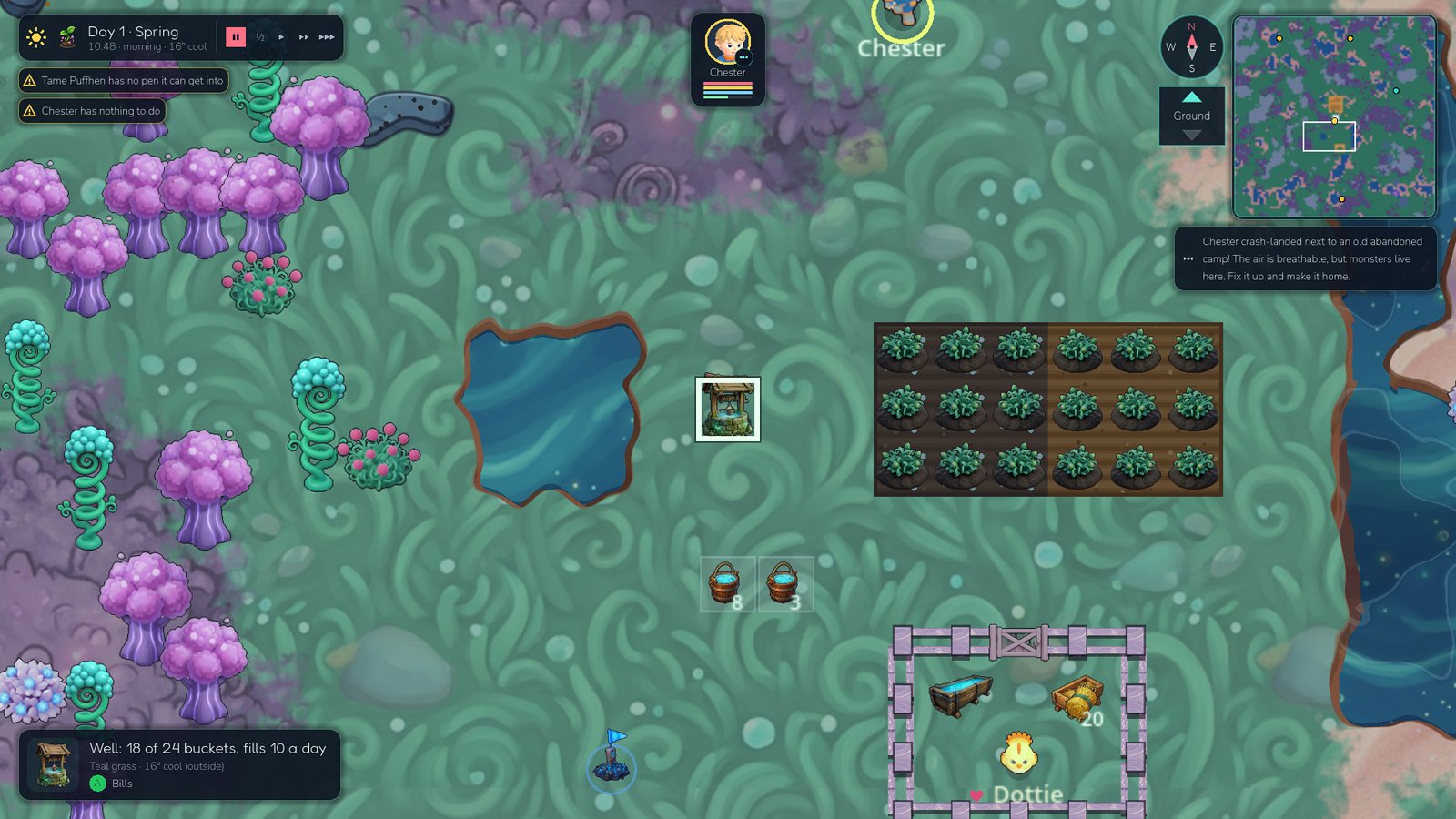
Colonists get thirsty and drink buckets drawn from a well, or risk a bad tummy from the pond. The old camp has a well; more go near ponds and lakes, or on water pockets found by dowsing or the scanner. Farmers water crops so they grow faster, and water troughs keep animals productive. Later an electric water pump sends water along conduit to taps, troughs, sprinklers, stoves and baths: a wooden tub or a powered hot bath, best of all in a bathroom.
Food, farming and animals
Grow it, catch it, cook it
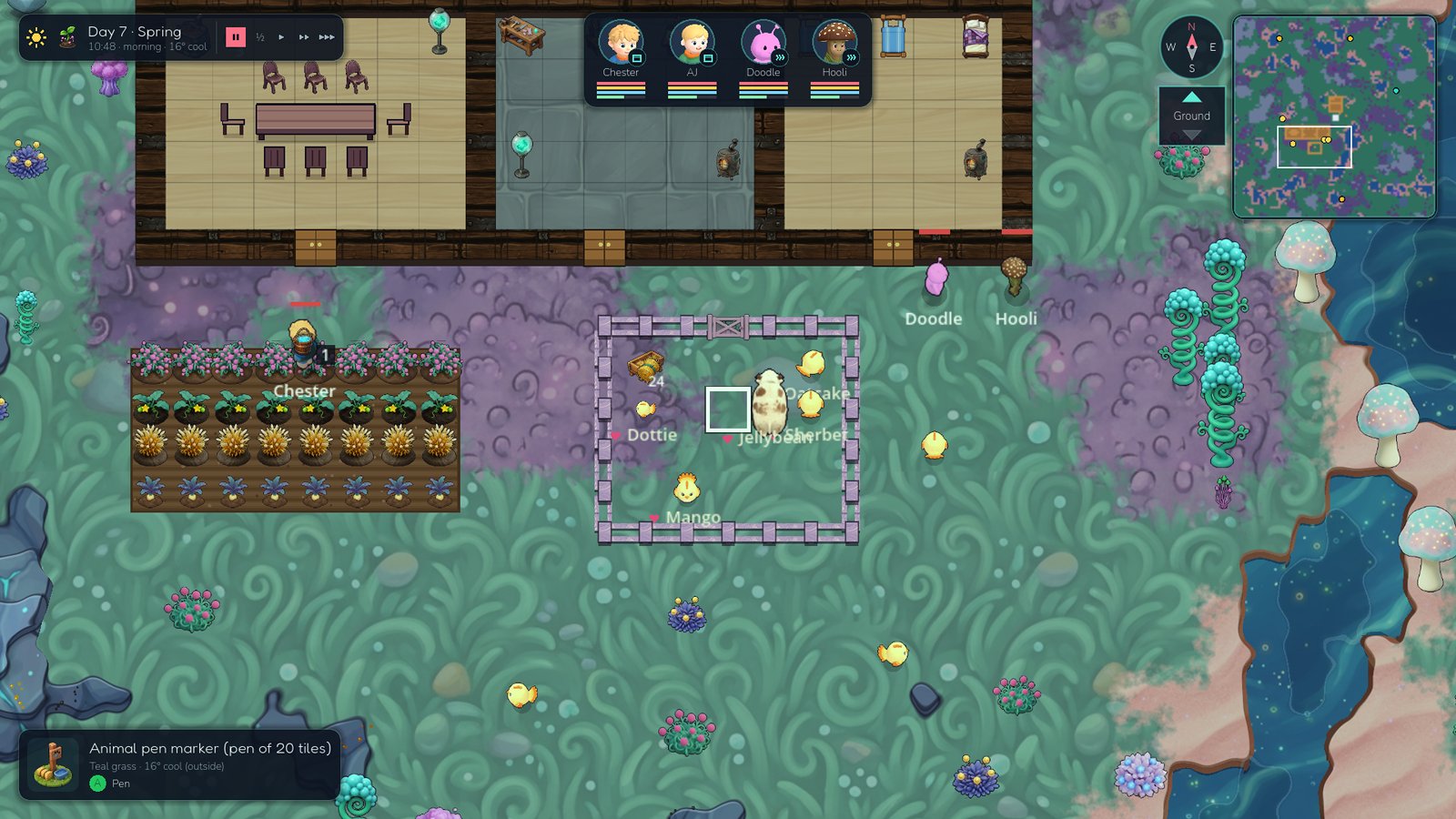
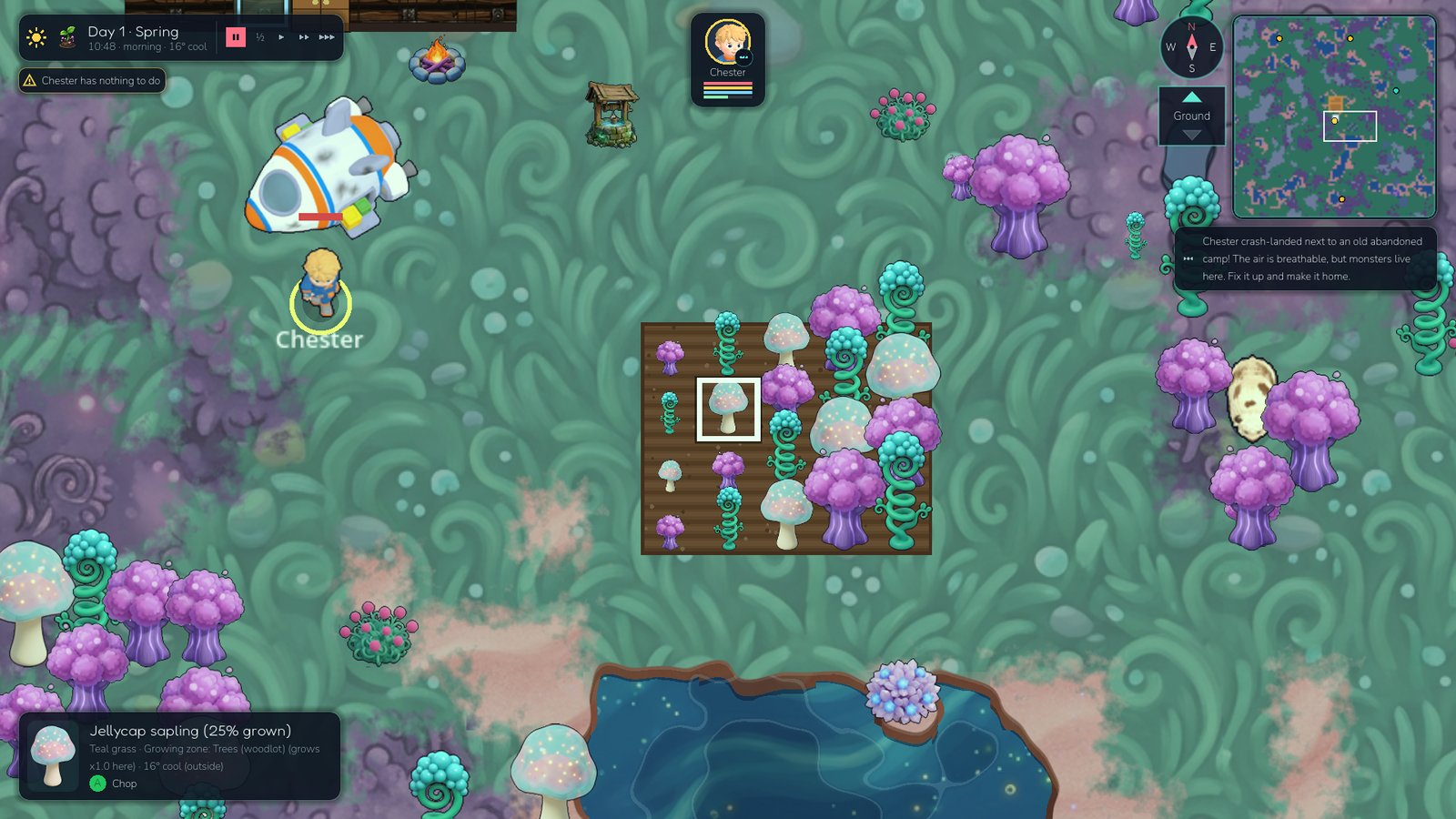
Alien crops
Puffberries, glowroot, sunmelons, healleaf, cottonpods and hayweed, each happiest on a different ground, growing in daylight (or under glow lamps) when it's warm enough.
Fishing
Seven fish that bite in different places and times: moonrays at night, sandskippers by pink sand, bubblepuffs in small ponds, and a huge deepjaw in big lakes for a skilled fisher.
Cooking
Meals, feasts, grilled fish, fish stew, moonray rolls, sushi and pickles, each with its own boost to mood.
Food goes off
Raw food rots in a few days, faster in the heat and slower in the cold. A cool box or a powered cooler keeps a whole larder fresh, and pickles keep for ages. Rotten food gets thrown away.
Strange mushrooms
Every new world grows its own six kinds of wild mushroom, with made-up names and colours, and nobody knows what one does until someone's brave enough to try it. Some make you faster, warmer or fill you up, some turn you rainbow-coloured, glow in the dark or give you hiccups, and a few give you a bad tummy.
Mushroom cellars
Grow the kinds you've tried on mossy logs in a dark room with no windows (a cave room is perfect). They crop every few days whatever the season.
Taming and pens
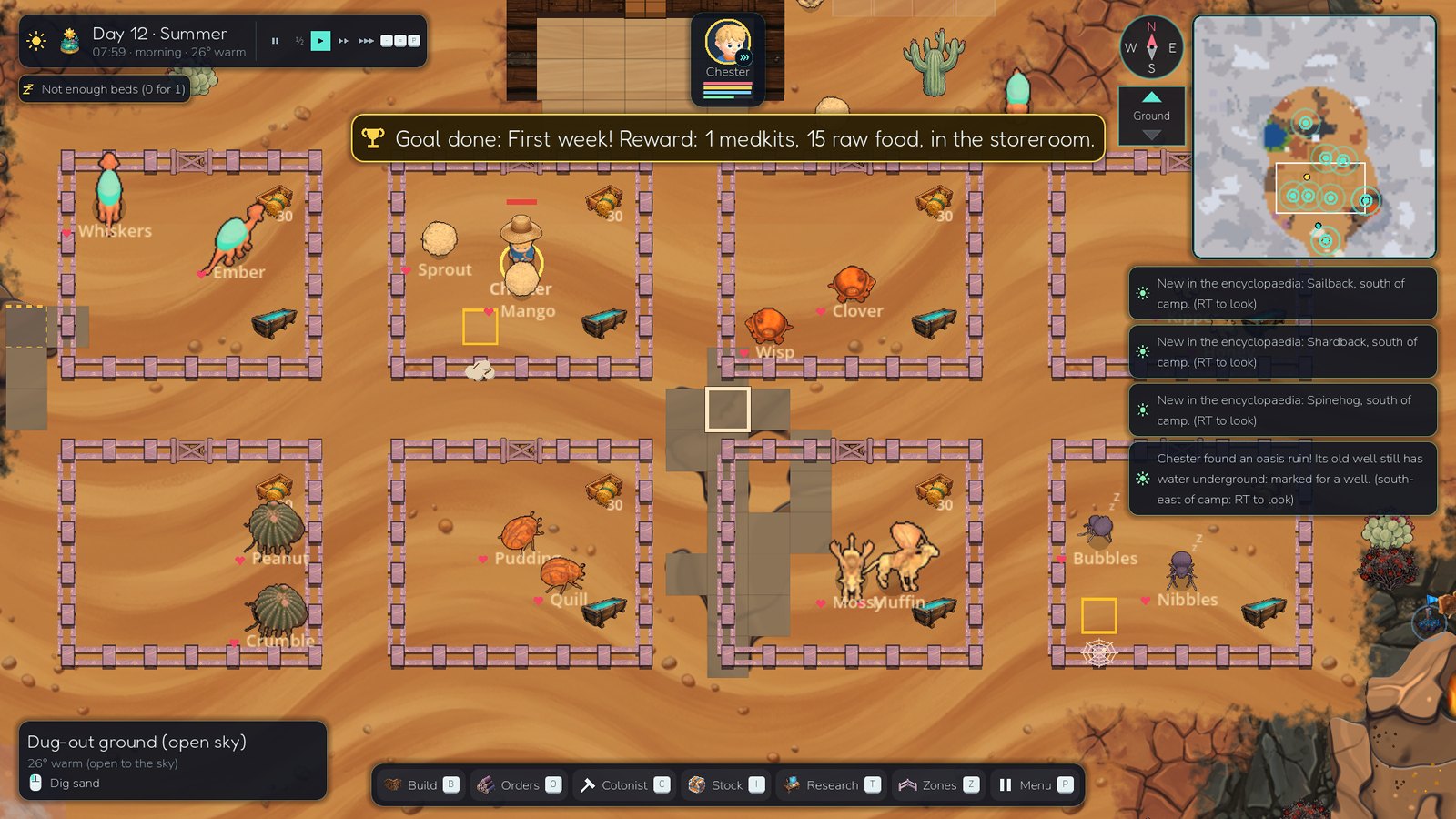
Tame Puffhens for eggs and Fluffalo for milk and wool, train a Glowfox or Bristleboar as a guard, and choose which animals live in which pen.
Riding Striders
Tame a shy, long-legged Strider, put a saddle on it and pick its rider. It carries them on long trips nearly twice as fast, saddle bags let them carry twice as much, it waits outside while they go indoors, and it kicks in a fight.
Feed and babies
Animals eat by size (a Fluffalo far more than a Puffhen) from a hay trough, and two well-fed animals in a pen with room have babies that grow up.
Wood that grows back
Wild trees slowly spread back onto open ground, and a woodlot zone gets planted, chopped and replanted. Young trees give less wood, so it pays to let them grow.
The lands
Pick where you crash
Each new game starts in a land of its own, chosen on the new-game screen: its own ground, trees and crops, its own animals and monsters, its own weather, and its own places to find. The colony game is the same; how you survive isn't.
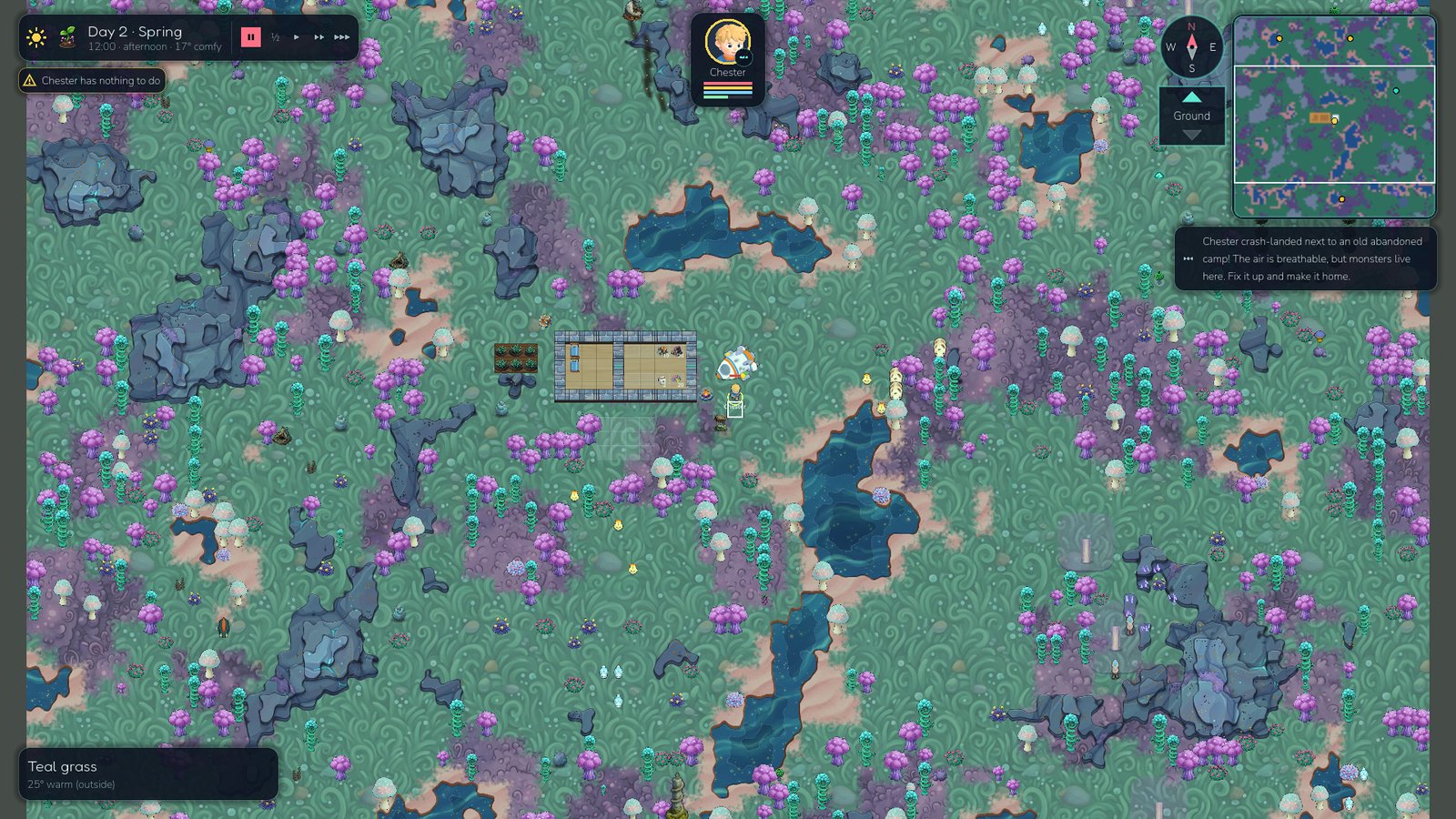
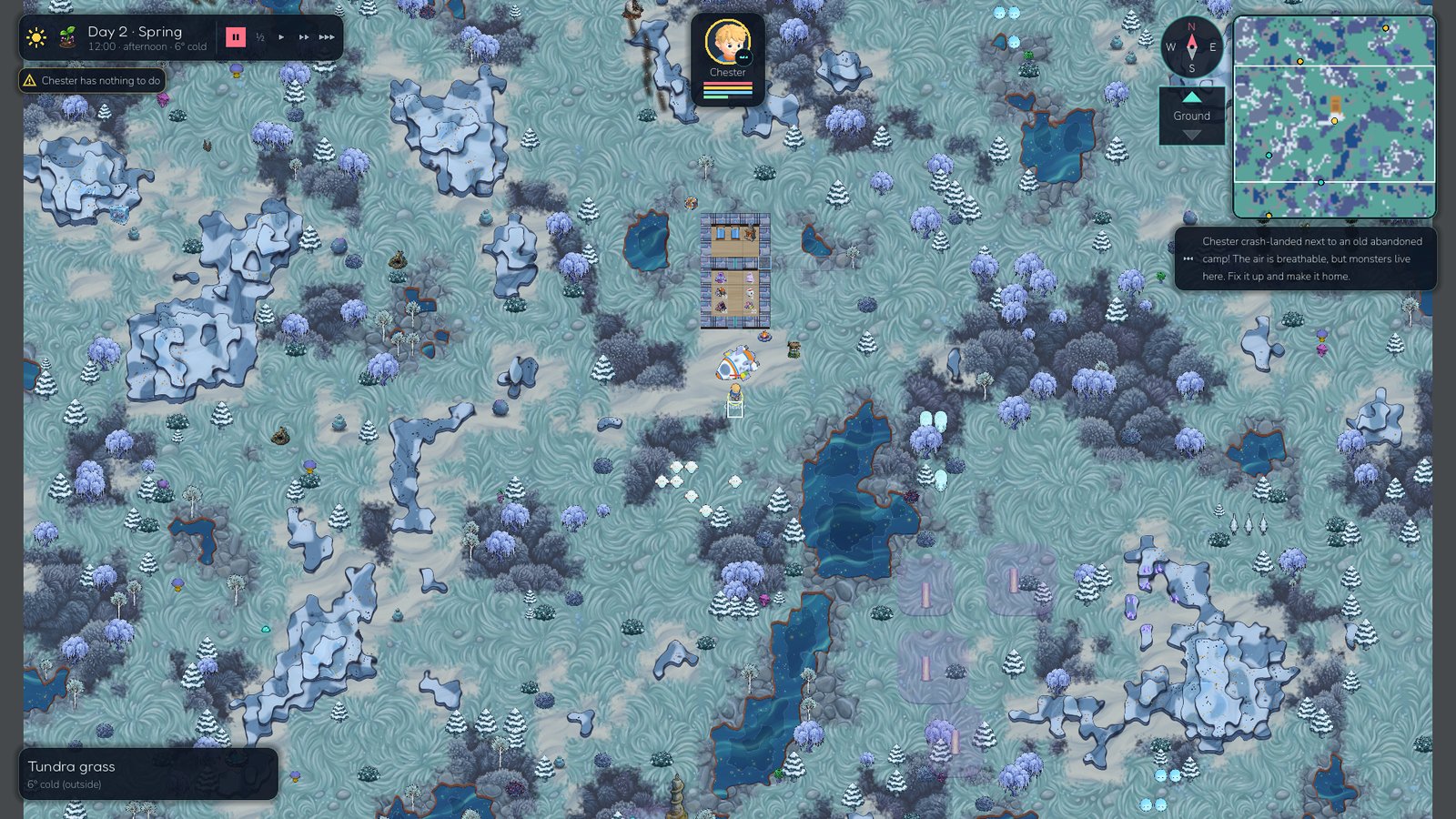
The Teal Grasslands
The land the colony first crashed in: mild springs and summers, a cold winter, berry bushes and glowing trees, Fluffaloes, Puffhens and Glowfoxes, Skitters and Thornbacks, and fuzzbees for honey.
Frostfen
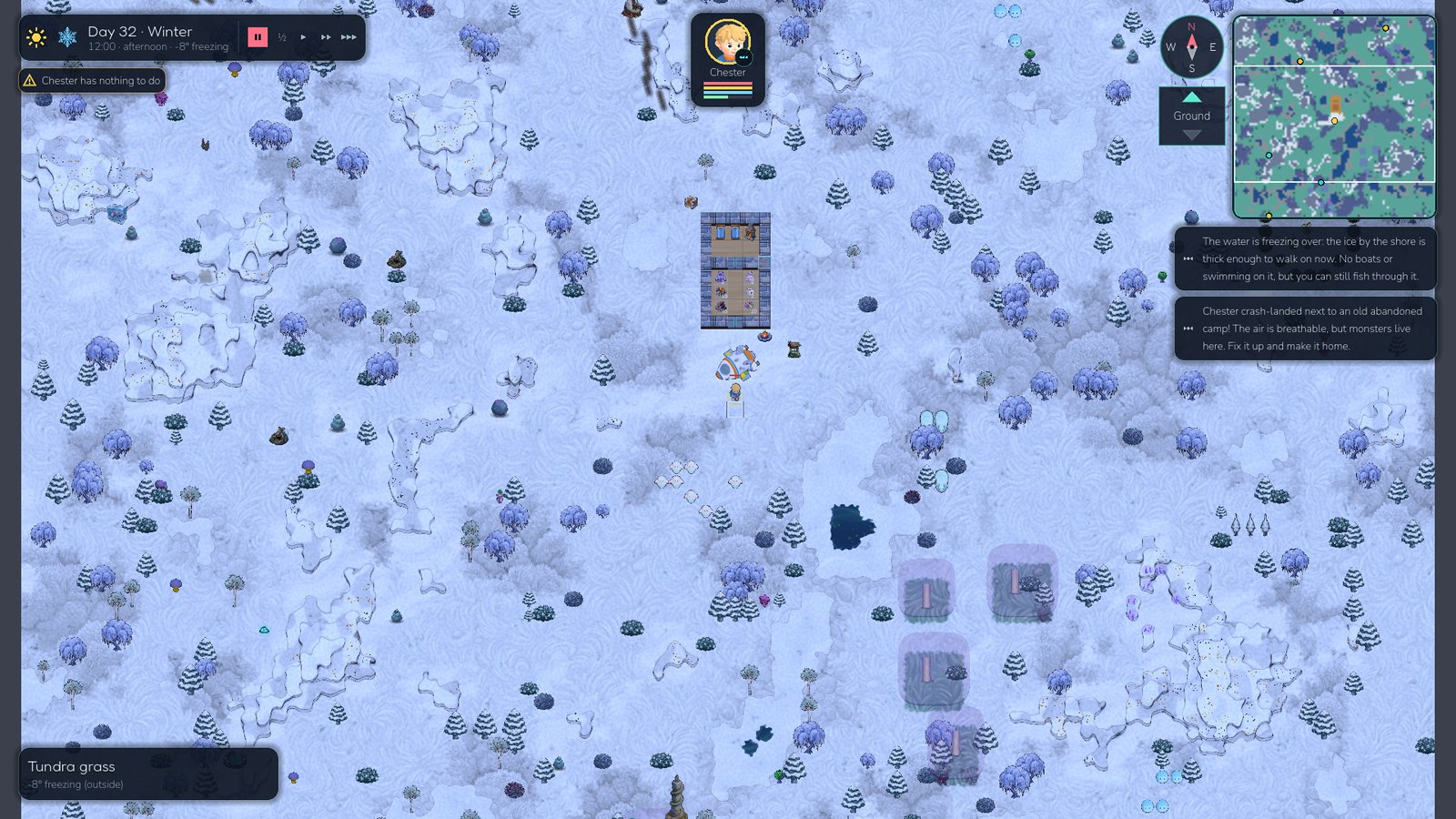
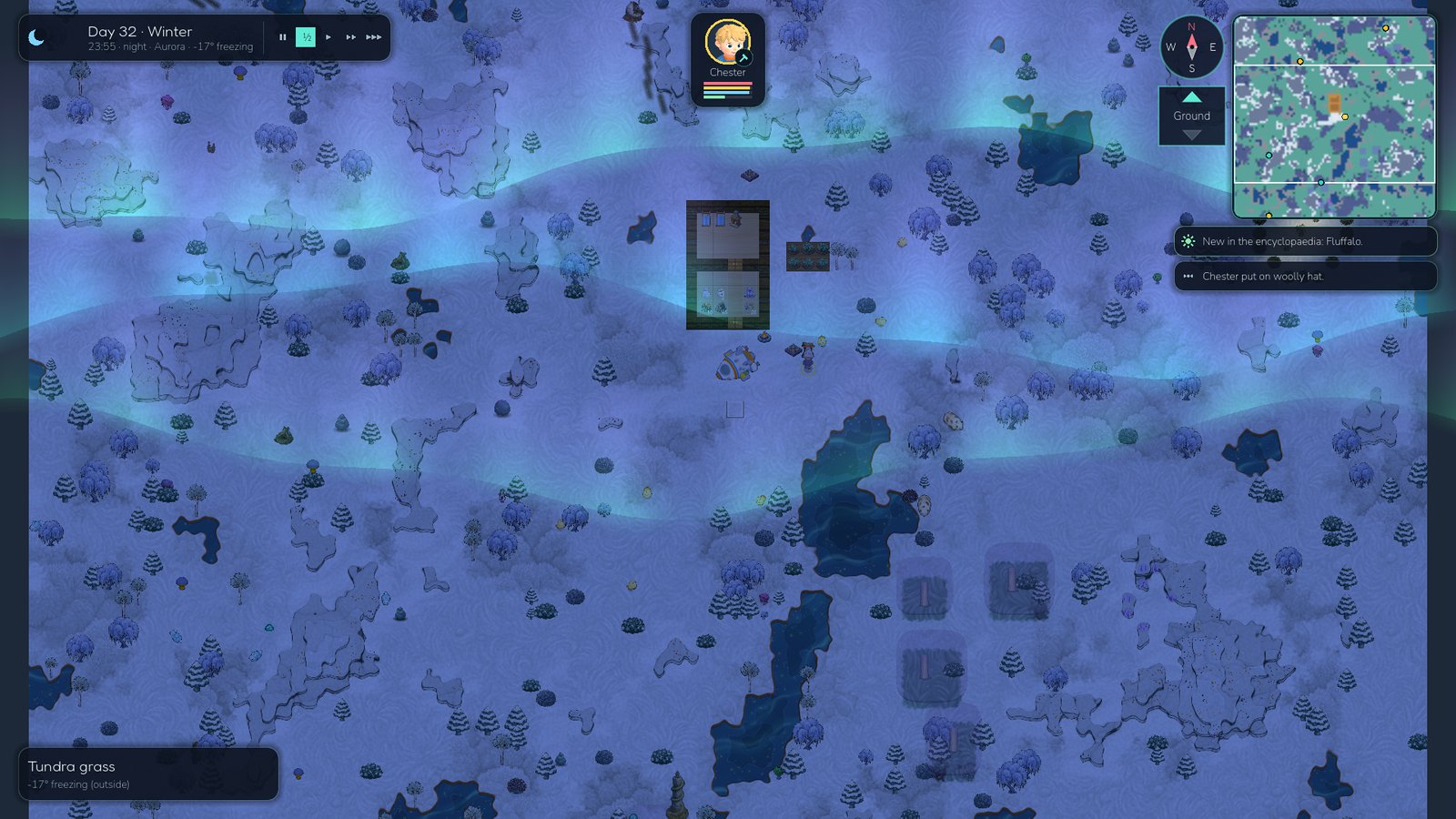
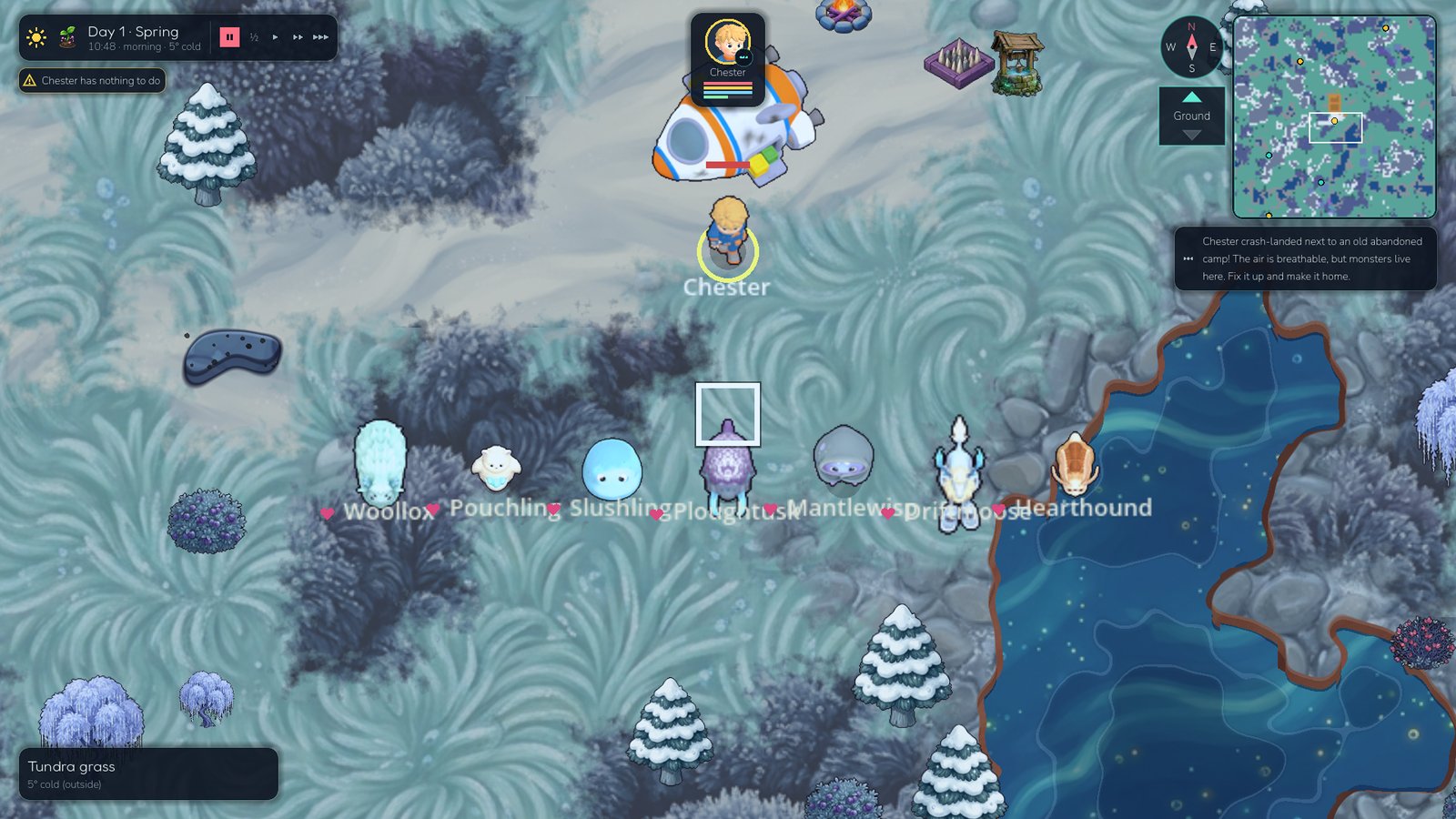
A cold land, with spring nights below freezing and winter nights below -15°. The start camp is ready for it: a whole building with a fireplace in the bedroom, fur coats, woolly hats and hide to start on warm clothes. Anyone who joins arrives in a fur coat.
Snow and ice
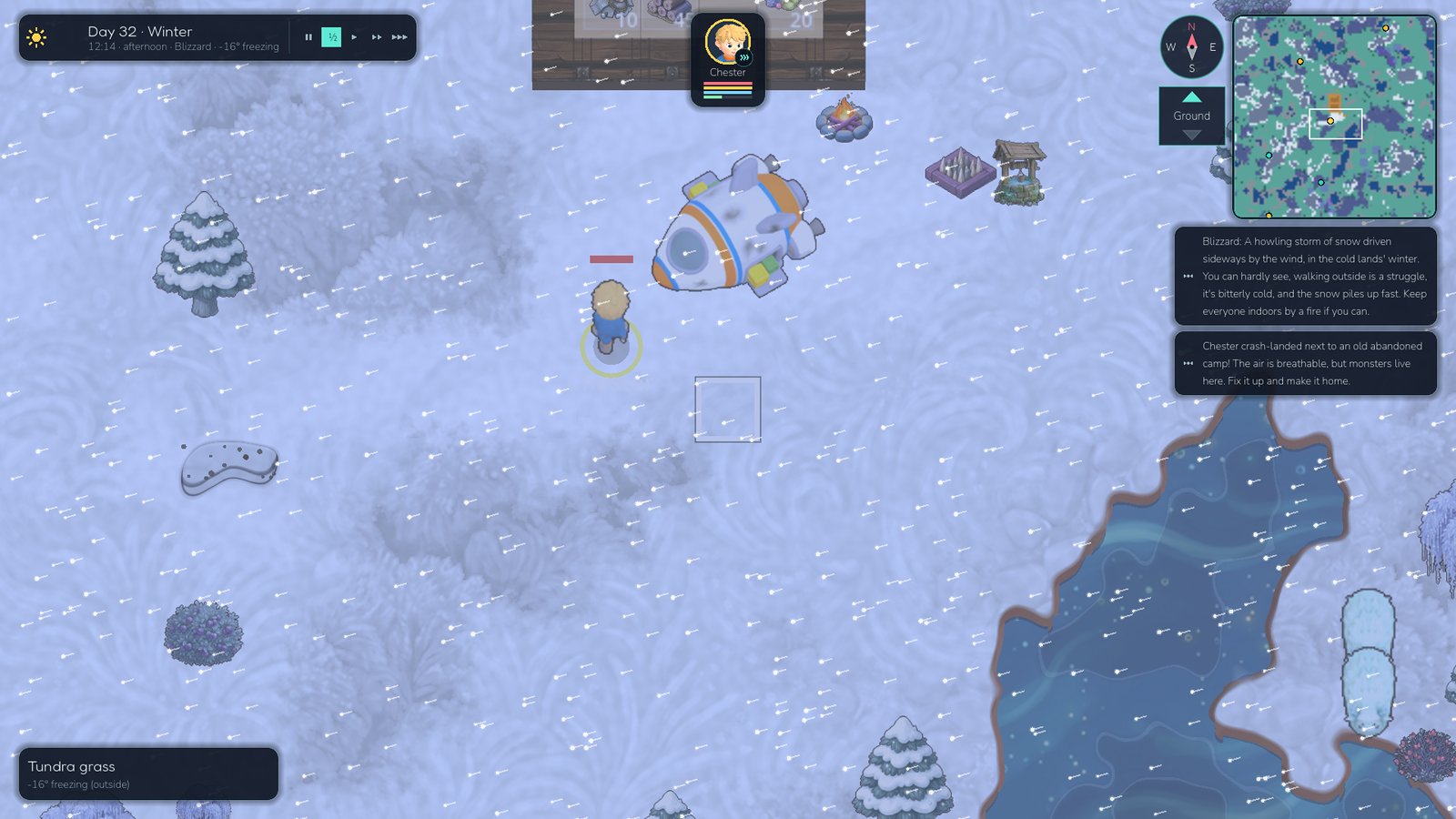
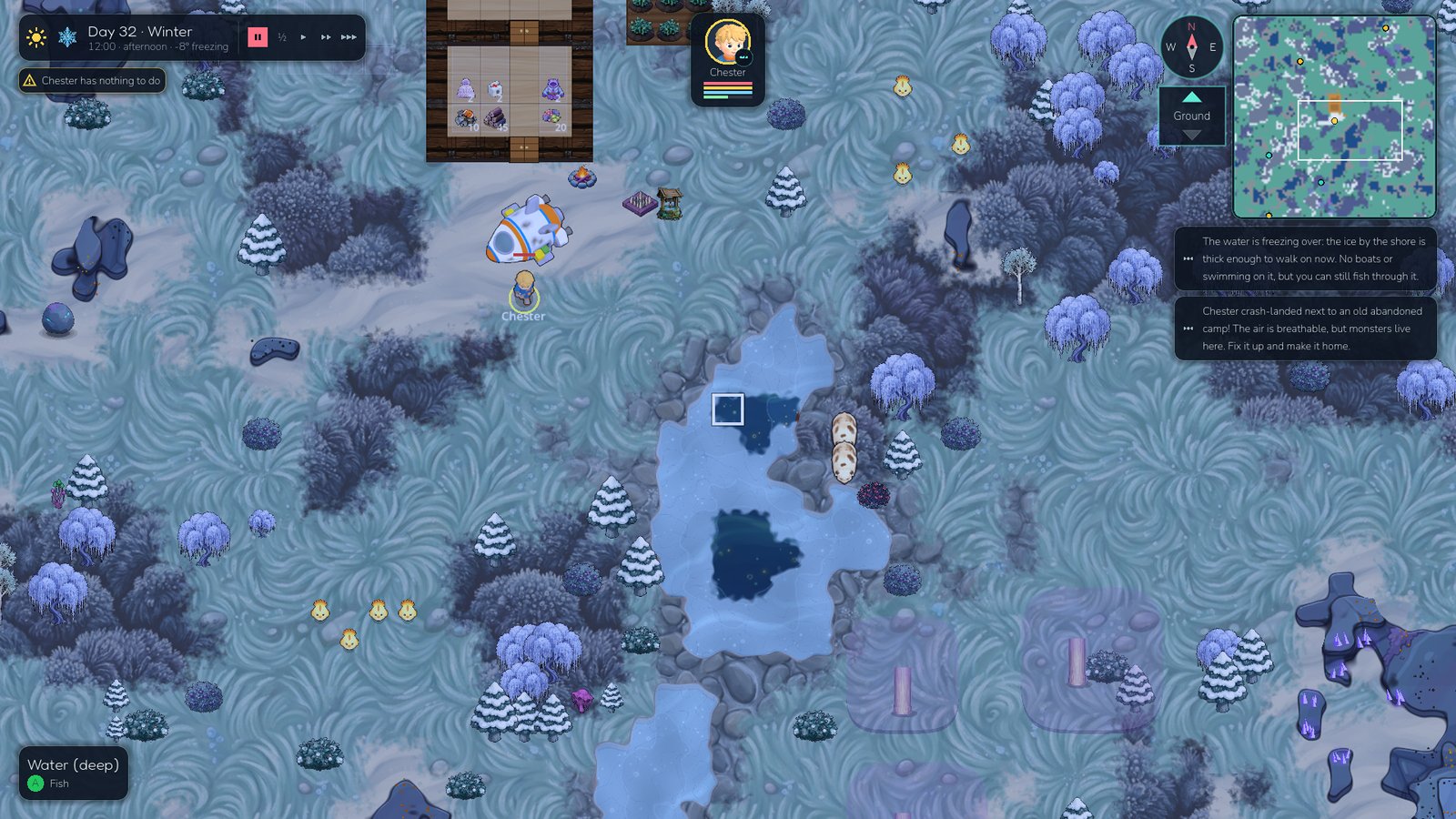
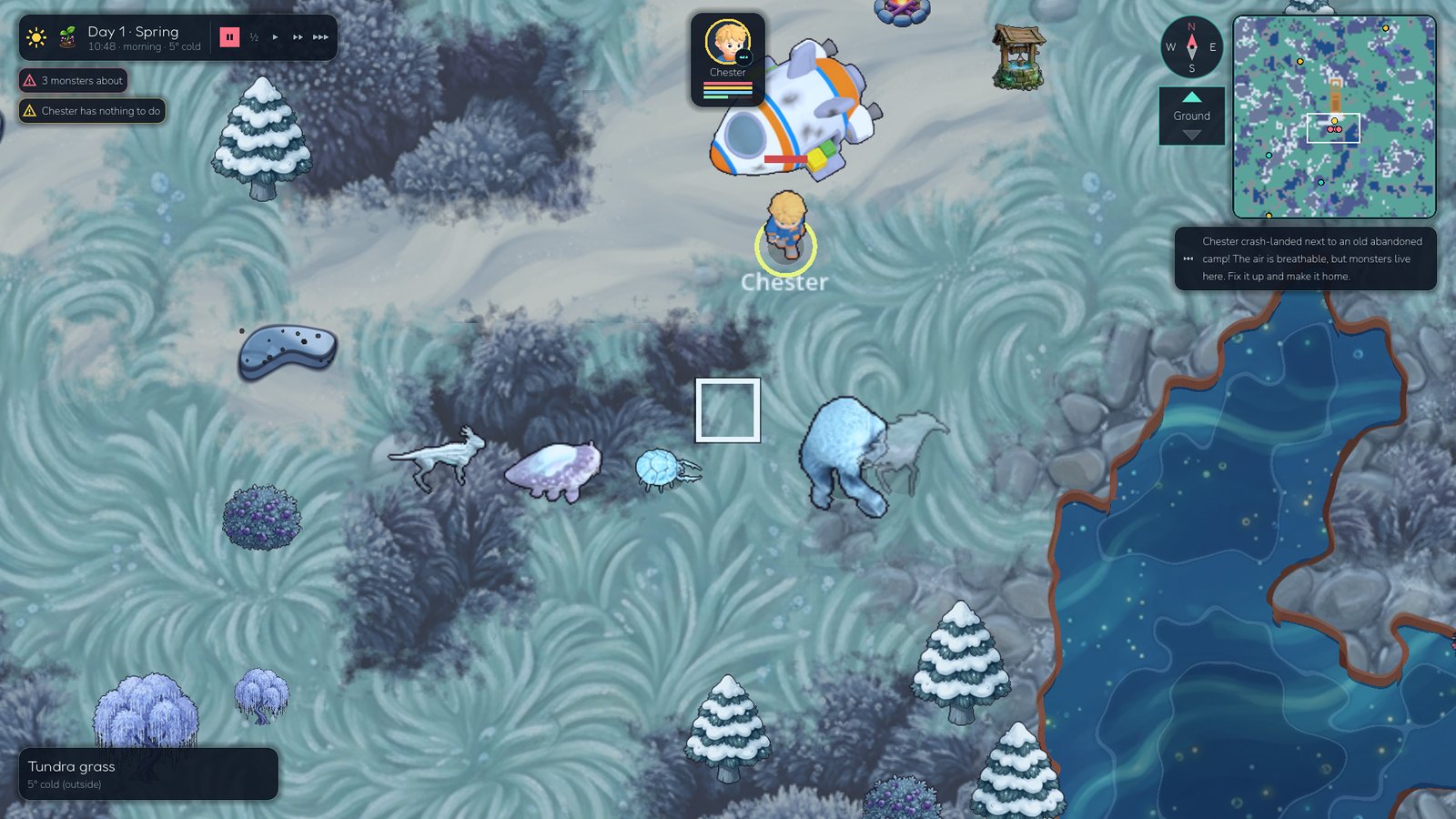
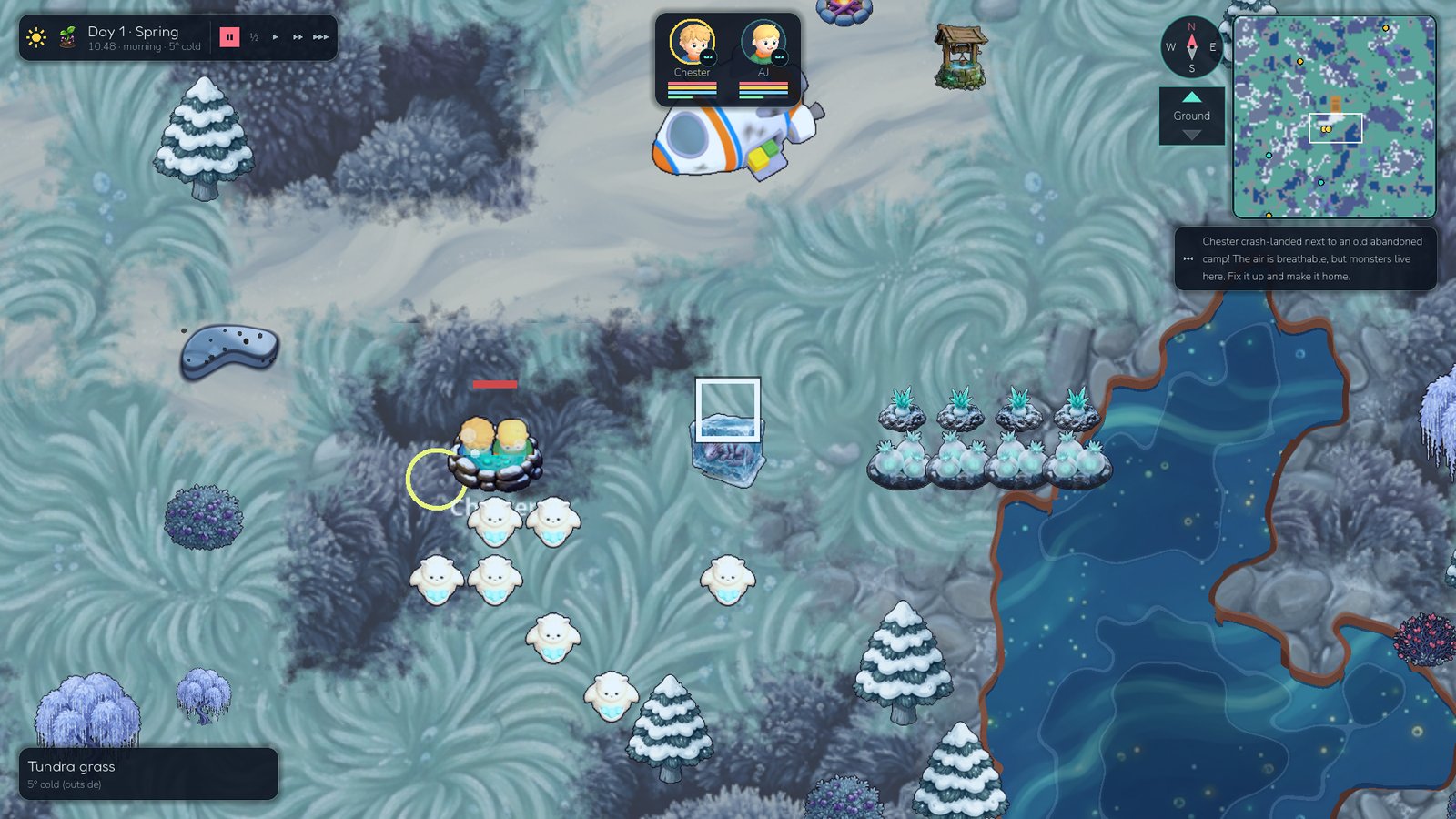
Snow settles even in spring and buries the grazing, shallow lakes freeze over to walk on, and colonists cut holes in the ice to fish. Blizzards blow in over winter and cold snaps come three times as often. On freezing nights colonists keep to indoor jobs.
Its own animals
Woollox for wool, Pouchlings that lay fresher eggs, Slushlings that split in two, Ploughtusks that clear the snow, Mantlewisps that shed hide, Driftmooses to ride through deep snow (their shed crystal antlers make crystal spears and swords), and a Hearthound pet that keeps the cold off and drags anyone knocked out home to bed.
Its own monsters
Rimewolves hunt anyone out alone on winter nights, but keep off fires and the camp. Icemites come in packs and Frostbrutes smash walls. The Blizzard stalker only comes in a blizzard, see-through and with no warning, and melts away when it passes.
Its own plants and finds
Frost pines, icicle willows and snowberries; Frostbulbs that grow down to -8°; frostmoths in place of fuzzbees, for wax and silk; Bulkars, who like the cold, settle more often. Out in the mist: a hot spring and a beast frozen in the glacier.
The Emberdunes
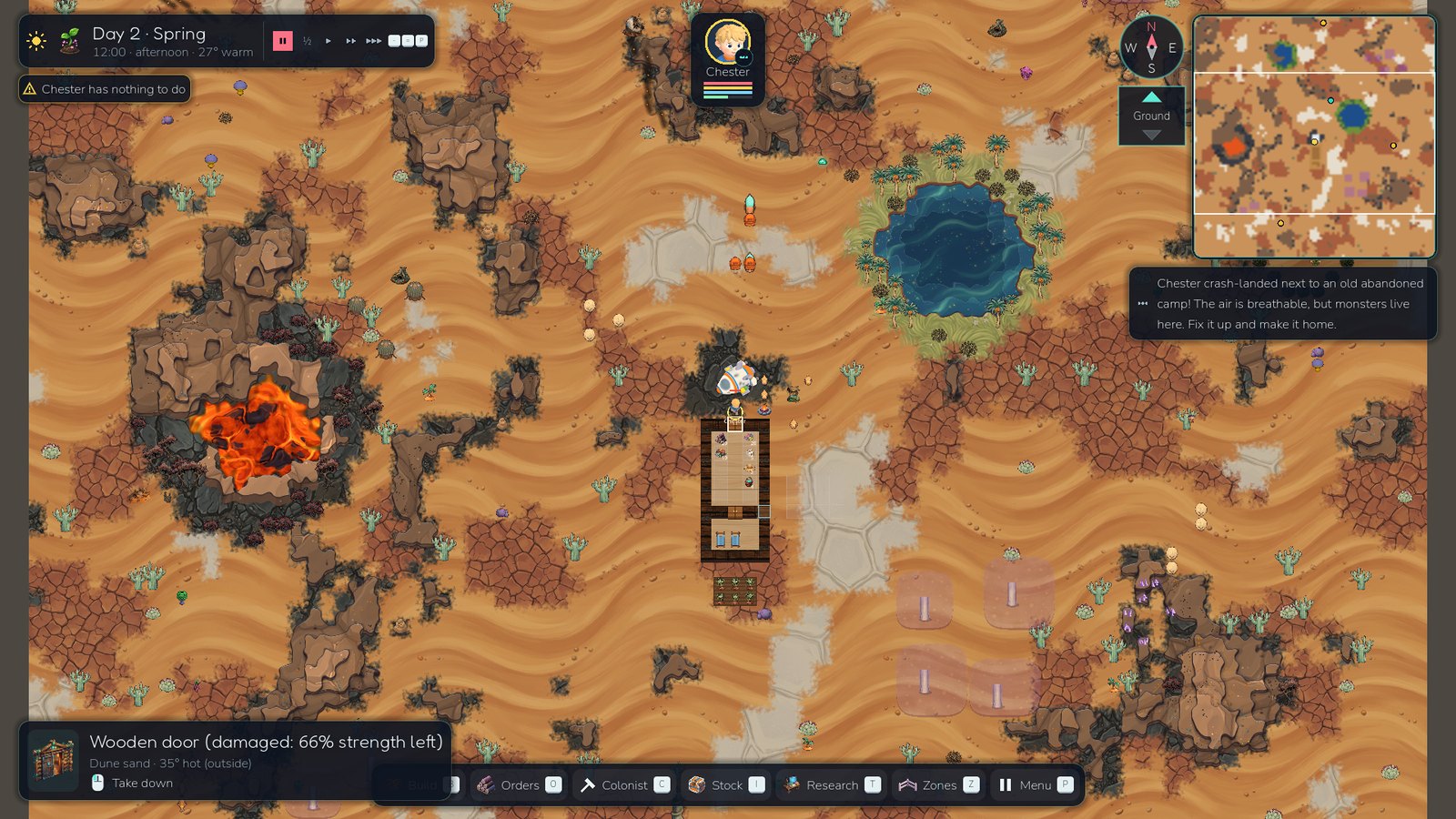
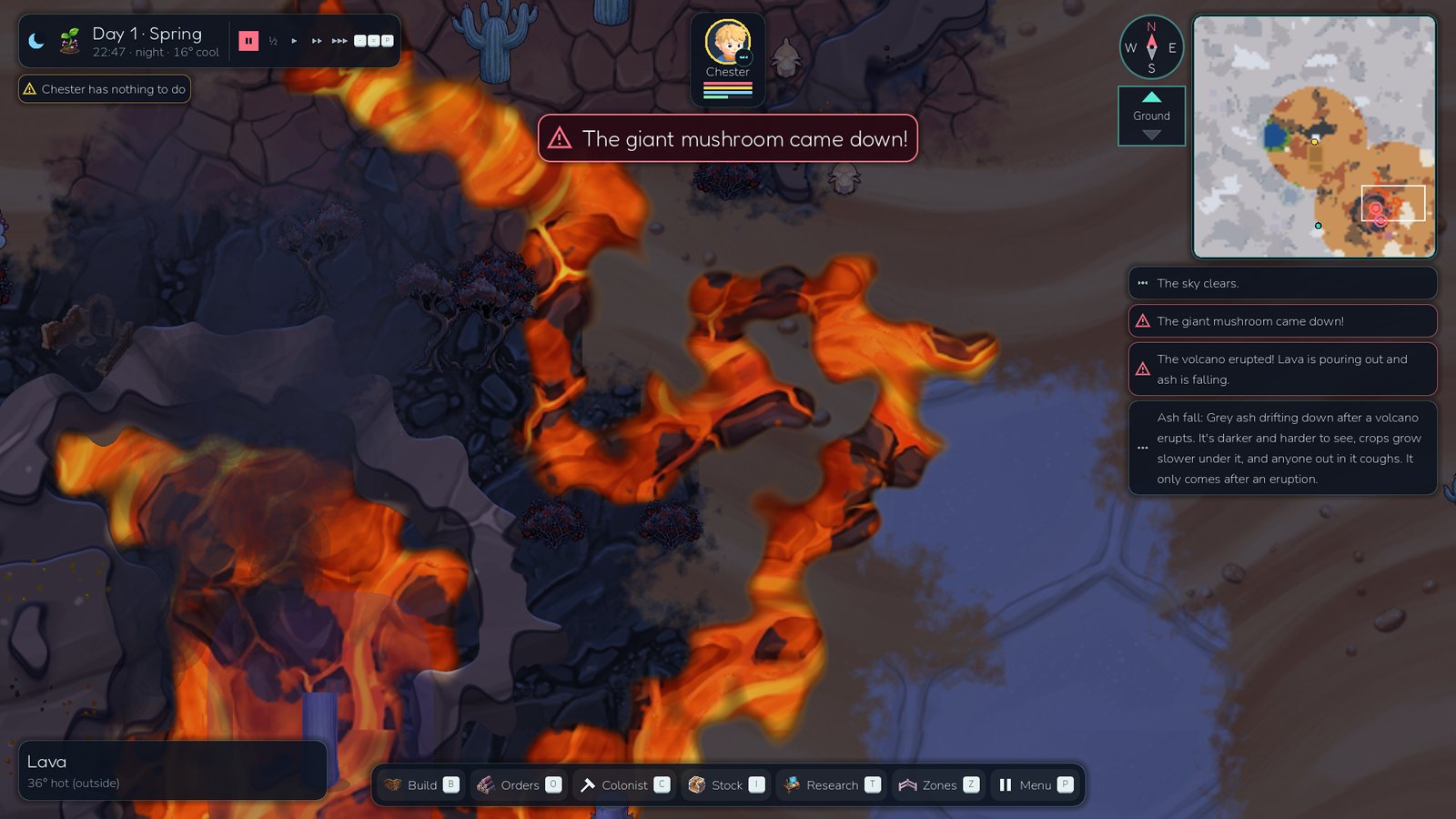
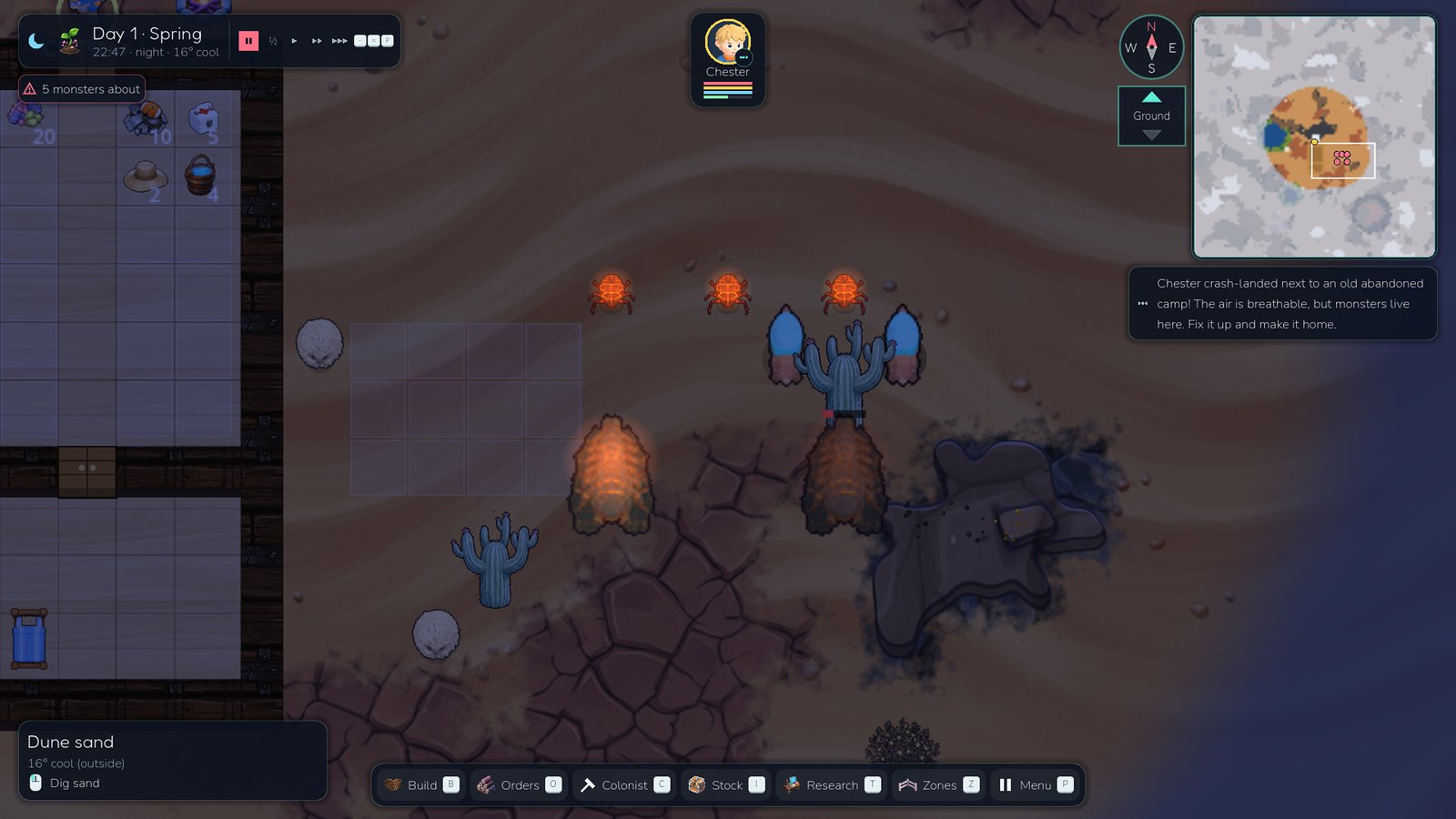
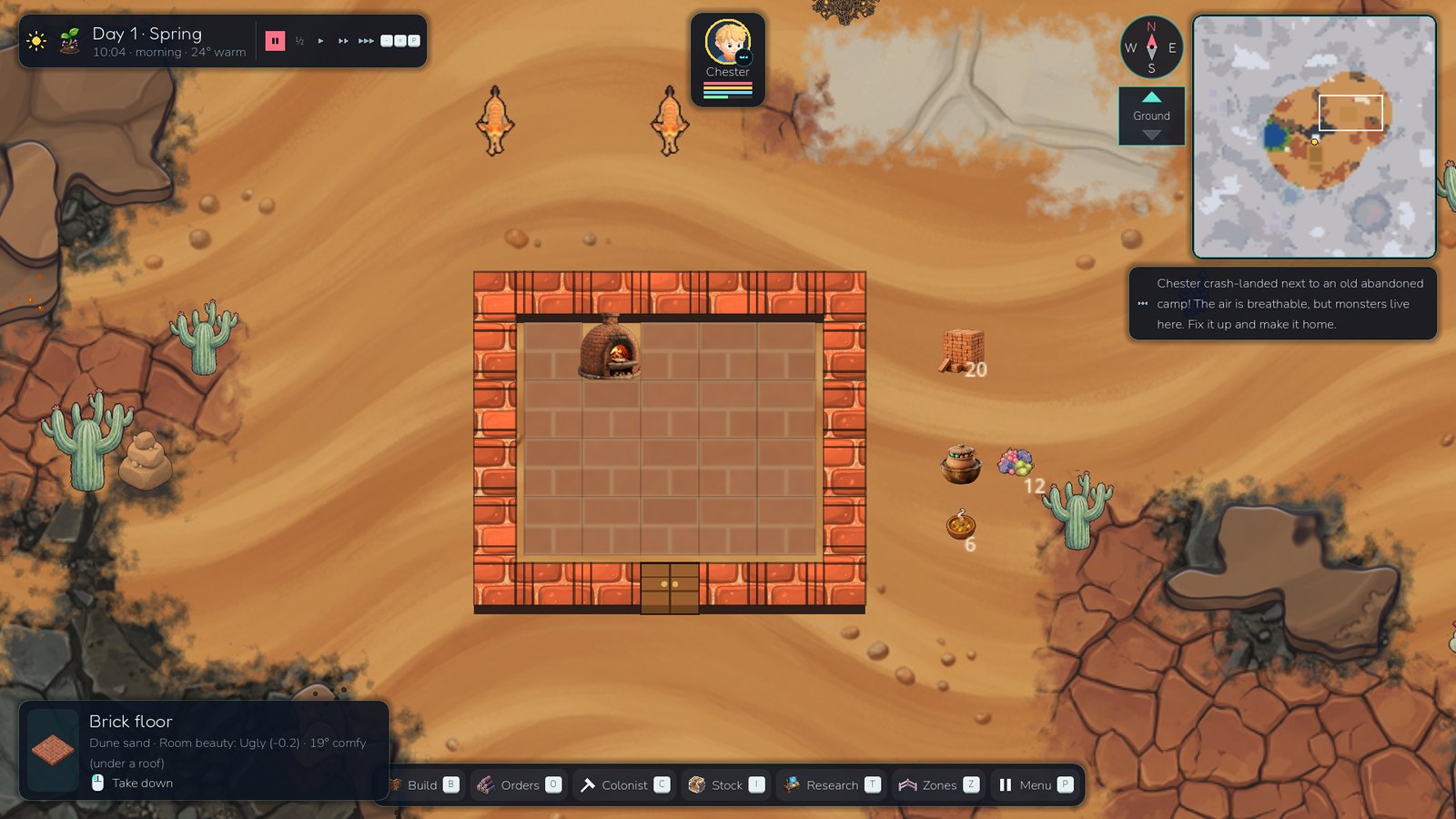
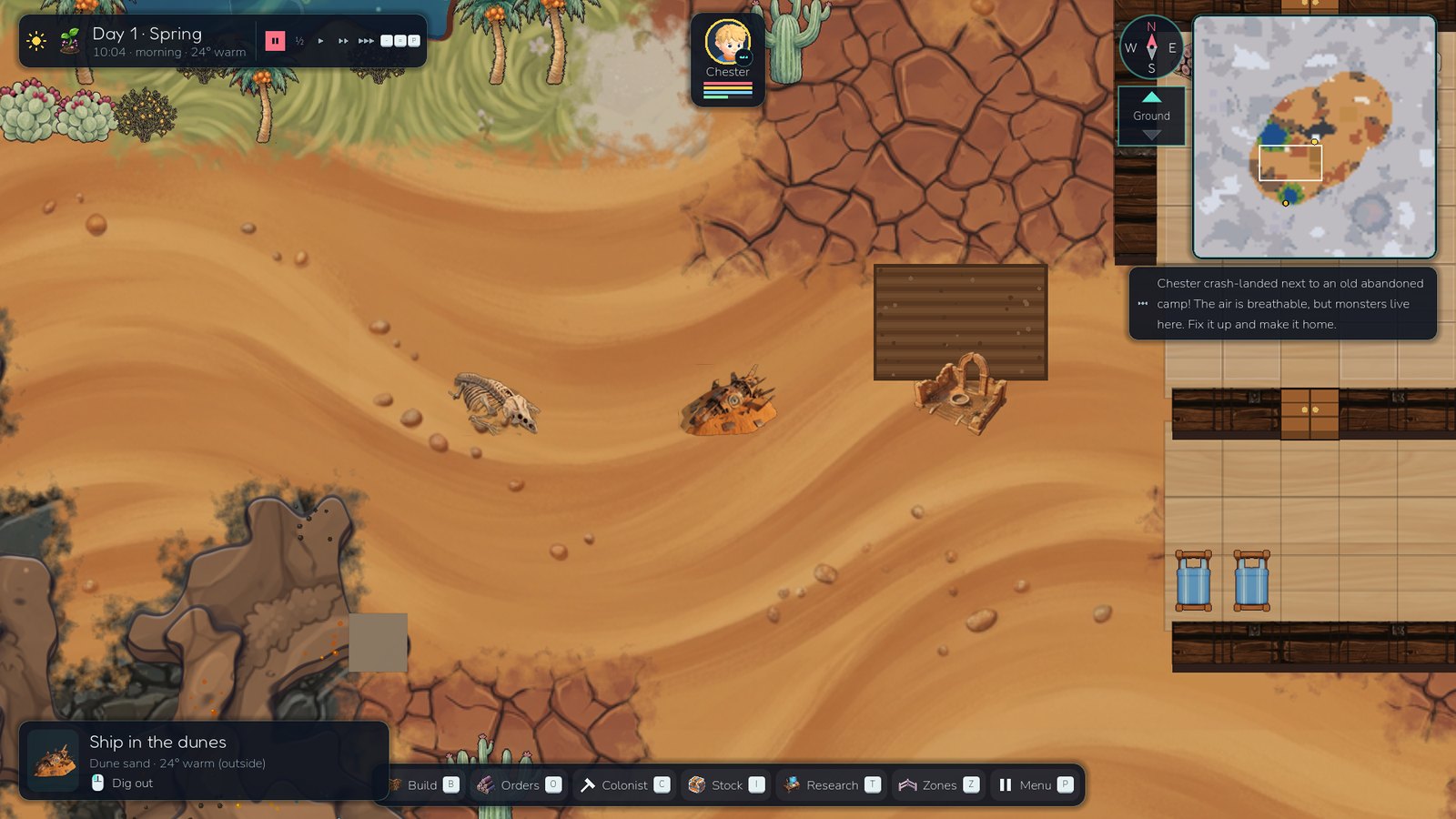
The hot land: dune sand, cracked clay and salt flats, green oases, and black basalt round pools of lava. Long hot summers and heat waves, a siesta at midday when the sun is at its worst, sandstorms, and rain that makes the desert burst into bloom. Wood is scarce, so the colony builds in fired clay brick.
Volcanoes
Smoke rises from a volcano's crater before it erupts. Then lava creeps out a step at a time, glowing through the night and setting fire to anything it touches, before it cools from its edges into warm black rock you can walk on. Walls and trenches turn a flow aside.
Its own animals
Sloshbacks that drink deep and go days without, Tumblefluffs that leave wool on their fence, Shadeweavers that spin silk webs at night, Burrowbuns that dig underground in the heat, Spinehogs for spines, Sailbacks to ride under their parasol, Sunwasps for honey, a Heatkite that finds water from the air, and the Breezlet, a pet that squeaks when danger's near.
Its own monsters
Cinder skitters and Slag crawlers crawl out of the lava. A Slag crawler sets everything round it alight and shrugs off weapons, so firefighters cool it to stone with buckets of water. In a sandstorm the Burrowmaw moves under the sand and bursts up at anyone caught out on open ground: get everyone onto a floor or indoors.
Its own ways and finds
Dig clay, sand and salt; fire bricks at the kiln for brick walls, floors and an oven; keep food cool beside a clay food pot; salt food so it keeps for weeks. Dusklings, who work through the night, and heat-proof Kilnbacks settle here. Out in the mist: a fossil bed to dig, an old ship half buried in the dunes, and an oasis ruin with water still under it.
The planet and expeditions
A whole world past the edge of the map
Your colony is one small square of a planet with its own lands, seas, rivers and island chains. Pick where you crash on a globe, then send teams out from a map table to explore the rest.
A planet to start on
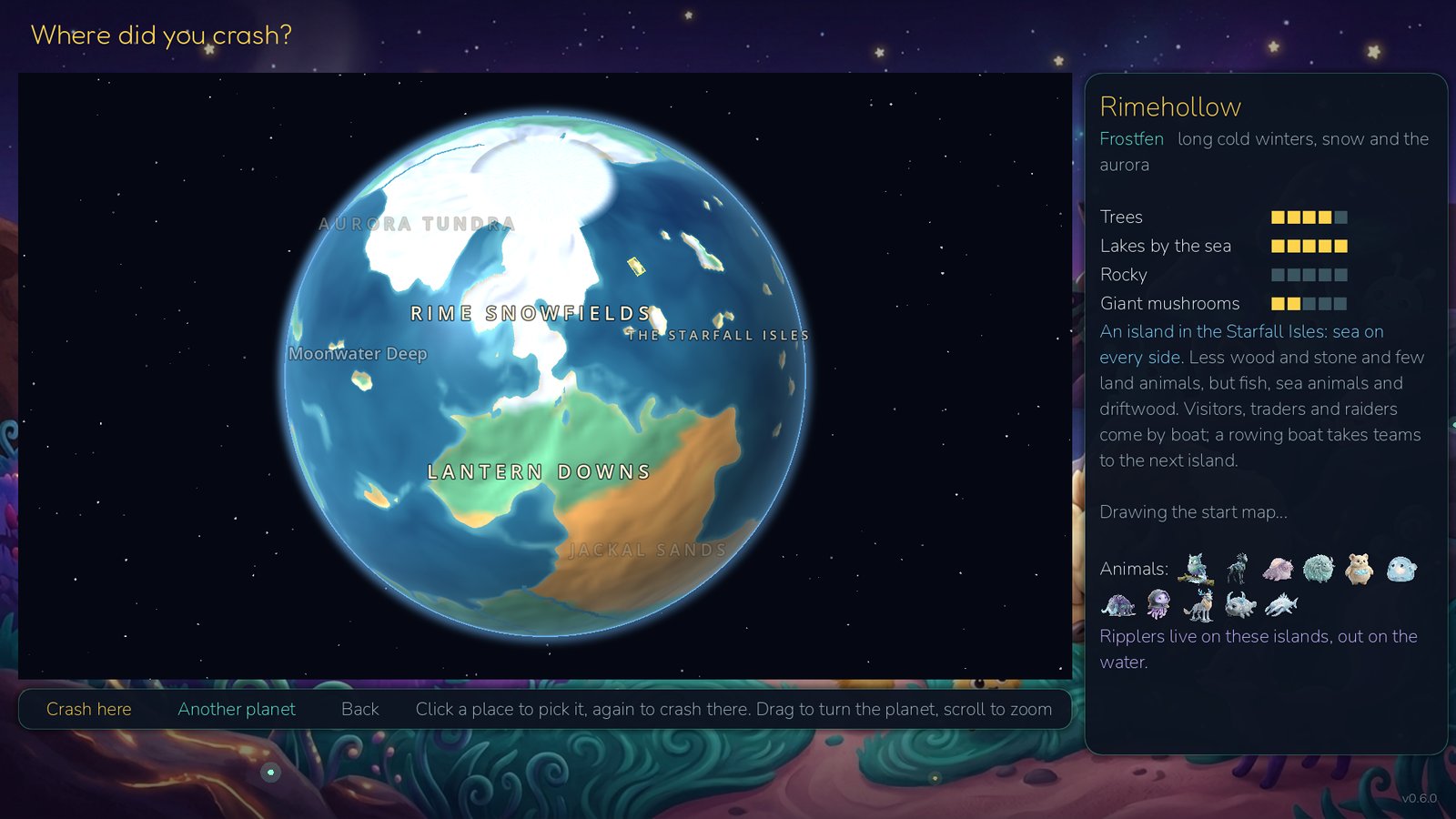
Each planet has three lands, rivers, seas and named island chains, the same every time you pick it by its code. Start inland, on a coast, or on an island with sea all round it.
Scouting
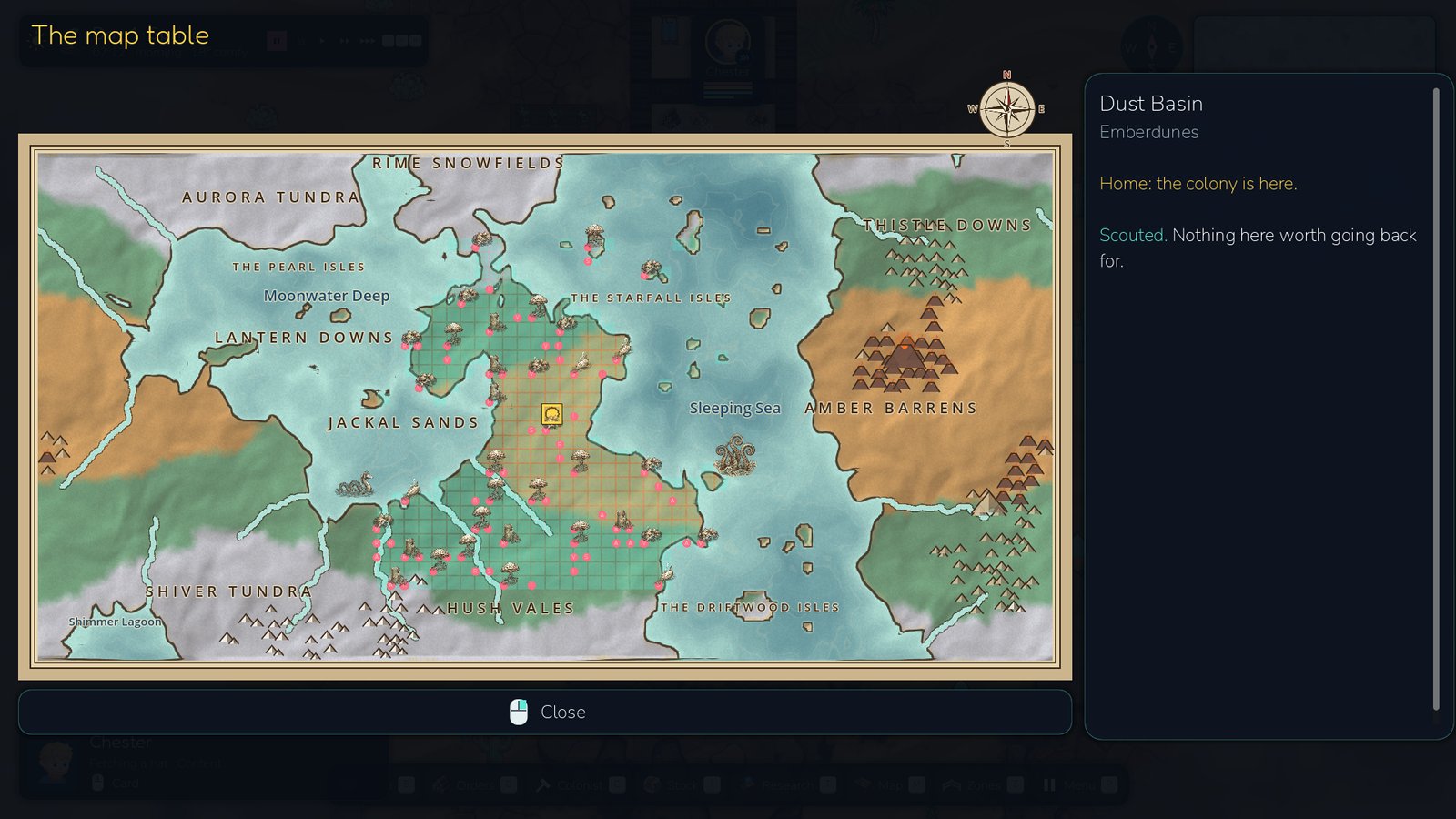
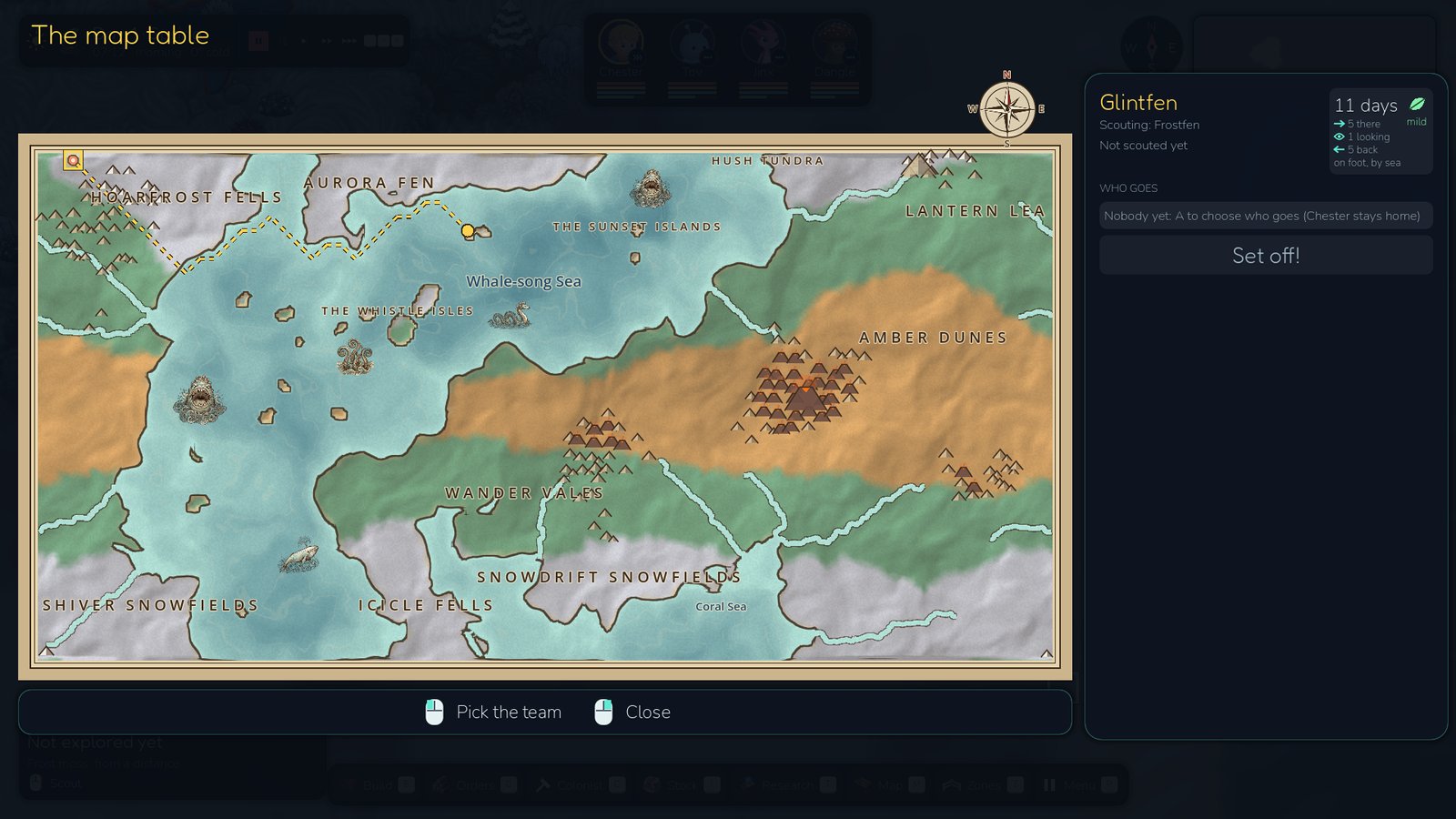
Research Cartography and build a map table, then send a team off the map. They scout regions as they go and come home with a story card about what happened on the way.
Places to go back to
Ruins and crash sites to search, villages to trade with, raider camps to clear, natural wonders and animal grounds. Each one is drawn on the map once a team has found it.
Packing for the trip
Food, water, bedrolls and tents, clothes for the weather, healing, backpacks, mounts with saddle bags and wagons, all against how much the team can carry. Things happen on the way: raiders, getting lost, shortcuts and old stashes.
Trade envoys
Send a team to a village you've found and trade with its people when they get there, priced by what their land has plenty of or lacks. What they buy has to fit in what they can carry home.
By rowing boat and by ship
A rowing boat hops a team to the next island. Research Shipbuilding for a shipyard and a sea-going boat, and trips cross whole seas, sailing from home and walking the rest.
The radio mast
It picks up village chatter and distress calls worth following up, brings news of teams that are away, and can call them home early.
The coast and the sea
Life by the water
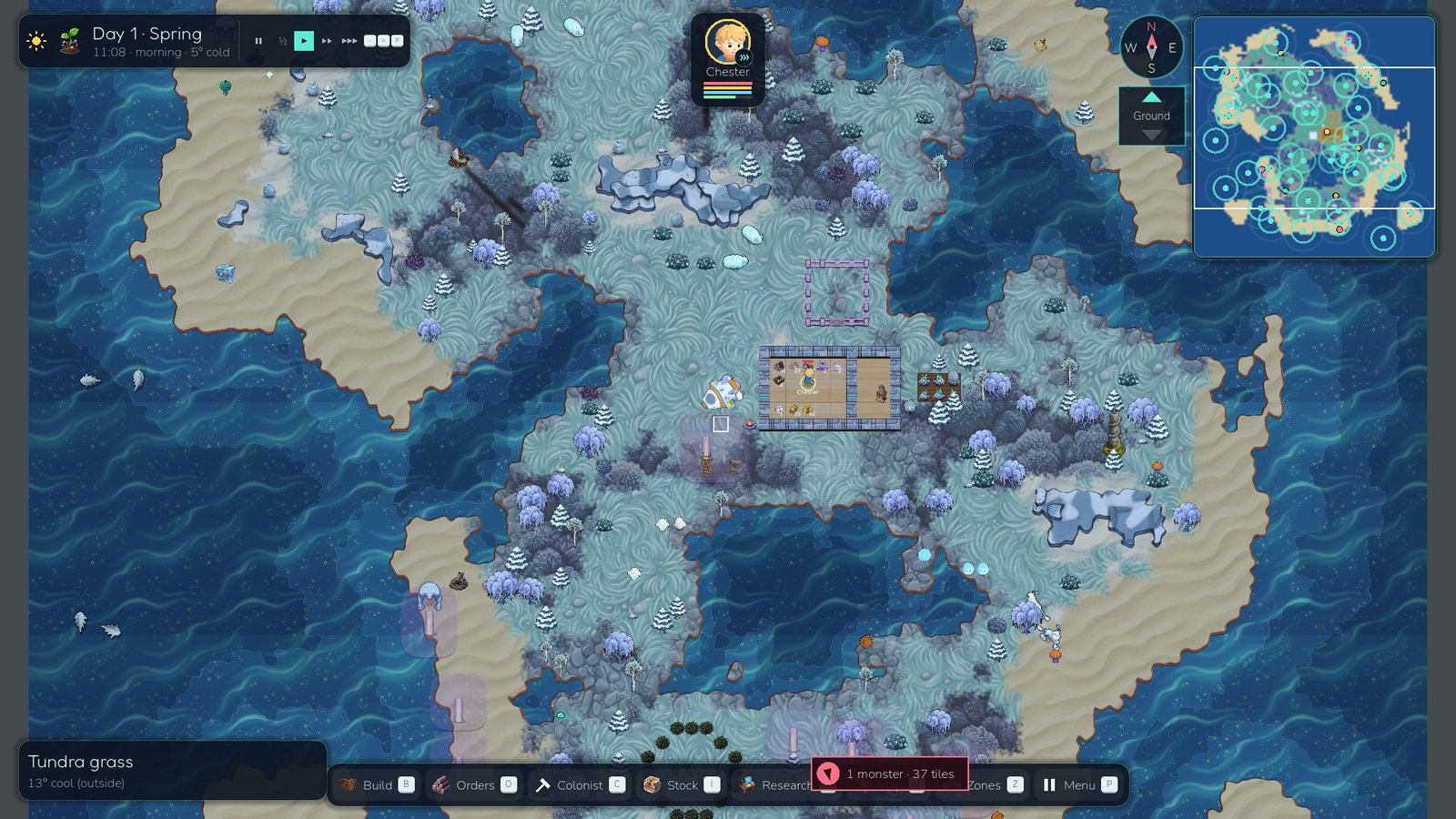
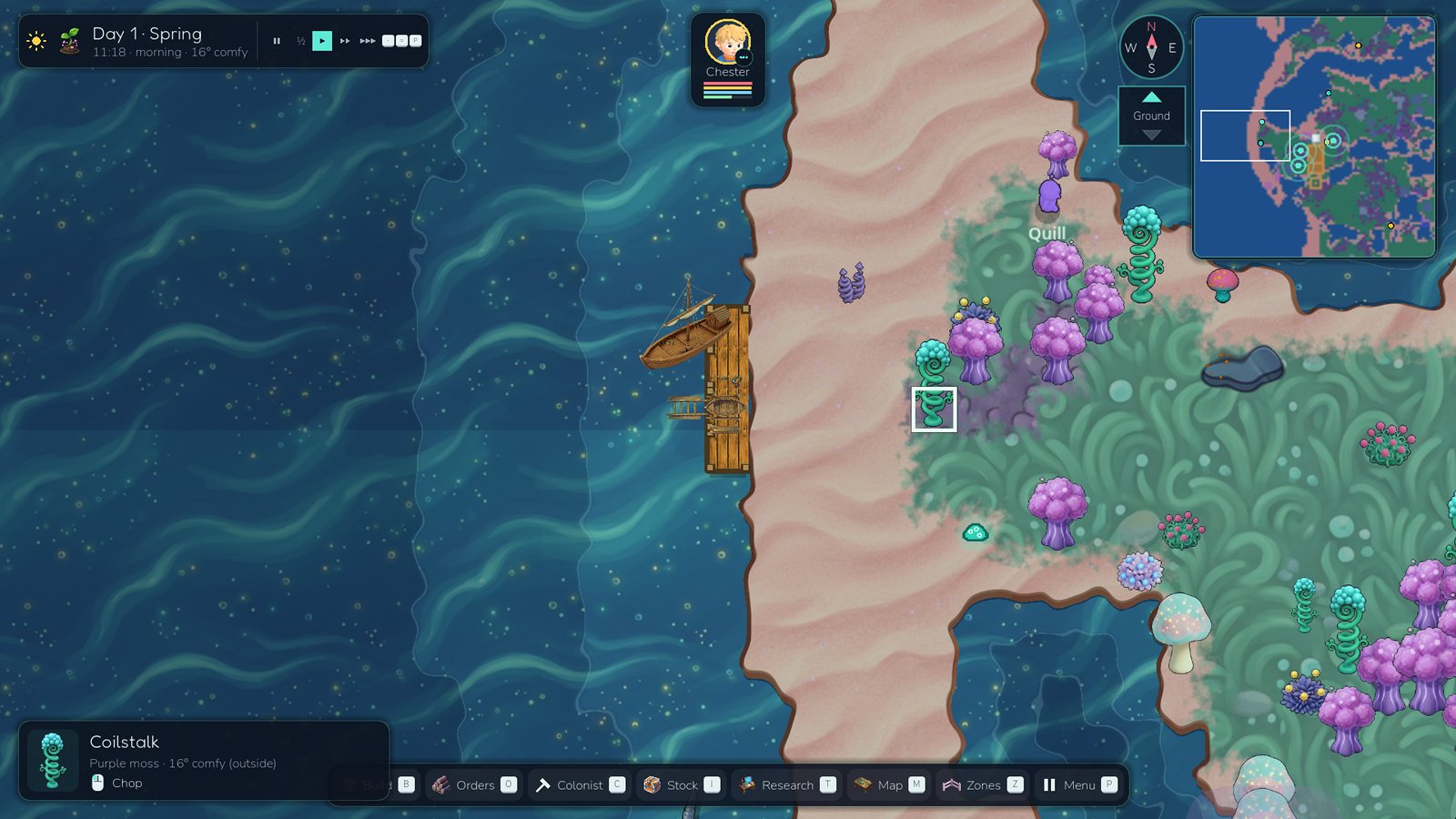
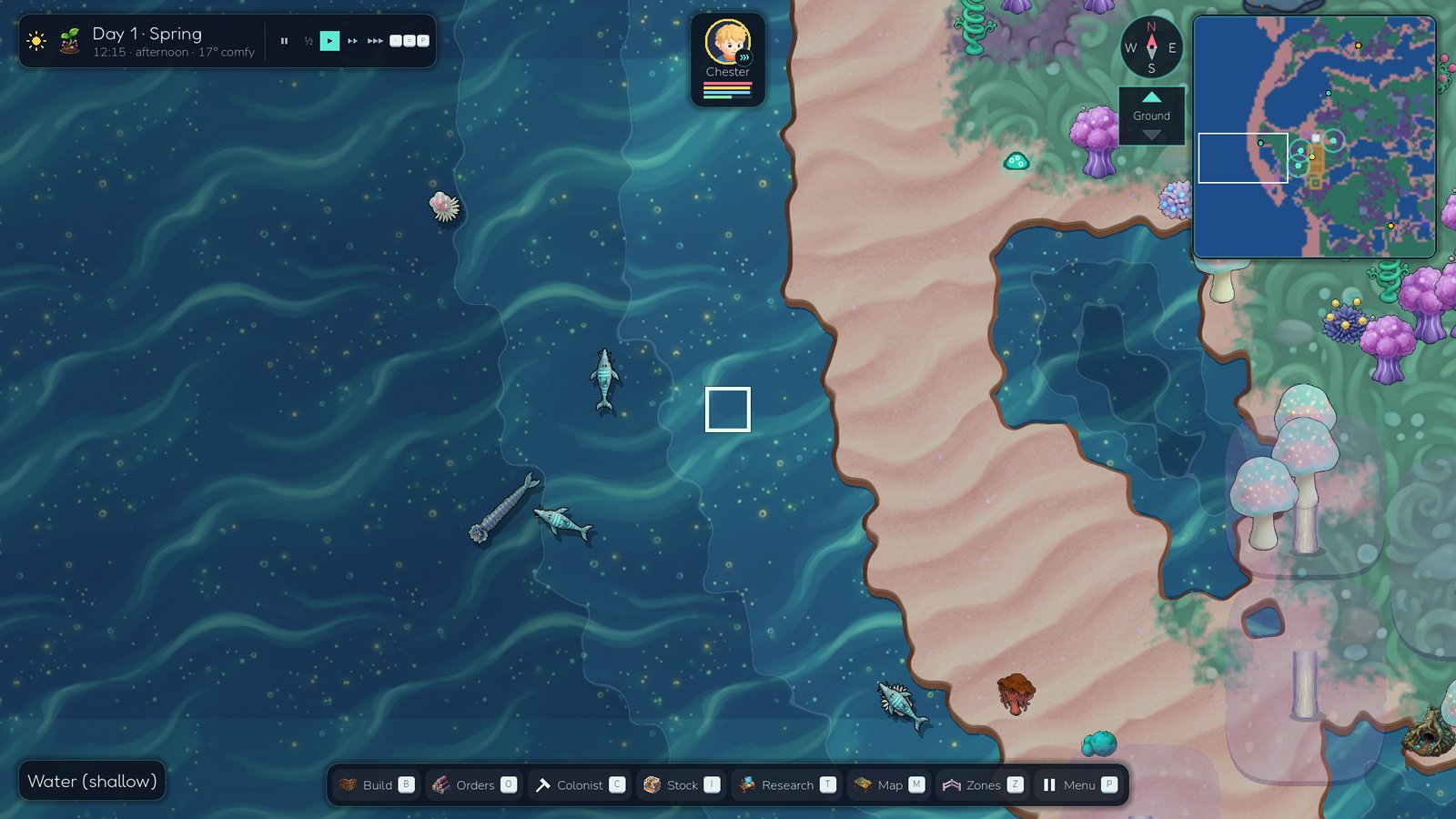
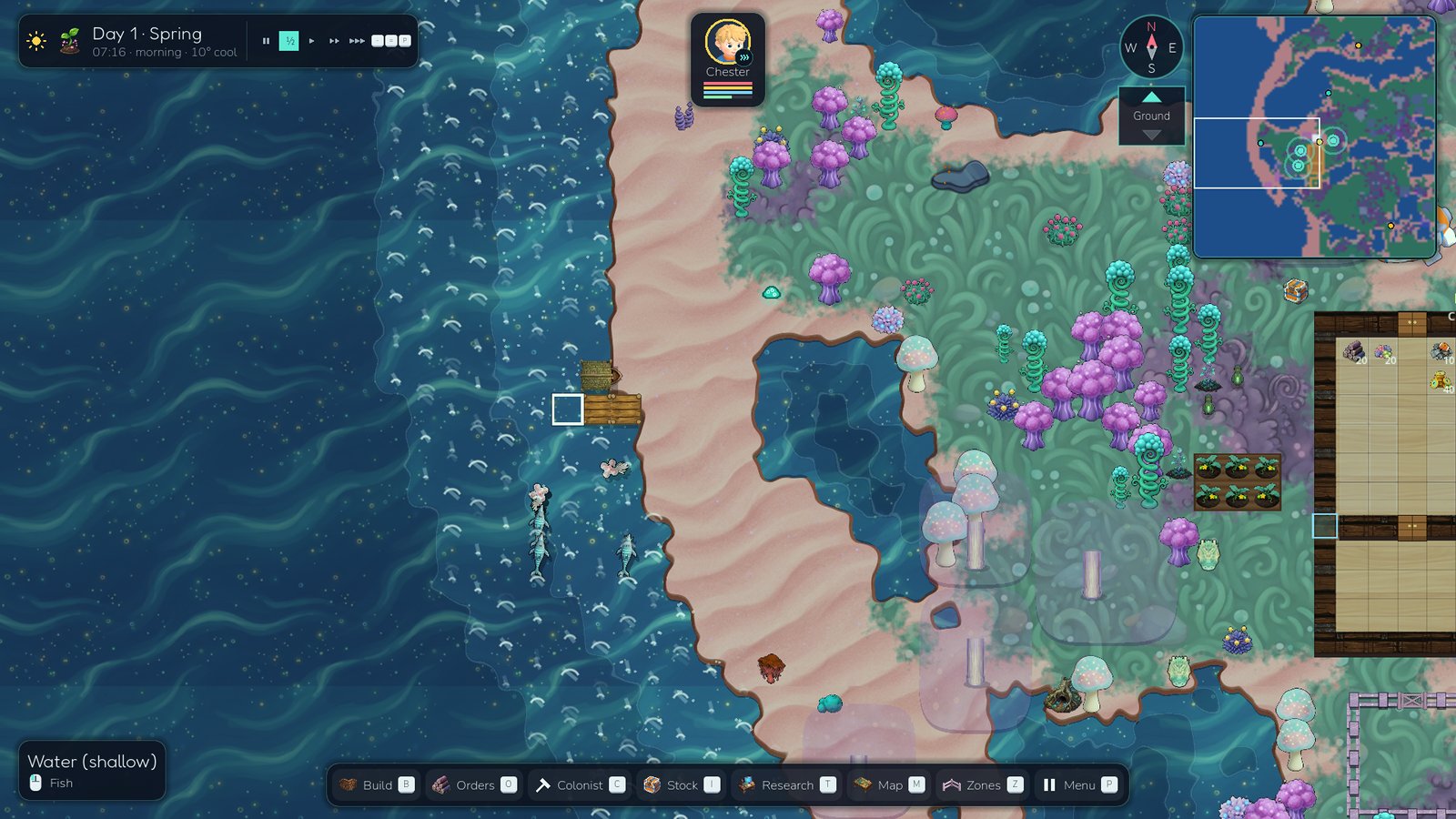
Start on a coast or an island and the sea is right there: a beach, shallows and deep water to build out over, fish and sea animals to catch, and storms and sea monsters to watch out for.
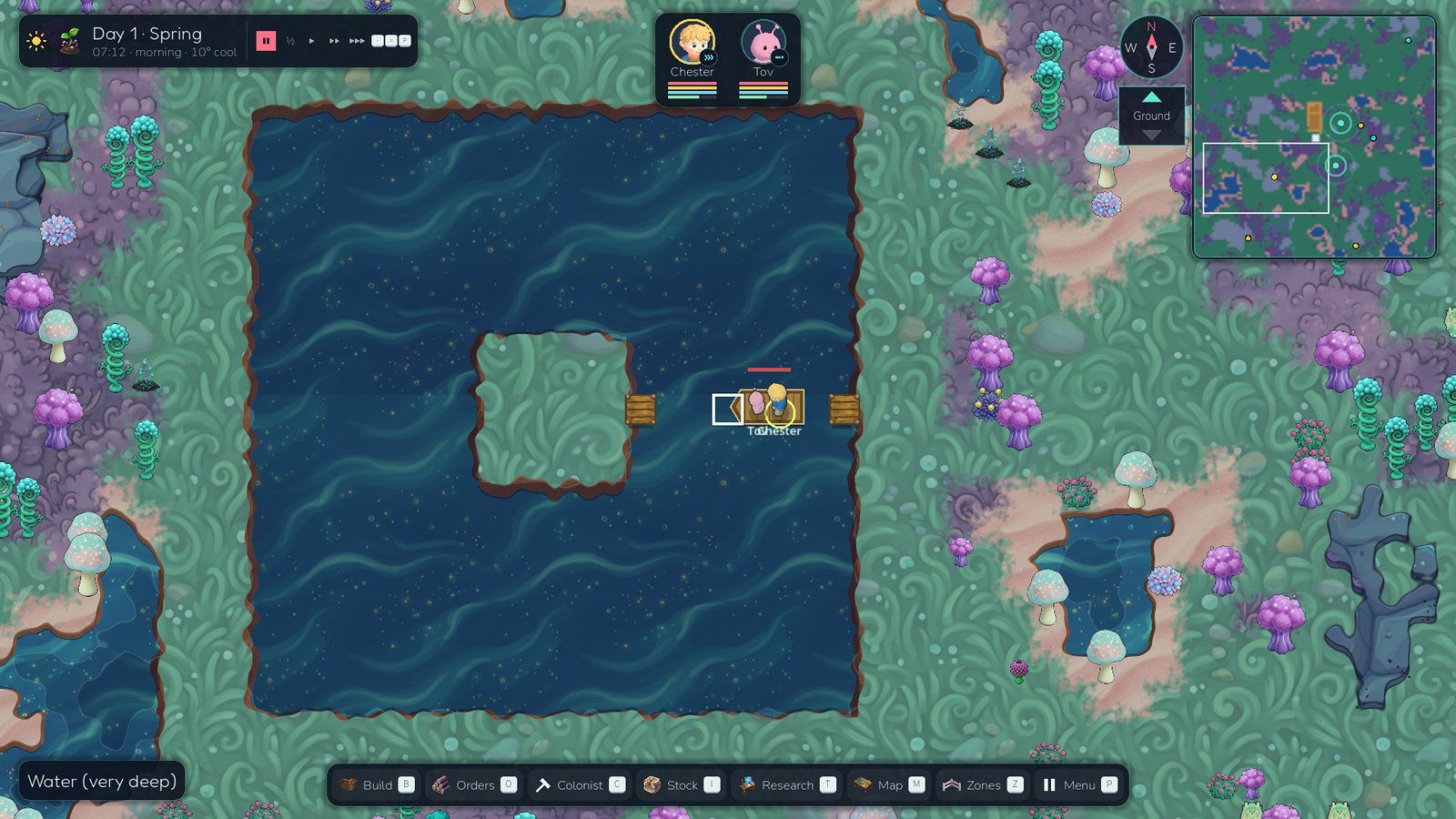
Island starts
The planet has island chains out in the ocean, and you can crash on one. A few islets sit offshore, visitors and traders come by boat, and Ripplers, who swim and fish better than anyone, turn up more often by the sea.
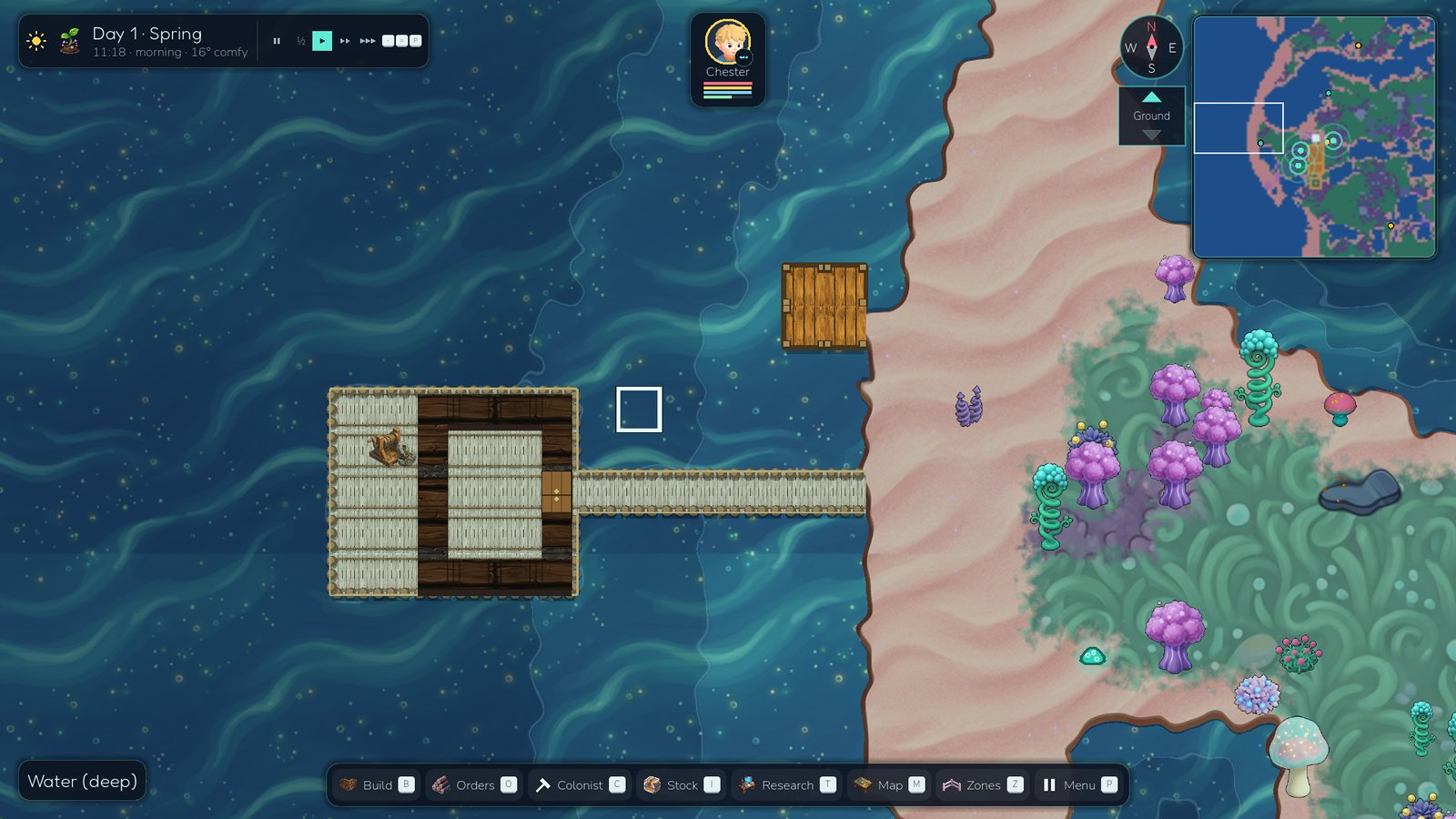
Building over water
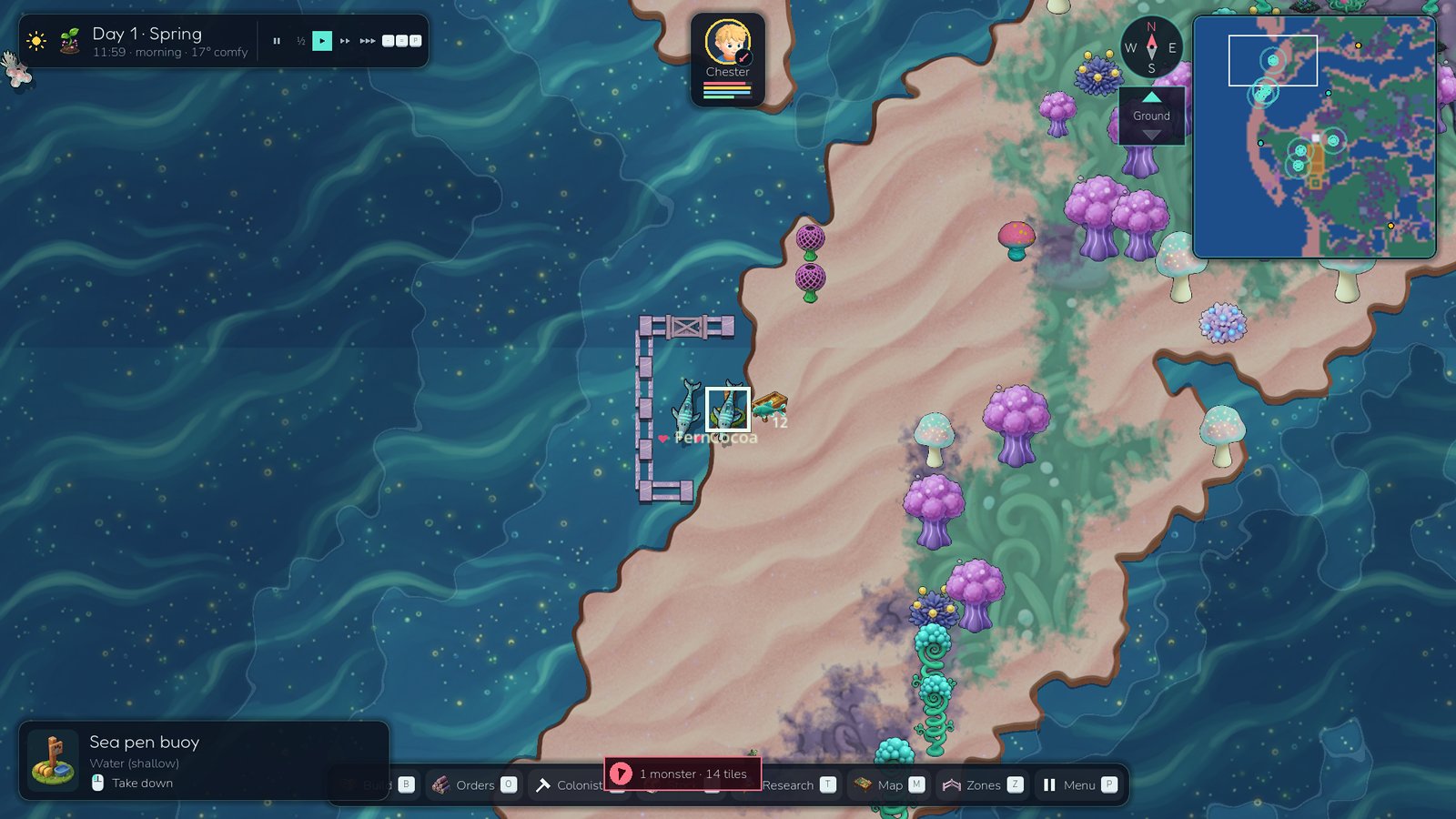
Stilt platforms over the shallows for a house on stilts, docks and bridges over deep water, floating pontoons with anchors, and ferry landings with a four-seat ferry between them.
The lighthouse and the shipyard
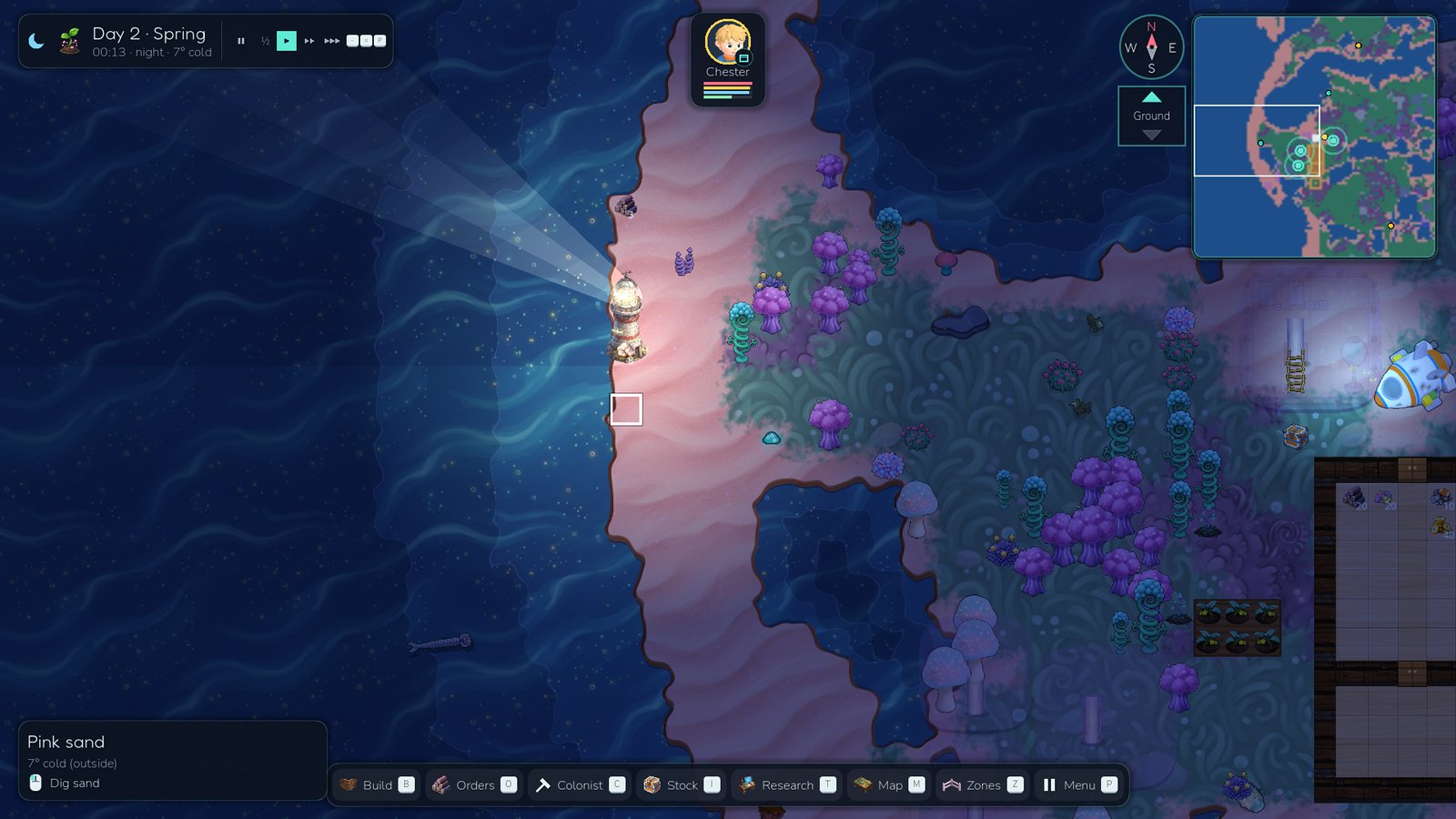
The lighthouse is kept fuelled by the haulers and watches the sea by day and night. The shipyard sits on its own stilt platform and builds a sea-going boat that rides out a swell.
Sea animals and sea pens
Eight sea swimmers, from fish to shelled grazers. Tame them with fish, keep them in a sea pen with a fish feeder, and get blubber and shell grit from them. Sea guards defend the shore and sink raider boats.
Sea swells
A coast event, more often in autumn and winter, with a warning first. Boats out row home, ferries stop, moored boats break loose unless they're under a boathouse, and the beach is left covered in shells and driftwood.
Sea monsters
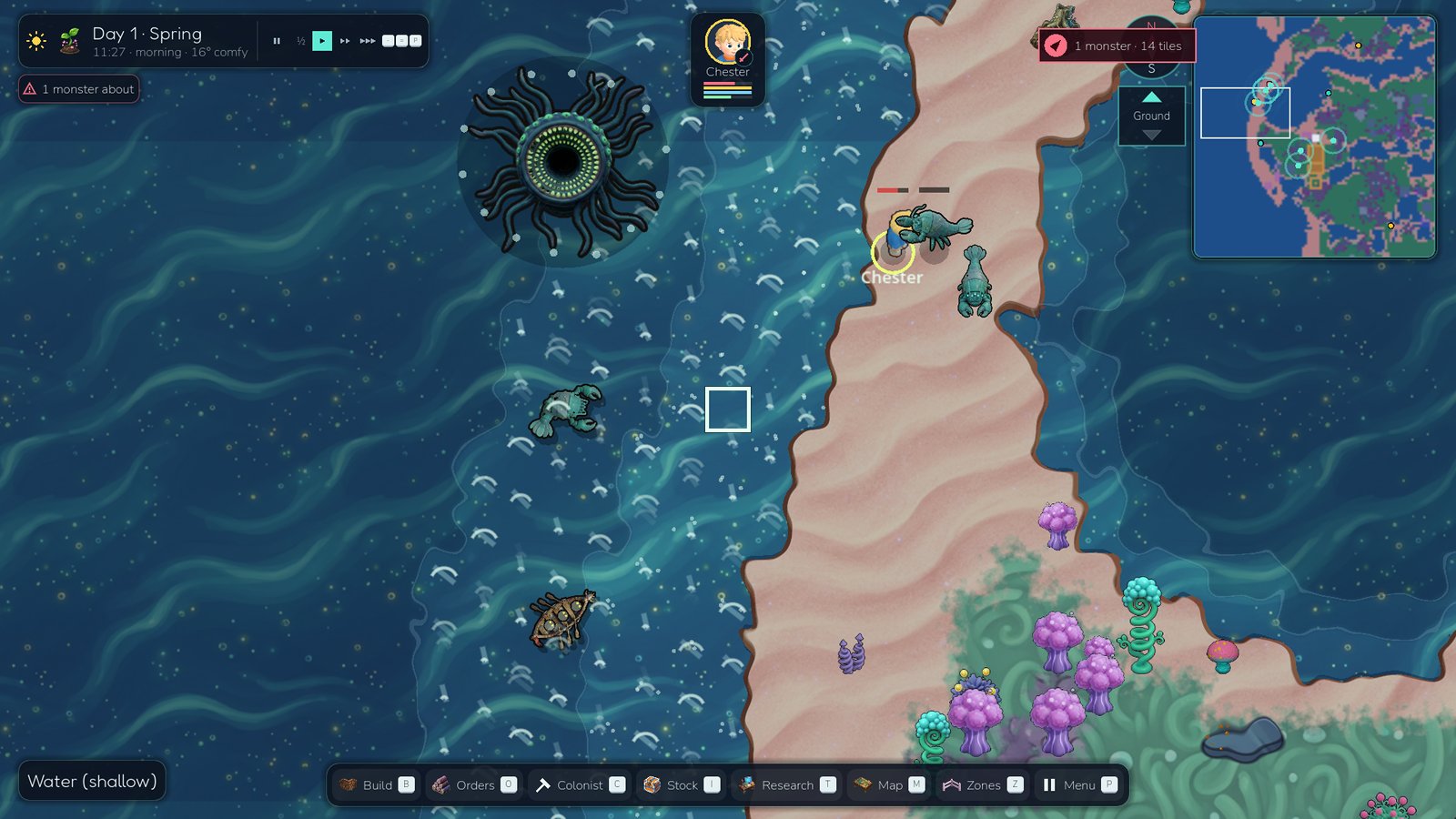
Shore monsters swim in on a swell and haul out to raid, then swim off when it calms. Far out at sea the Tidemaw rises under a rowing boat and sinks it, leaving the rower to swim for the shore.
Raiders by sea
Half the scavenger raids on a coast come by boat, rowing in to the beaches near camp. A tame sea guard can sink a boat before it lands, tipping the raiders into the water.
Icebergs and falling in
In a long hard cold, icebergs grow out from the shore ice, to walk on and chip for water until the thaw. Anyone who falls in is carried along, climbs out soaked and dries off by a fire.
Seasons and weather
Four seasons, and the odd cold snap
Ten-day seasons, weather that changes how the colony lives, and now and then a spell of real cold or heat.
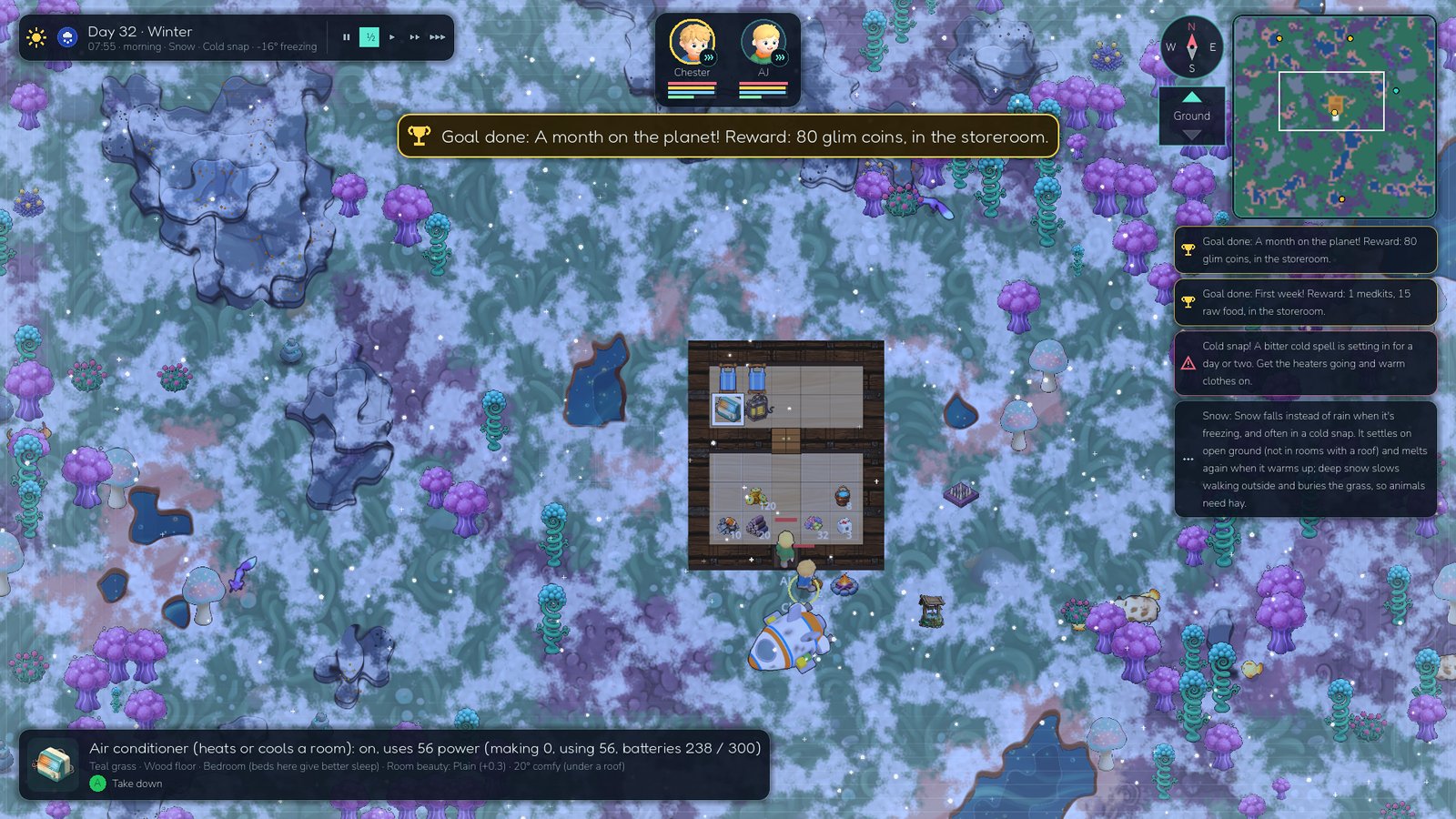
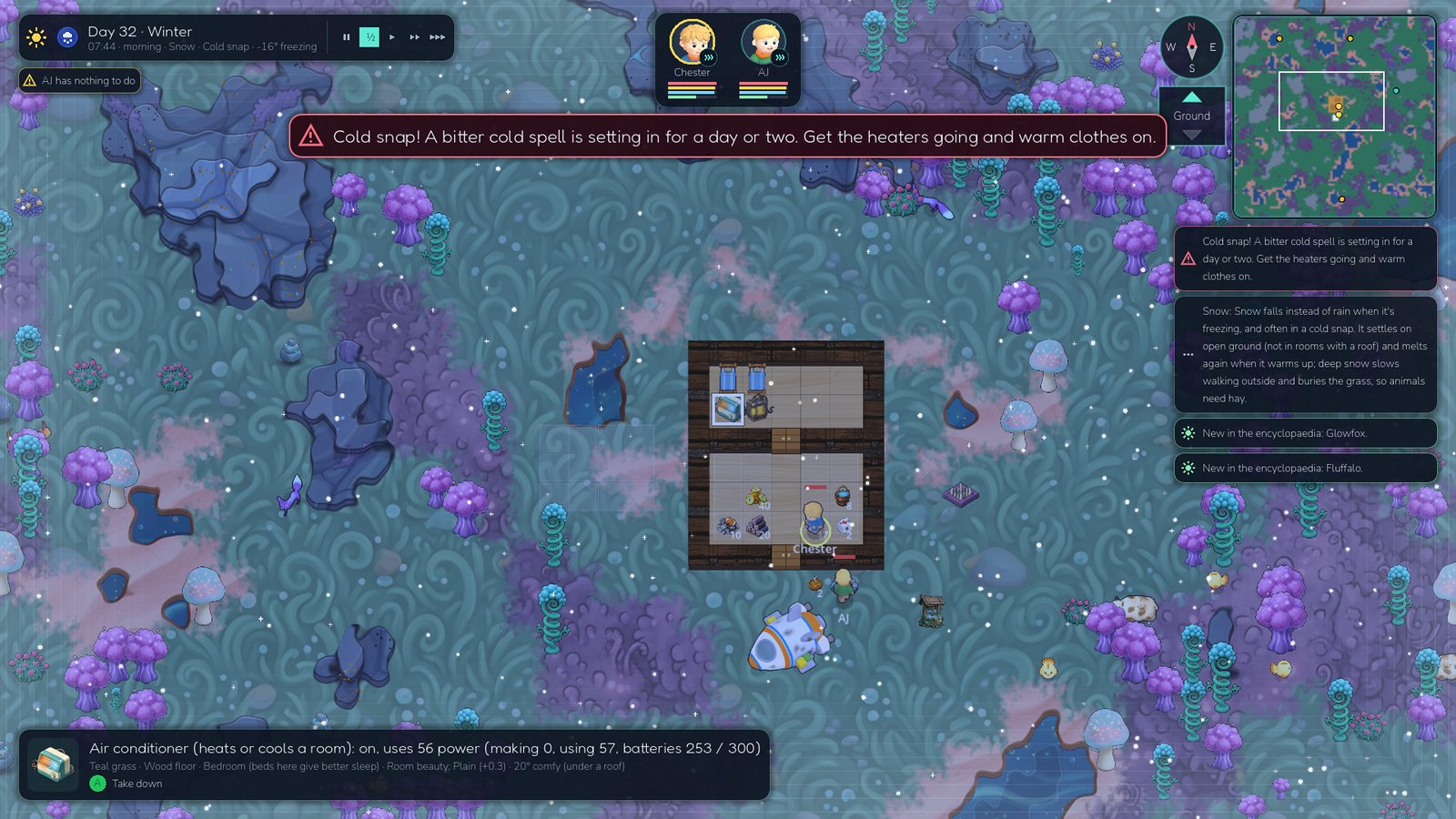
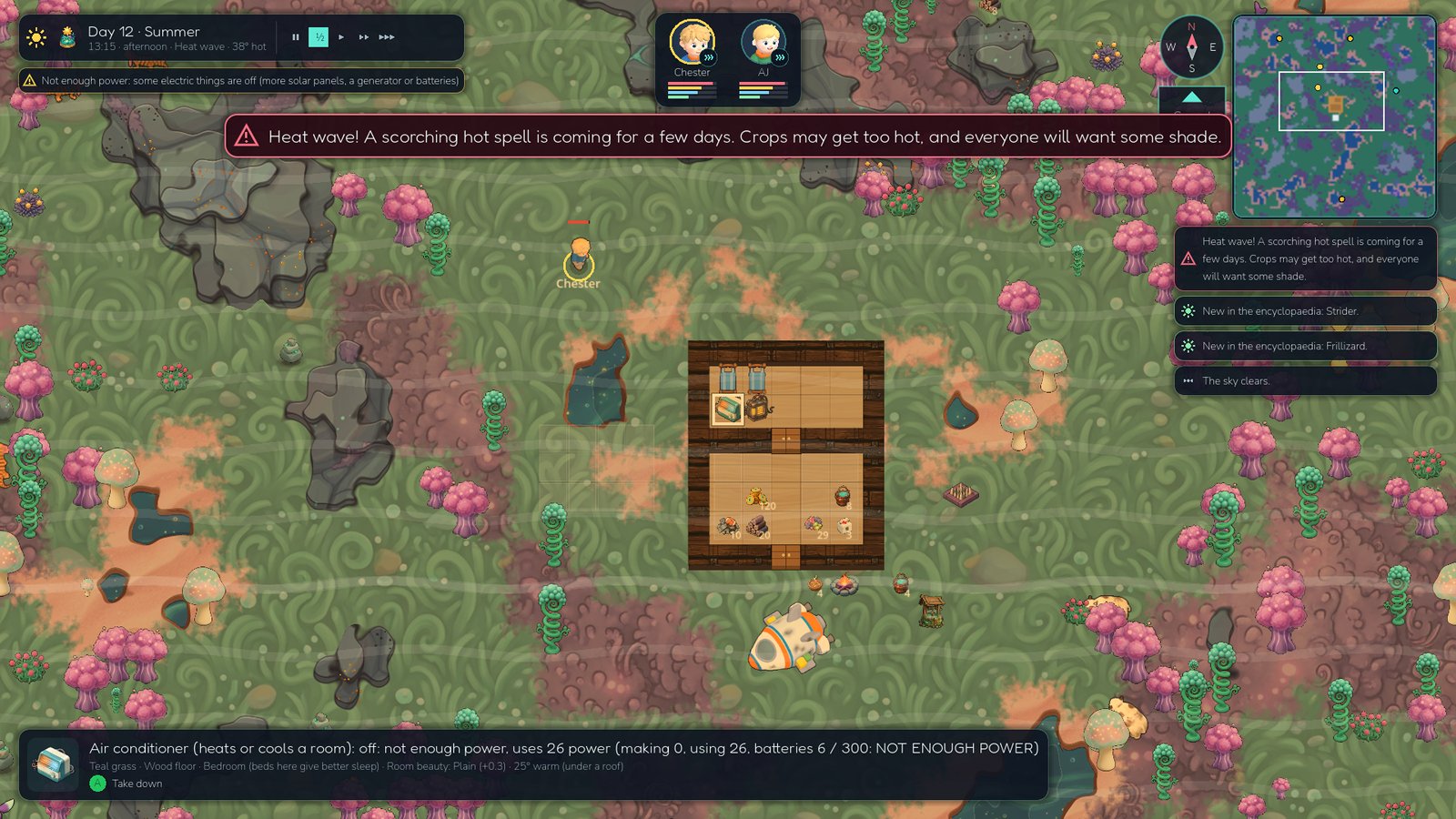
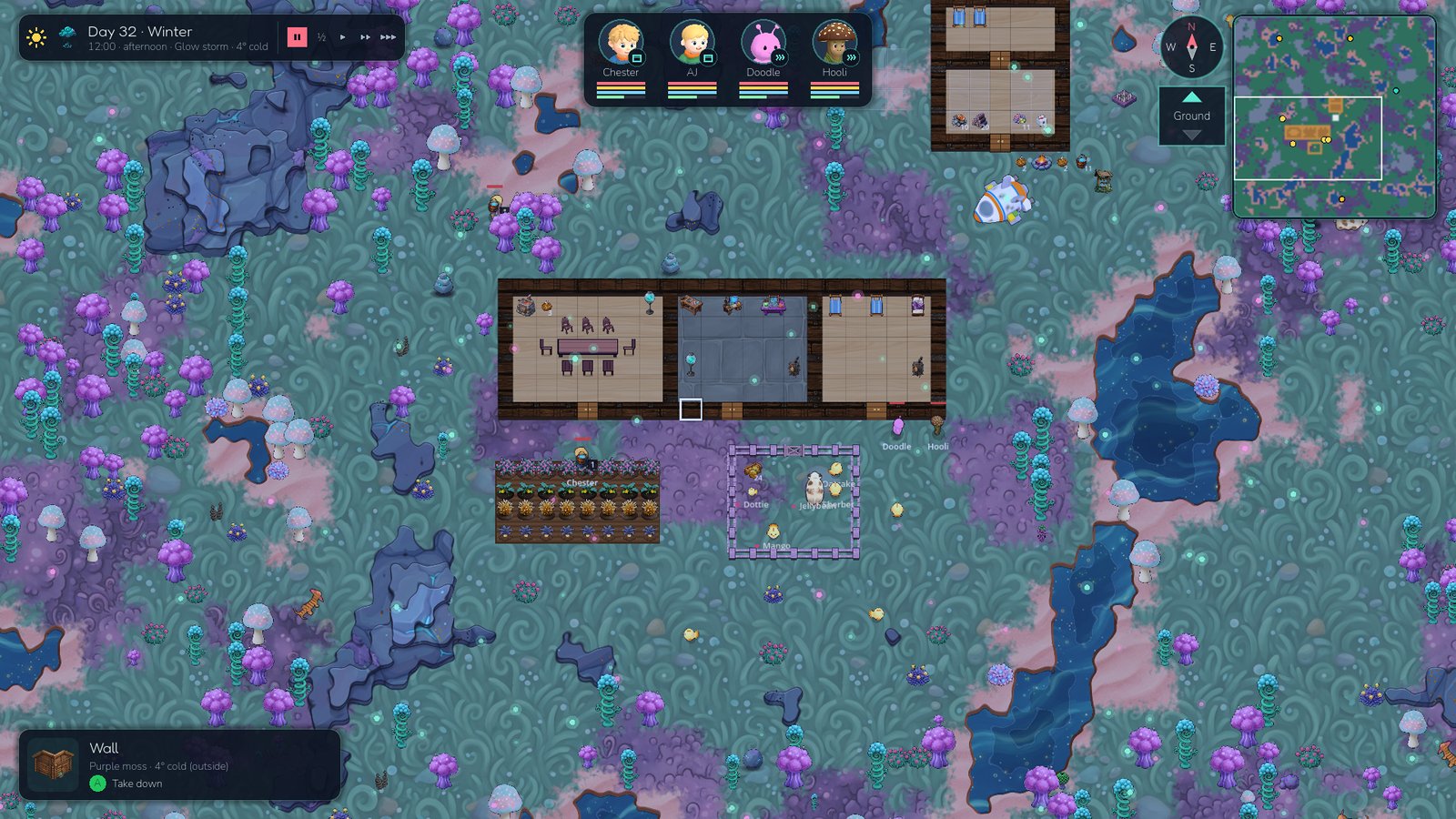
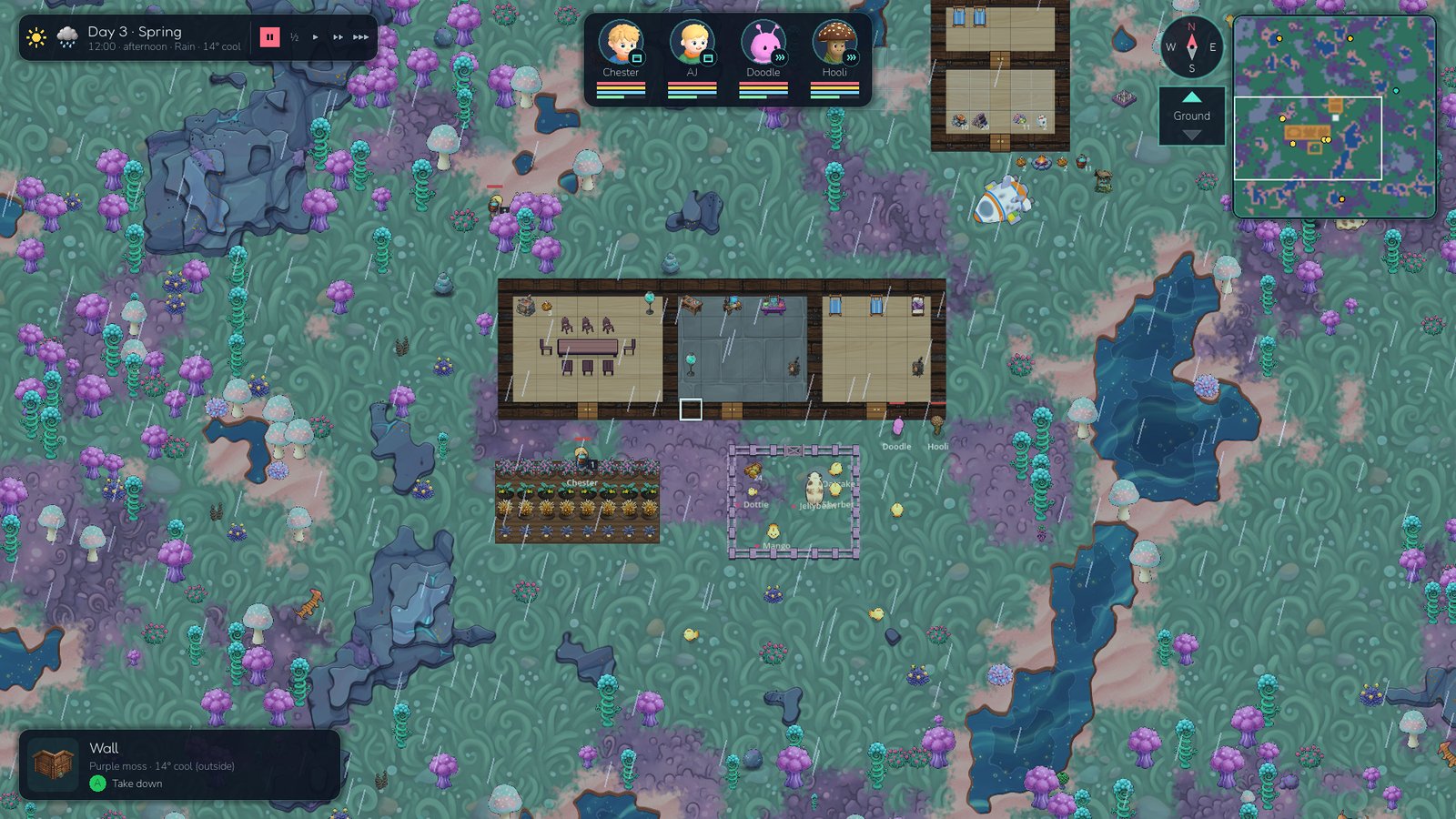
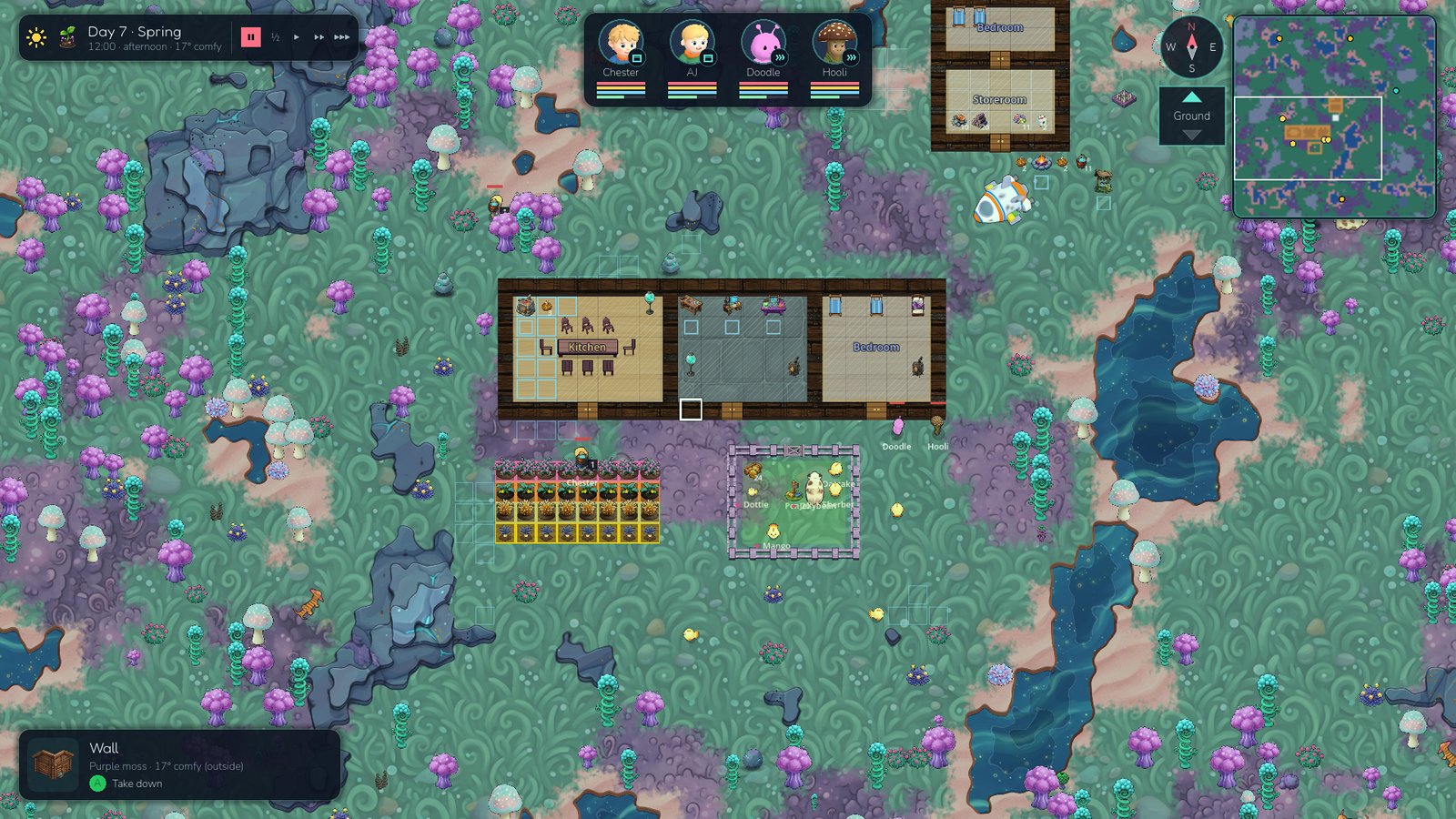
Seasons
Spring, summer, autumn and winter, ten days each. Winter nights freeze, crops outside stop and grass stops feeding the animals, so you stock up first.
Keeping warm
Roofed rooms hold their warmth; campfires, stoves, the smelter and a glow heater warm them further. Coats and jumpers keep colonists warm outdoors. The cold makes people grumpy, never worse.
Weather
Rain, thunderstorms whose lightning splits trees into wood, fog that hides raiders, and the alien glow storm that makes crops grow faster.
Snow
When it's freezing, rain falls as snow. It settles on open ground over a few hours (never in a roofed room), slows walking outside and buries the grass so animals need hay, then melts once it's above freezing.
Trodden paths
Every step treads the snow down a little. The ways the colony walks again and again wear into clear paths that aren't slowed by the snow, so colonists go a little out of their way to use them. Fresh snow fills them back in.
Cold snaps and heat waves
Now and then a bitter cold spell in autumn or winter, often blowing in with snow, or a scorching spell in summer. Frost creeps round the edges of the screen, or the air shimmers, and the colony has to keep warm or cool.
The land
Mountains, moats and the mist
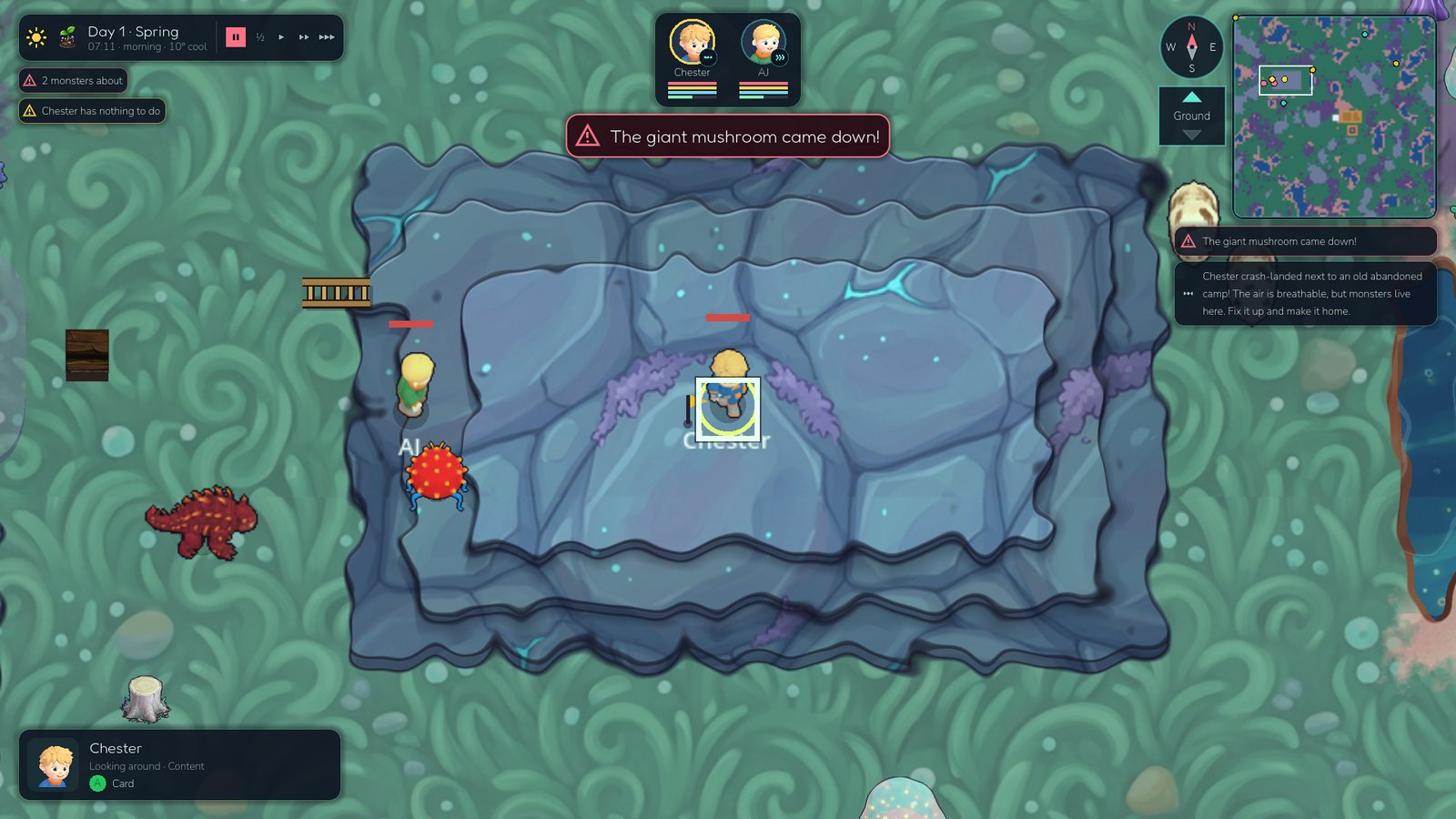
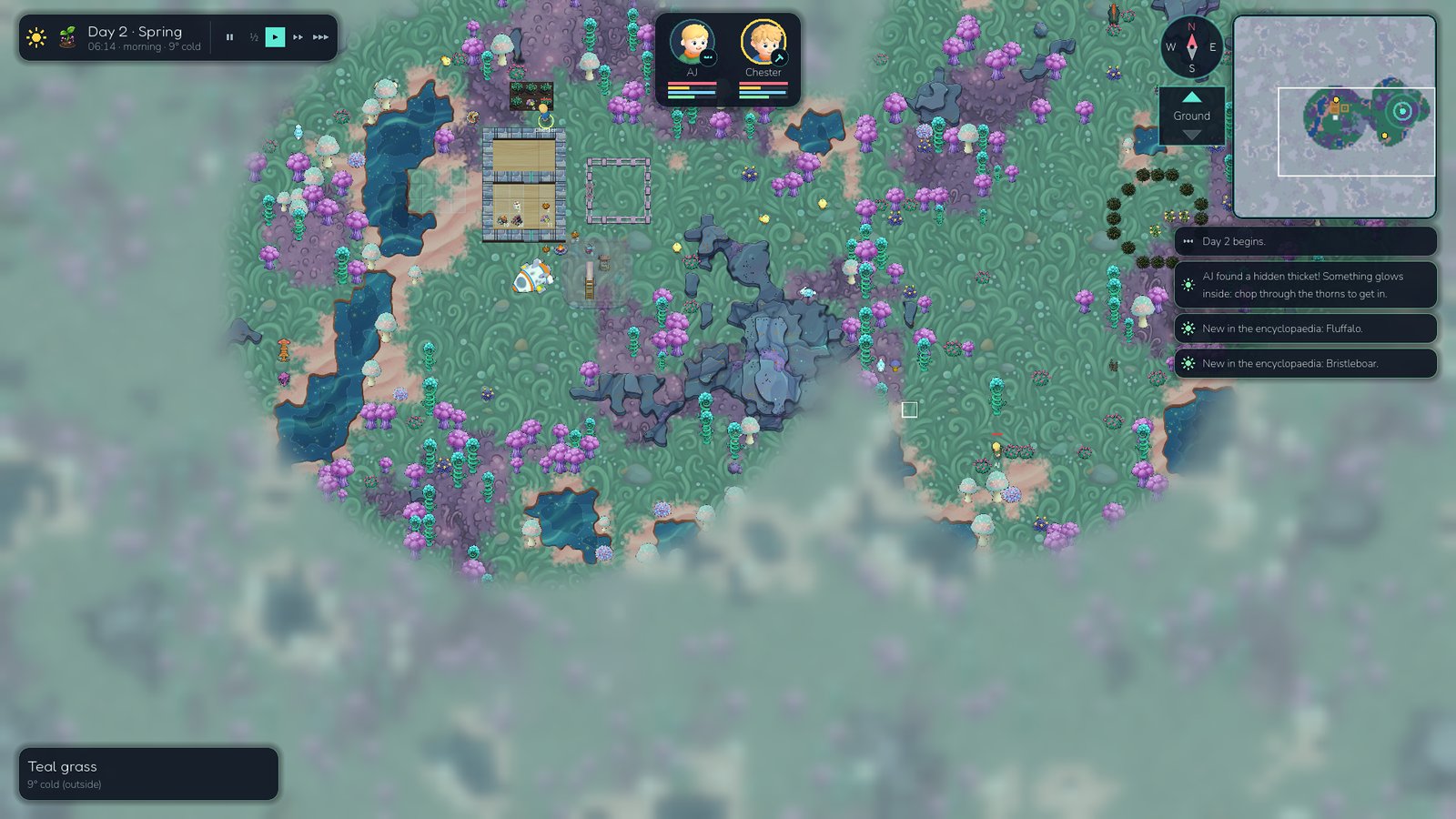
Every tile has a height, from deep water up to tall rock: colonists climb it, dig into it and dig down. Past the camp, the map sits under a mist until someone goes and looks.
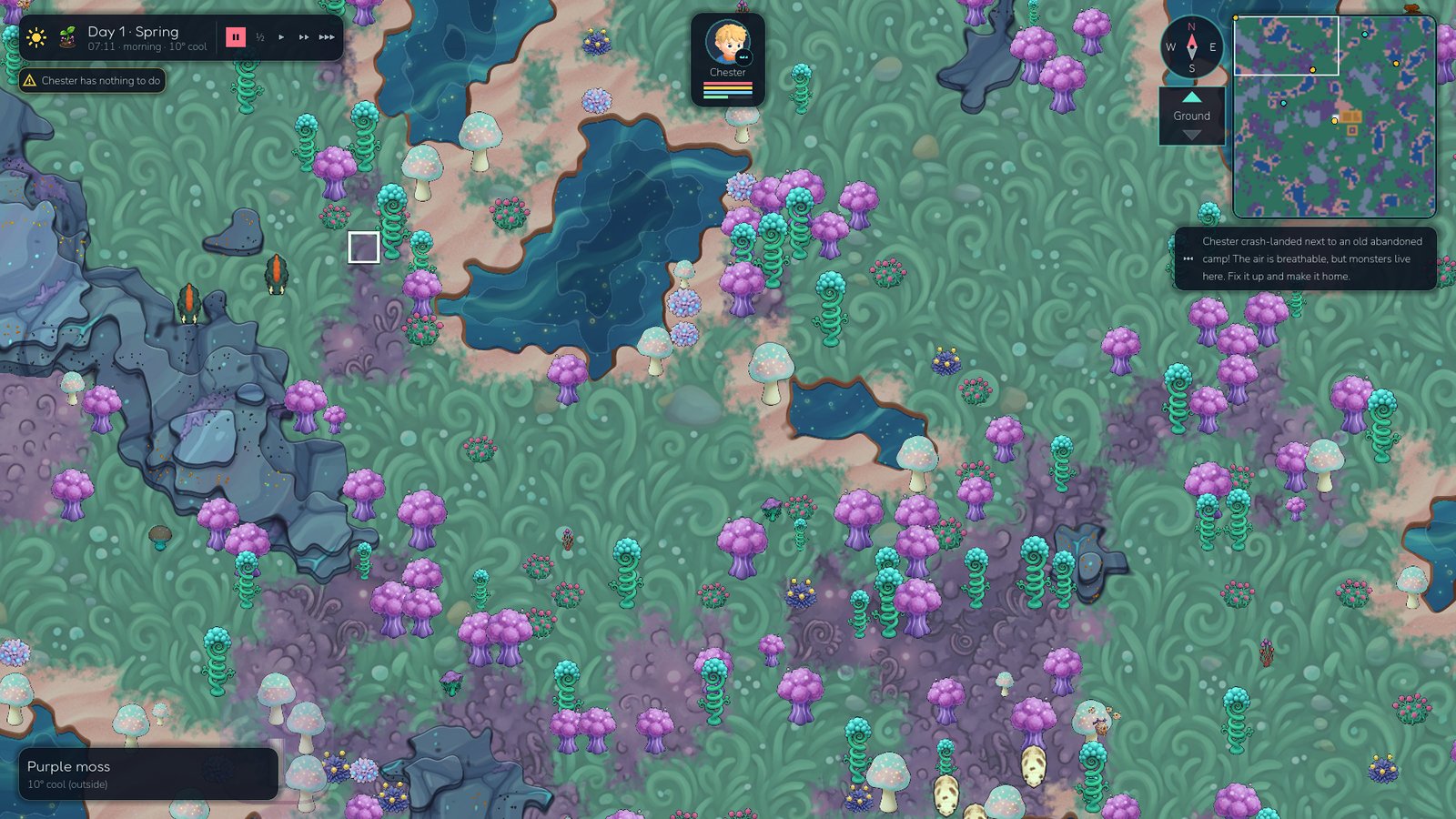
Mountains and deep water
Mountains are one, two or three high, and water is shallow, deep or very deep. Point at any tile and it tells you how high or deep it is.
Caves with a roof
Dig into rock two or more high and you're under a rock roof: out of the rain, safe from meteors, and shaded grey so you can see where the roof stops. Dig one-high rock and it's open to the sky.
Pillars and cave-ins
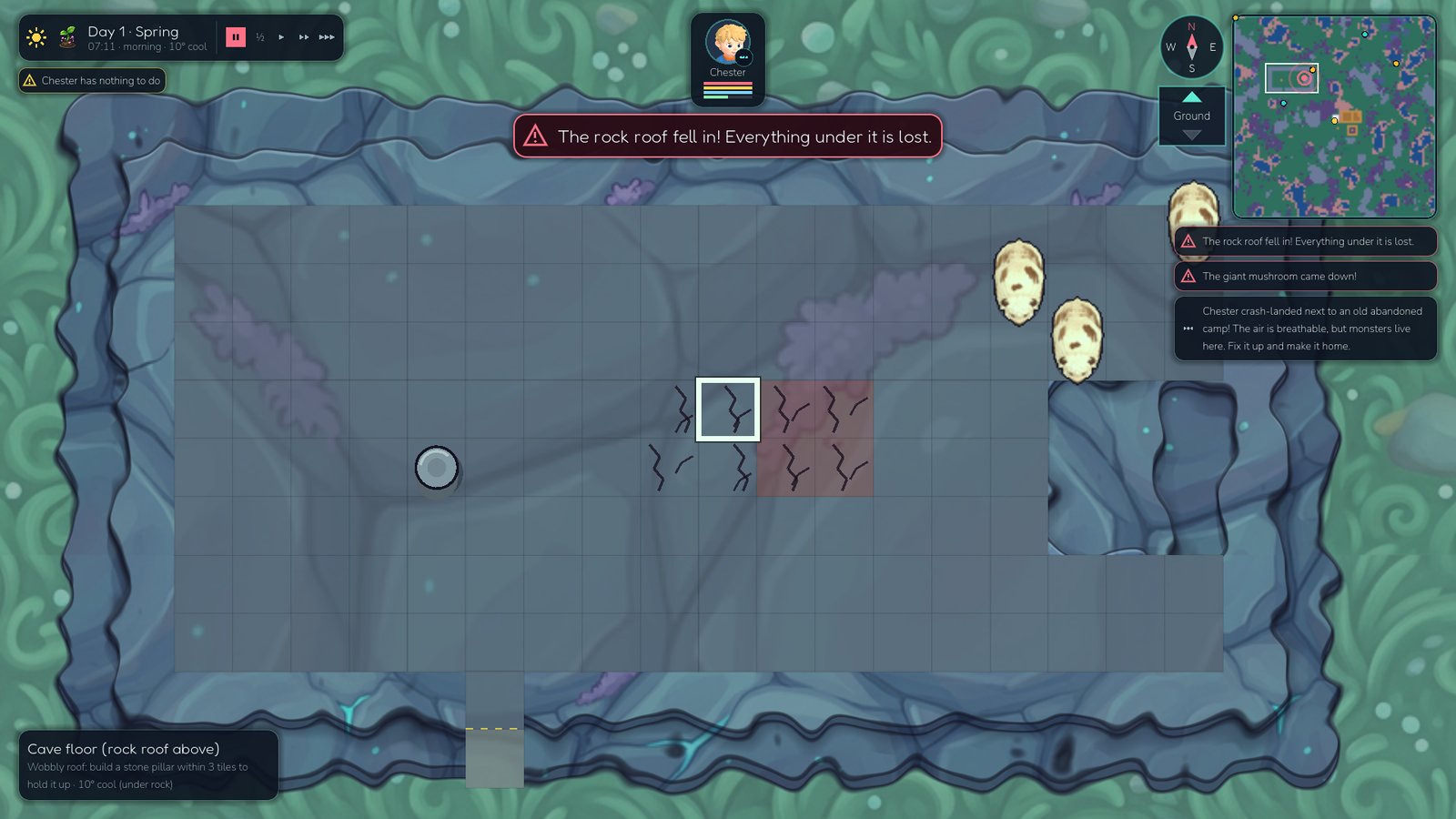
A rock roof needs rock, a wall or a round stone pillar within three tiles. Dig too wide and it goes wobbly, then creaks (the game stops to warn you), then falls in, turning back into solid rock and crushing anything underneath.
Climbing
Colonists can walk on the mountains, up or down one level at a time, more slowly than on the flat. A drop of two is too steep. They're drawn up on top of the rock.
Ladders
A ladder at the foot of a cliff lets colonists climb two levels at that spot. It leans on the tallest rock beside it by itself.
Dig down
Dig the ground into a trench that slows everyone crossing it, raiders too. With Earthworks research, dig it again for a deep trench nobody can climb out of without a ladder. Each dig leaves earth to fill it back in.
Moats and dams
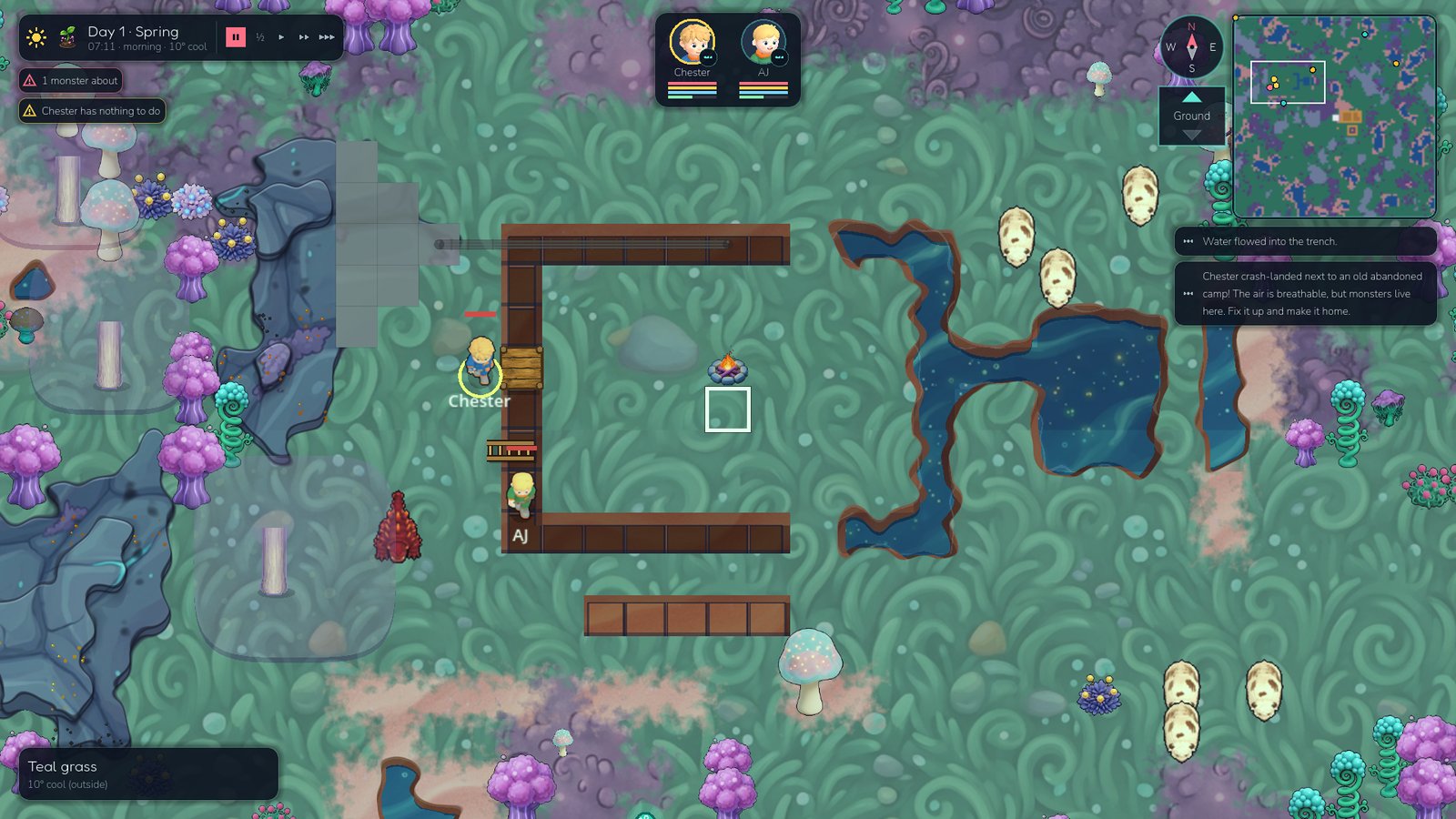
Join a trench to a pond or lake and the water flows along it, but never on to ground you haven't dug. Dig a ring round the camp first, join it last, and you have a moat. Fill a tile back in to dam it.
Bridges
Planks over a trench or water, built out from dry land: the way in and out across your moat. Conduit can run along trenches too, so the camp keeps its power, goo and water.
Hidden caves
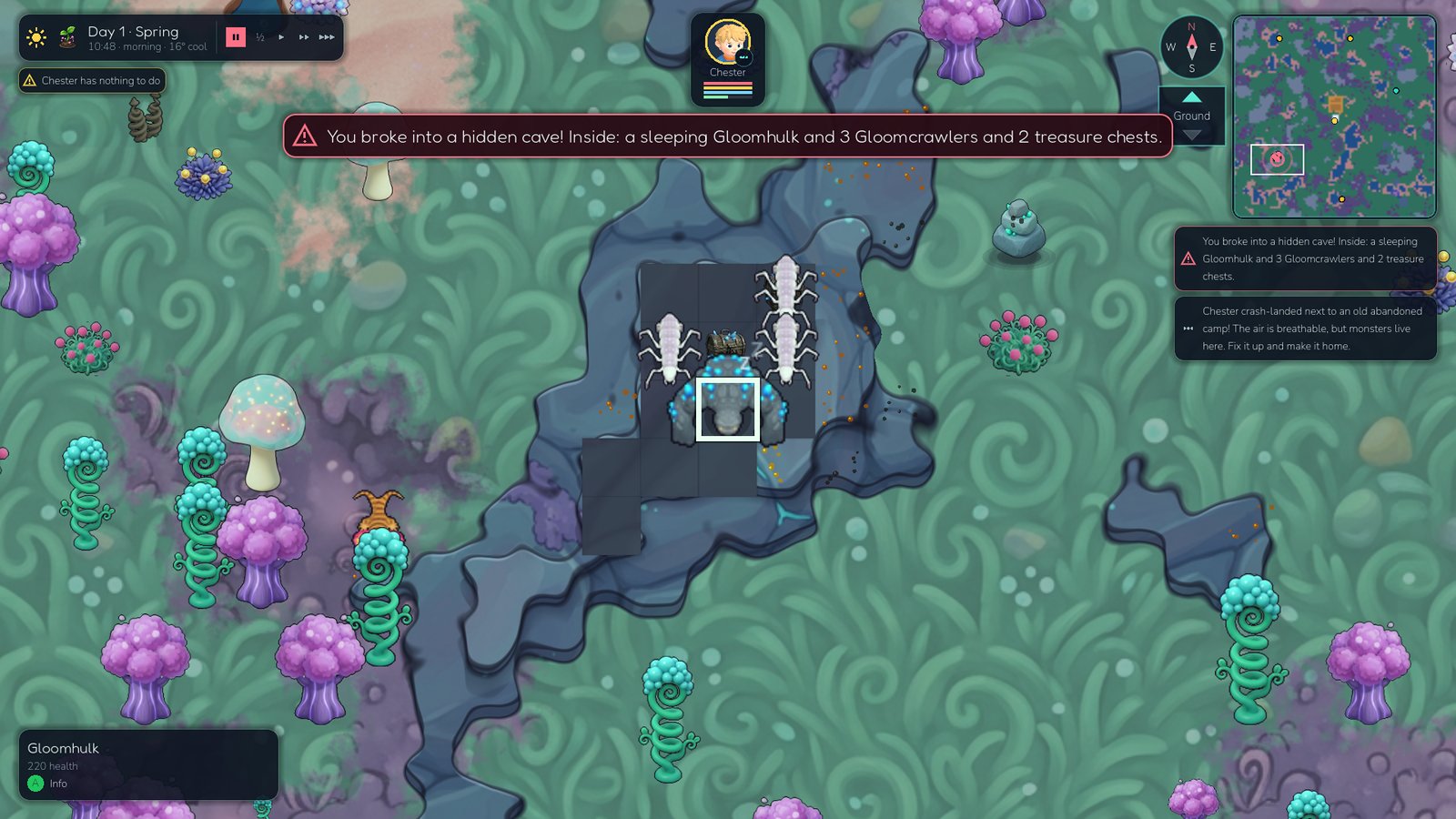
Some mountains hide sealed caves. Mine into one and it opens out, dark until you light it, with treasure chests to carry home and open, packs of Gloomcrawlers, or a Gloomhulk asleep on the treasure.
Fog of war
Out in the mist you can make out land, water, trees and mountains, blurred and greyed, but not what's in it: animals, berry bushes, ore seams, nests and crates wait to be found. Places stay uncovered once someone's seen them, and the minimap fills in as you go. It's a new-game option, on to start with.
Everyone looks round
Colonists uncover what's round them wherever they go, a bit less far in the dark. Nothing can be planned out in the fog until someone's been there. Raiders still show coming through it.
Scouting
Point at the fog and pick who goes: they walk there and look round everything within about 22 tiles of it, then head home once it's all seen. Or send them north, south, east or west (there's a compass by the minimap): they head for the nearest patch in that quarter (north is anywhere between north-west and north-east) that's still unexplored all round, and explore that. Without a pack they're home by bedtime. They also come home when the pack's food runs out, when they're hurt or when you call them back, and run for home if raiders come near.
The explorer's pack
The second hero turns up on day 2 with one from the ship: a bedroll, and food and a water flask for about 3 days. A scout wearing it camps out instead of walking home every night, and heads home when the food or the water runs out. They always set off with it full: cooked meals first, then raw food, and water buckets for the flask. Sent from out in the wild, they walk home to fill it first, and the scout menu warns you if the stores are too low to fill it. It goes back into storage afterwards. More are sewn at the tailor's bench.
Places to find
Each new map hides special places out in the mist, away from the crash. When someone spots one, the whole place comes into view, it gets a pin on the minimap and a page in the encyclopaedia, and whoever found it is thrilled:
- Lookout rock: climb it to see about 40 tiles all round.
- Hidden thicket: chop through a ring of thorns to reach glowing wild lanternblooms, then grow them at home. A field of them glows at night, and their petals make lamps that need no fuel.
- Scrap of treasure map: pick it up and a red X appears far away. Dig there for treasure.
- Bits of the ship: salvage them for scrap, parts and navigation parts for the beacon.
- Crystal hollow: the only place starshard crystal grows.
- Creature den: a baby animal, twice as easy to tame. Some are guarded by a sleeping Thornback.
Treehouses
A home up in the giant mushrooms
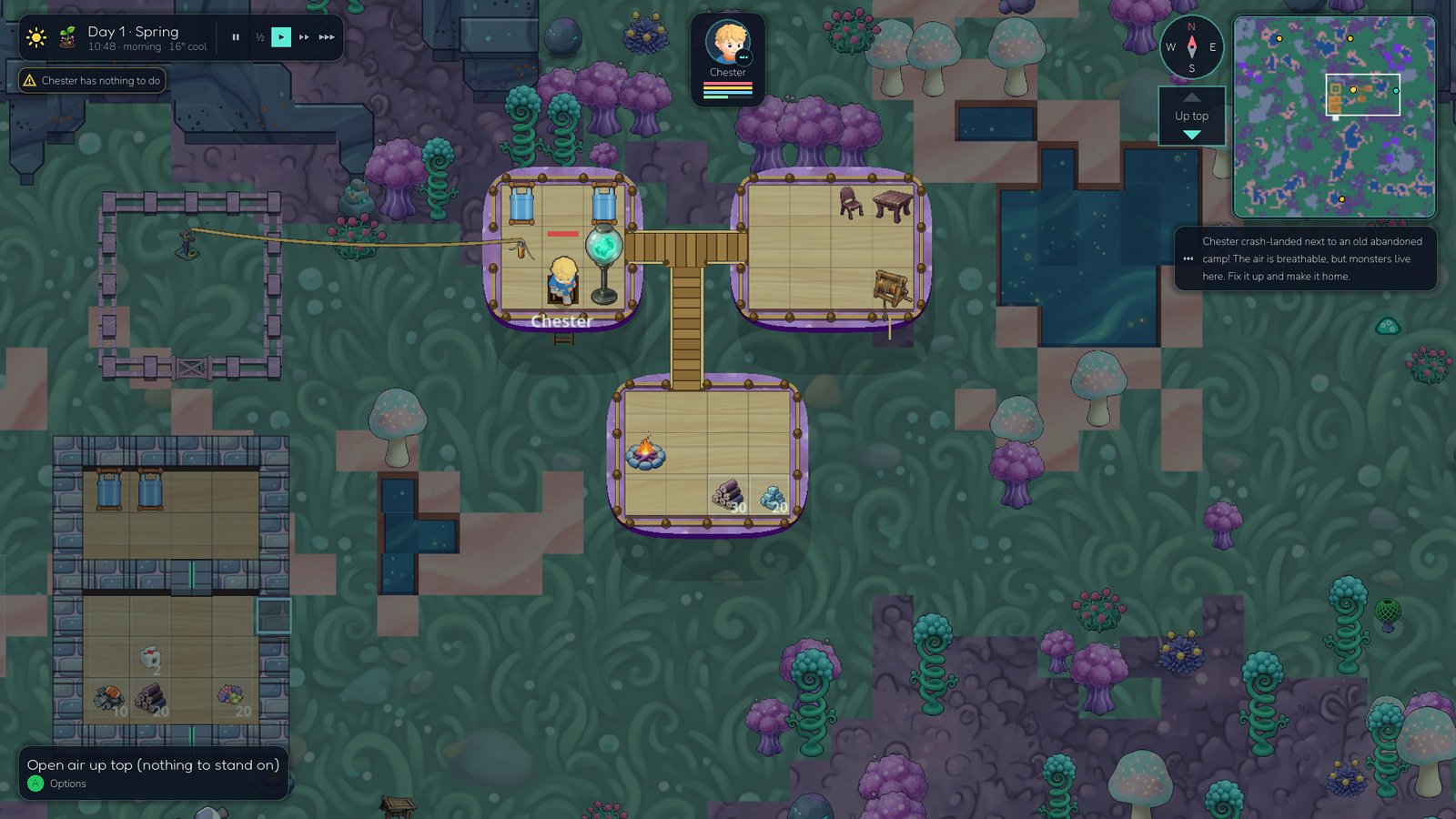
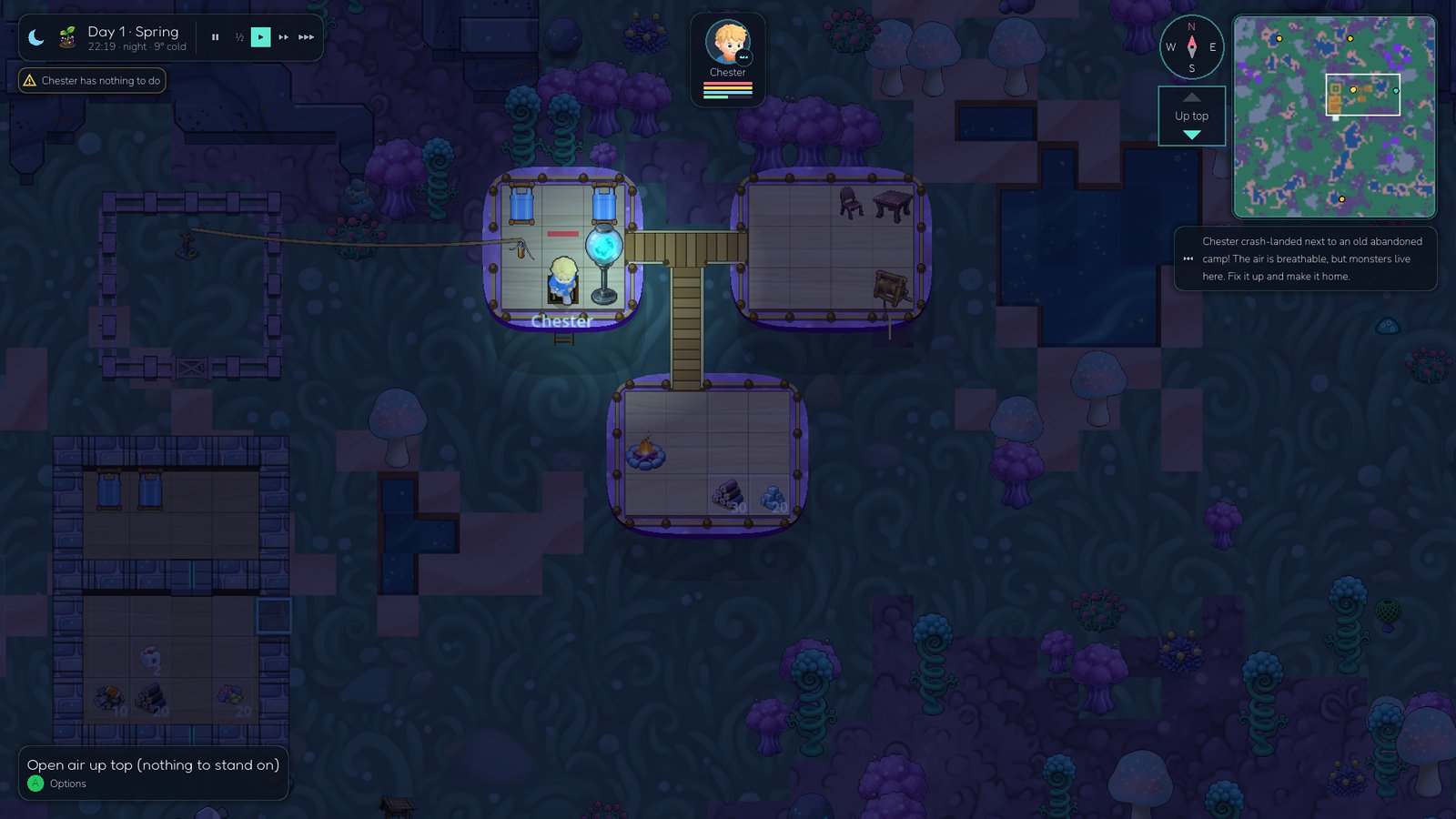
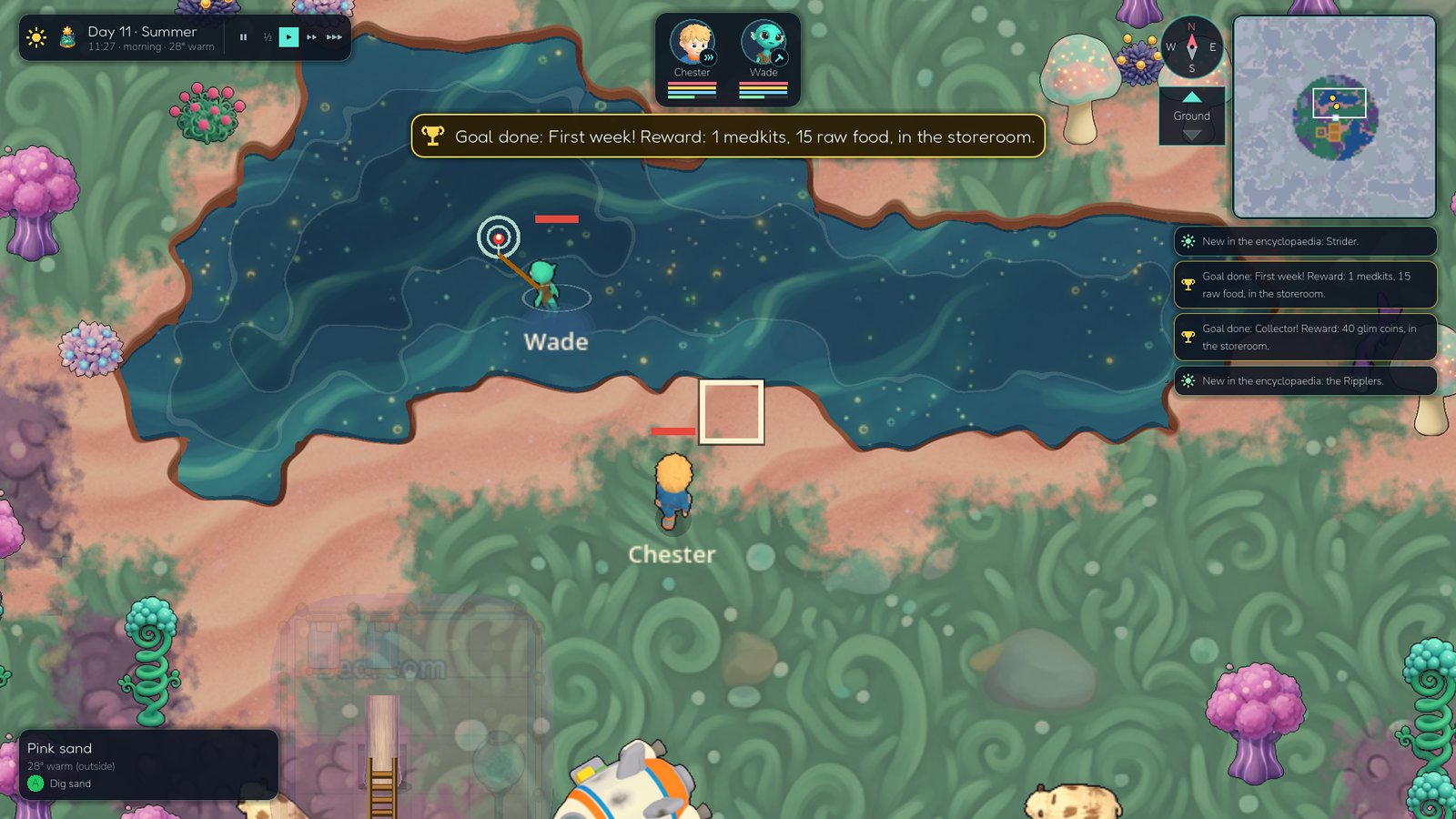
Every new map has groves of giant mushrooms. Their flat caps are high above the ground, higher than any mountain, and a colony can live up there, out of reach of most raiders.
Up the ladder
Build a rope ladder up a giant mushroom's stalk, then look up top to build on the cap: a wooden deck, rope edging round the rim, beds, lamps, workbenches, a campfire, even turrets.
Getting around
Rope bridges join the caps, and can branch. Zip lines are the quick way down. A winch at the cap's edge lifts a whole pile up or down by itself.
Power and water up top
Run conduit up the stalk and power, glowgoo and water come out in the middle of the cap.
Safe from most raiders
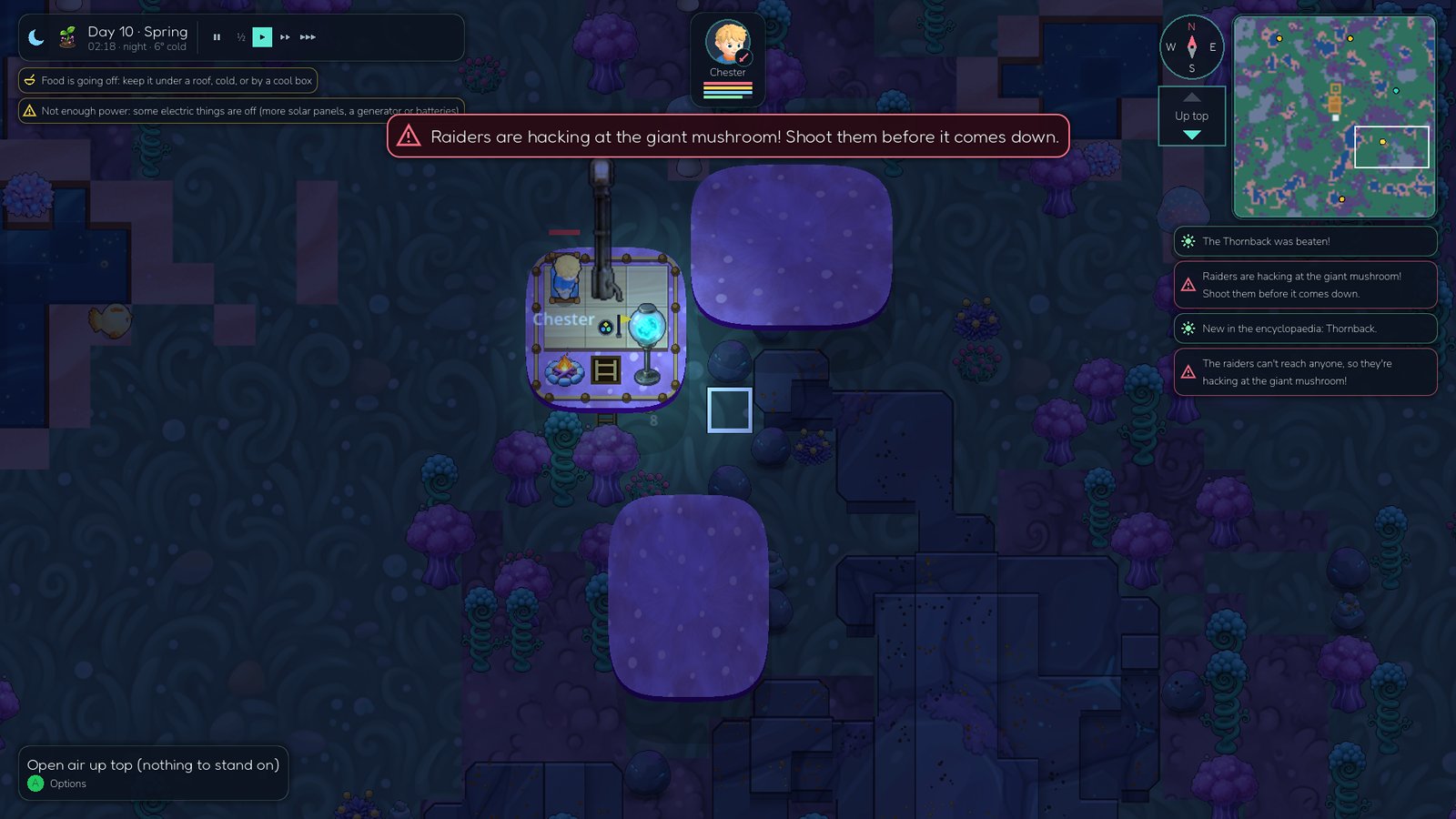
Pull the ladder up and walkers can't climb it. They hack at the stalk instead, and if it falls the treehouse comes down. Shooting down from a cap reaches further and hits more often, and the rim is cover. Skitters still climb the stalk.
Grow your own
Plant a spore and in about six warm days it grows into a new giant mushroom. A glow storm shakes a spore off every grown one: gather them before the storm passes.
New friends
Build a perch and tame a Skywhistle, a flying friend that clears the mist and shrieks when raiders are coming. The Capling, a new alien, climbs stalks without a ladder and loves a bed in a treehouse.
Mine carts and yards
Work far from camp
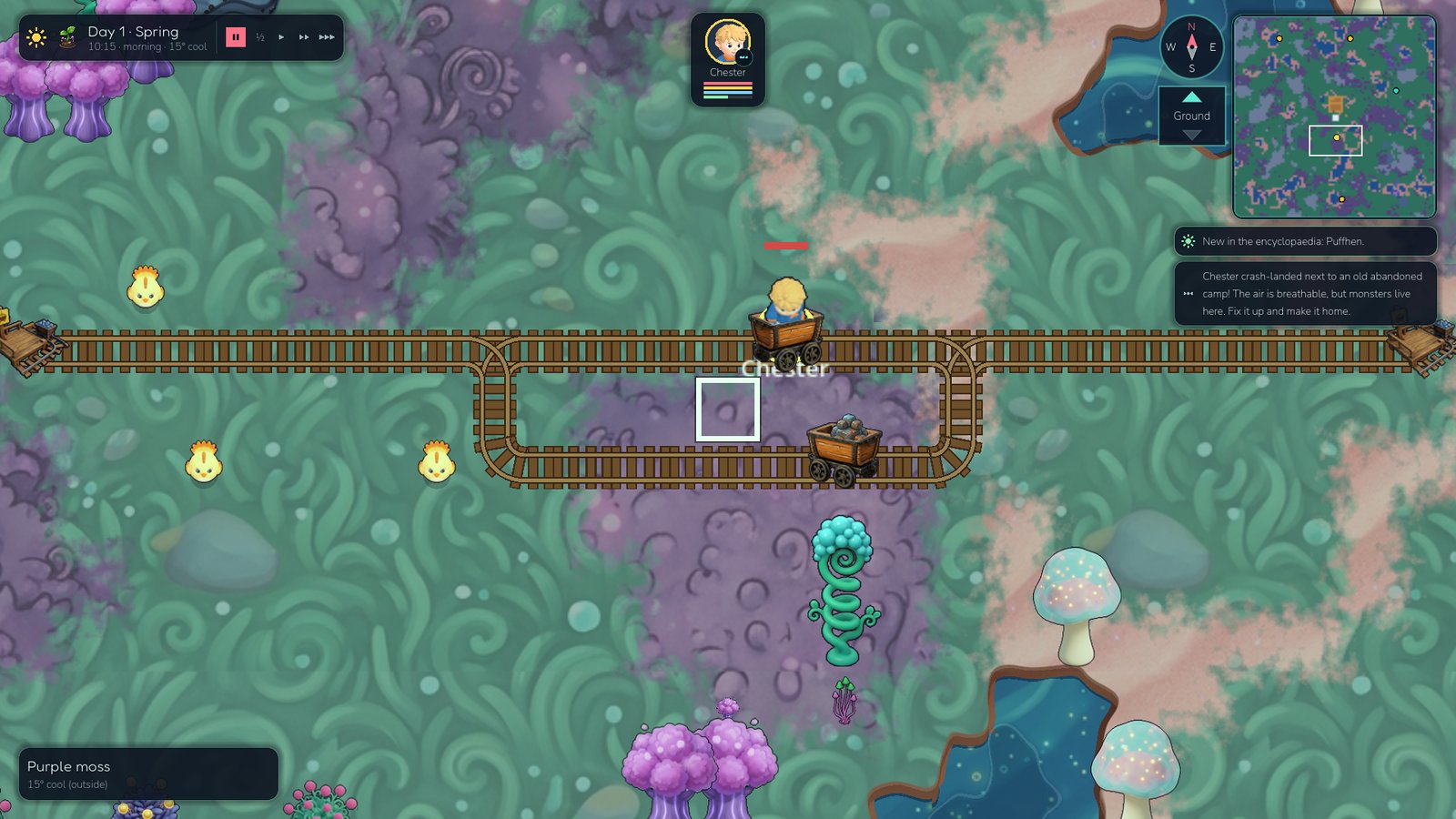
The best iron is often at the edge of the map. Lay a wooden track out to it, set up a service yard, and let the mine carts bring it home.
Full loads
A mined rock or a chopped tree only leaves a small pile, so haulers pick up more of the same from the piles close by until they're carrying all they can, saddle bags and all.
Home in time for bed
A colonist working a long walk from their bed times the walk home and sets off early enough to be in bed by bedtime, instead of walking half the night.
Wooden track and mine carts
Drag out wooden track (it goes along, then round the corner, over bridges and through doorways), put a stop at each end, and build a cart. Out by the work, haulers load it; when it's full it rolls home by itself, about three times walking speed, tips it out for the haulers and goes back for more. Colonists ride it on long walks.
Sharing the track
Lots of carts can share a line. A cart only goes onto a stretch of track when nobody's coming the other way, and waits at the junction or stop before it. Build a passing loop and they pass each other on it instead.
Service yards
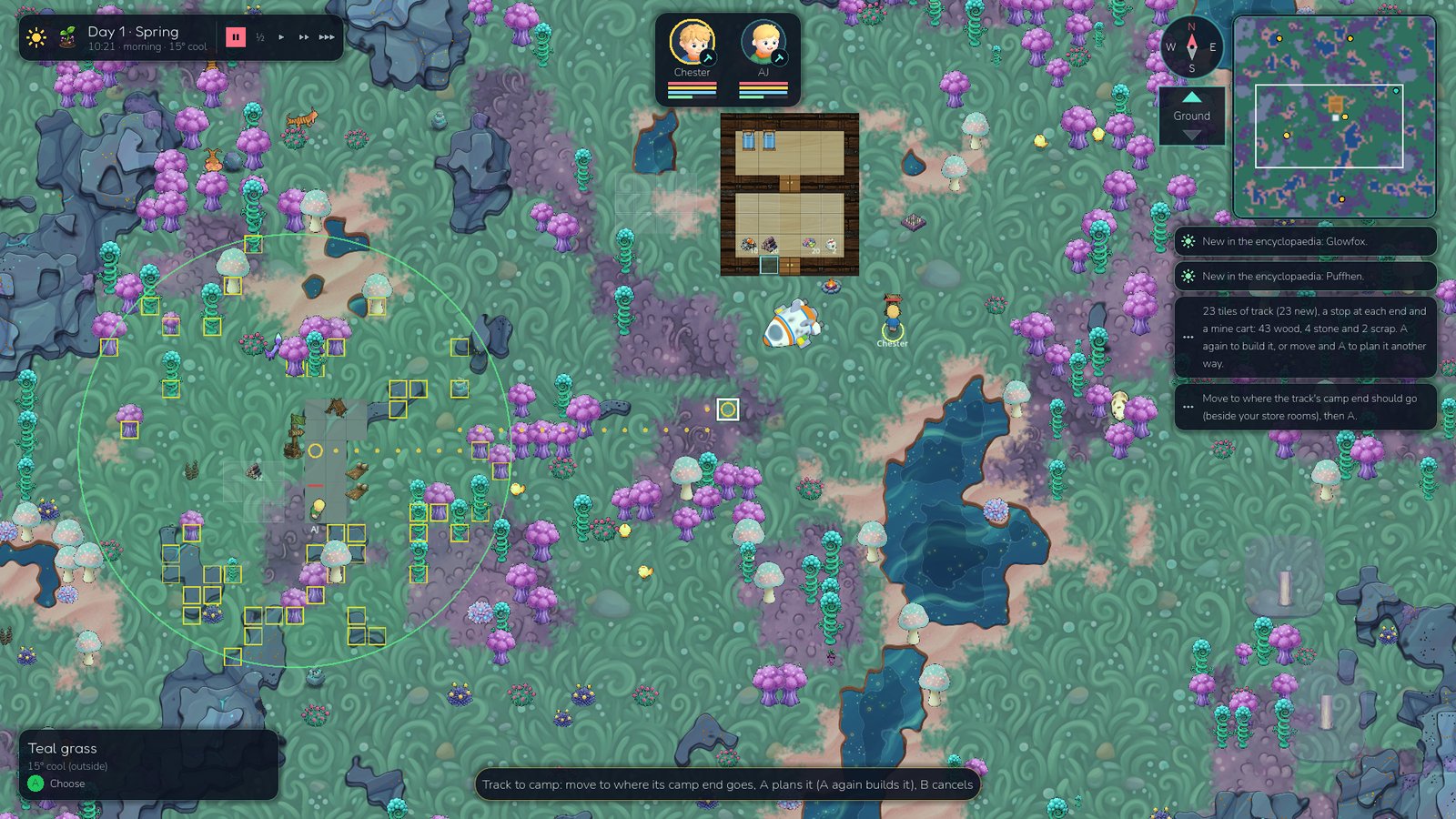
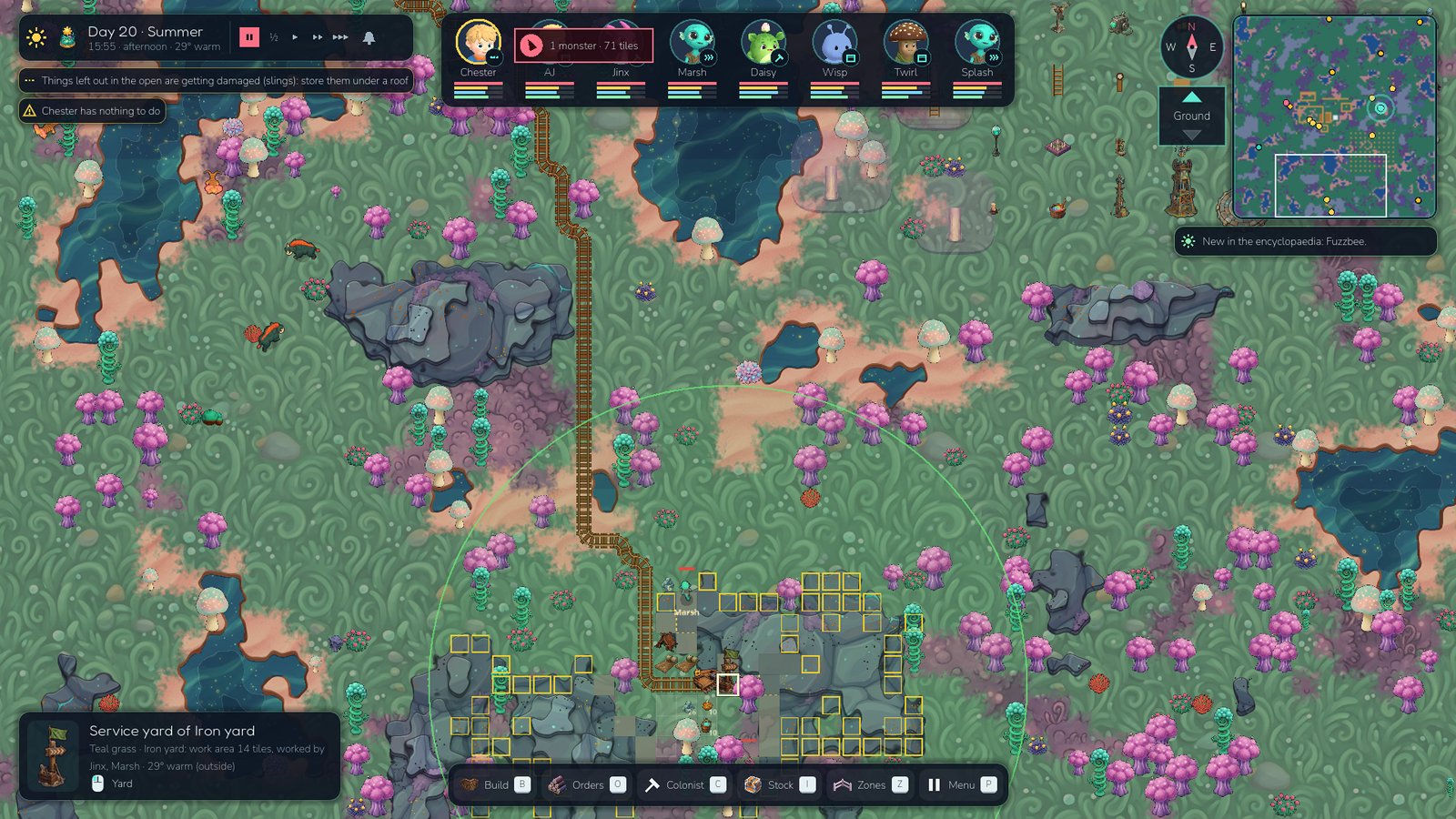
An outpost out at the far end of a track, named for what's round it: an Iron yard, a Timber yard. It has a work ring you can make bigger or smaller and see on the map, and its own little store room. Pick who works there.
Lay a track back to camp
Place a yard and it offers to plan the track for you. Pick where the camp end goes and it finds a way round water, steep steps, mountains, buildings and fields, joining any track already there. Each end gets its own stop, so loading never blocks the line.
Mark all
Mark every tree, iron, coal or gold seam, rock, berry bush or wild mushroom in the ring at once, with a count of each. Rock only marks lone boulders and the edges of mountains, so nothing caves in. Keep marking turns a timber yard into a wood camp that never runs out.
Bedrolls and tents
Yard workers live out there for days, sleeping in a rough bedroll or a snug hide tent, with food the cart brings out. After a few days they start to miss camp, and they come home by themselves when the work's done, they're badly hurt or the food runs out.
Camp stays camp
Only the colonists you send to a yard work there; everyone else keeps the camp running (they still go out to build the yard and its track). When the alarm bell rings, yard workers hold at the yard.
Raids and events
Something's always happening
Monsters and Glim scavengers turn up now and then, but so do meteor showers, eclipses, visitors and traders.
Raids
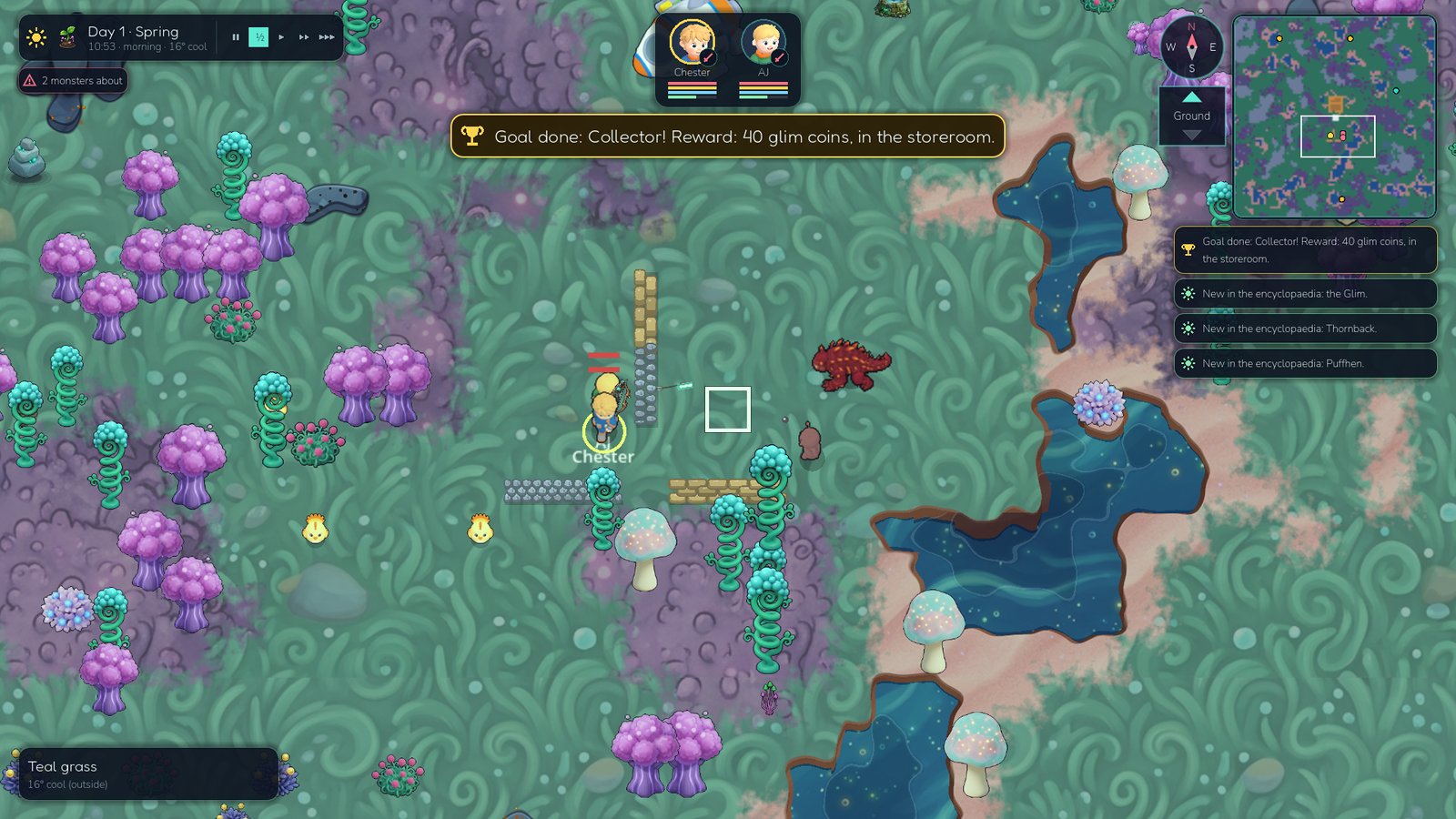
Monsters and Glim scavengers turn up now and then (never in the first week), spreading out to surround whoever they're fighting. Some scavengers carry slingshots and shoot from a distance; they drop their loot and run when beaten.
Ranged weapons and cover
Slings, bows and scrap blasters shoot from a distance, with stones, arrows and bolts you can see fly. Colonists find cover by themselves: anyone behind sandbags or a wall is much harder to hit, and walls block shots.
Defences
Rubble barricades and sandbags, an alarm bell and defence posts, spike and blade traps, scrap turrets and powered zap turrets, trained animal guards, and colonists who fight back with whatever weapon is to hand.
The alarm bell
Paint defence posts behind the sandbags or inside the moat, then ring the bell when a raid comes: everyone with a weapon runs to a post on the side the raiders are coming from (the ones with cover first, or their own), and anyone without one takes cover indoors. Ring it early and they're waiting for them. Ring it again for the all clear, or it sounds by itself after the raid. With the night watch, the lookouts ring it for you.
Hold the line
Send a colonist to a spot and they hold it, under a little flag, until you let them go. With a sling or bow they shoot from the spot; with a club or spear they step out to fight anything that comes within a few tiles, then go back. Post fighters on the side the scavengers are coming from and they all pile in.
Up on the rocks
Raiders can't climb, except Skitters, which scramble up after you. Anything that can't reach anyone smashes up the base instead, and the ones with slings and launchers shoot at whoever they can see. A moat with a bridge makes them come the long way.
Gentle by design
Chester and AJ always pull through: colonists get knocked out rather than killed, and bandages, bed rest and a medkit from a friend get them back on their feet. Only an alien colonist left knocked out with nobody to help slowly fades.
Meteor showers
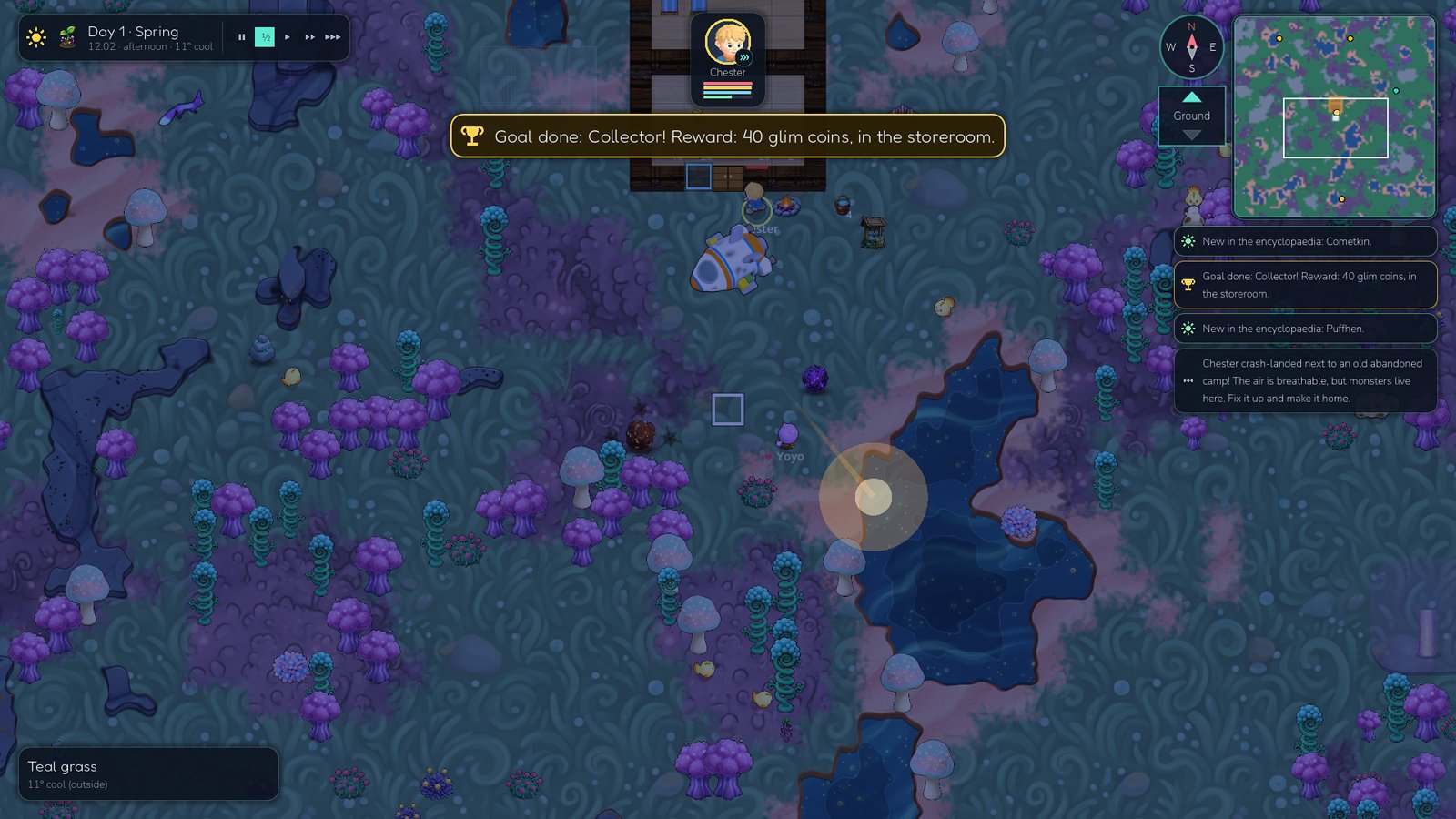
A warning in the morning, everyone indoors at dusk, then meteors streak down with a flash and a shake. They can knock down a wall or a tree, and leave craters with meteor chunks, glowing star meteors full of starshards and star iron, and very rarely a strange egg.
Sky shows
A midday eclipse turns day to night for a few hours (and the skitters come out), and a shooting star on a clear night has everyone making a wish, sometimes with a supply crate thrown in.
Visitors and luck
Glim who want to join, traders, survivors, supply drops, berry blooms, herds wandering in, and lost tame animals that decide to stay.
Crop blight
Some crops wilt and it spreads to the plants next to them, so farmers cut the sick ones out to save the field.
Made for the TV
A game pad, a sofa and big friendly menus
Everything on a controller
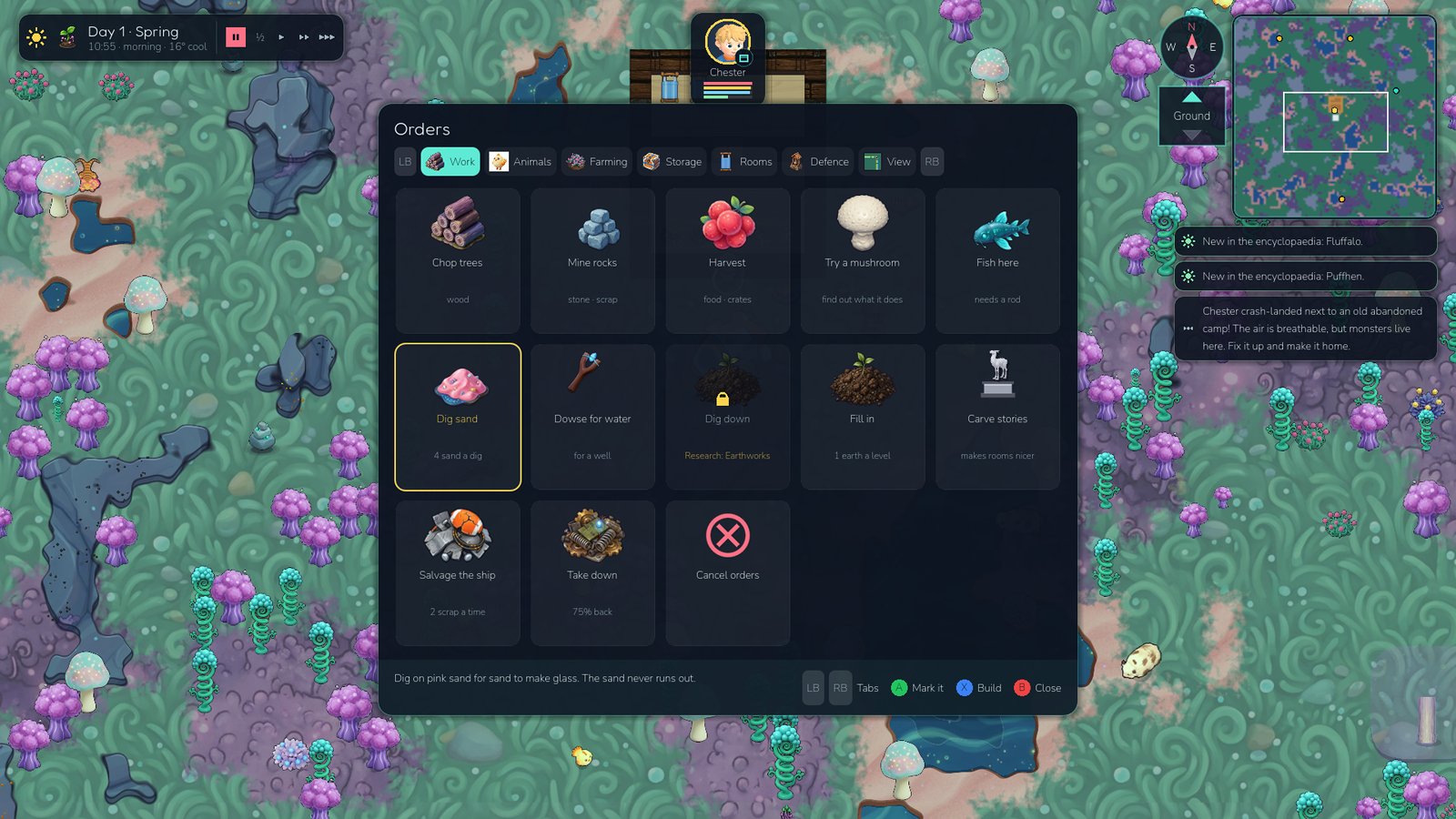
A cursor on the left stick, A to act, menus on the face buttons, and the game asks once which way round your controller's buttons are.
Easy to read across a room
A clean icon-based HUD with a minimap, a colonist bar, alerts and a text size setting for the TV.
Goals
Goals to chase, from catching every kind of fish to taming every animal, each with a reward, on the way to the big one: calling home.
Tips as you play
Short tips the first time something happens, and a "next step" when something's stuck: a wall waiting for stone, a stove with nothing to cook, nobody doing research.
Sound and music
Calm, cosy music, and sounds for chopping, mining, cooking, fishing, fights and thunder, with jingles for big moments. Music and sounds each have their own volume.
Encyclopaedia
Every creature, plant and thing in the game
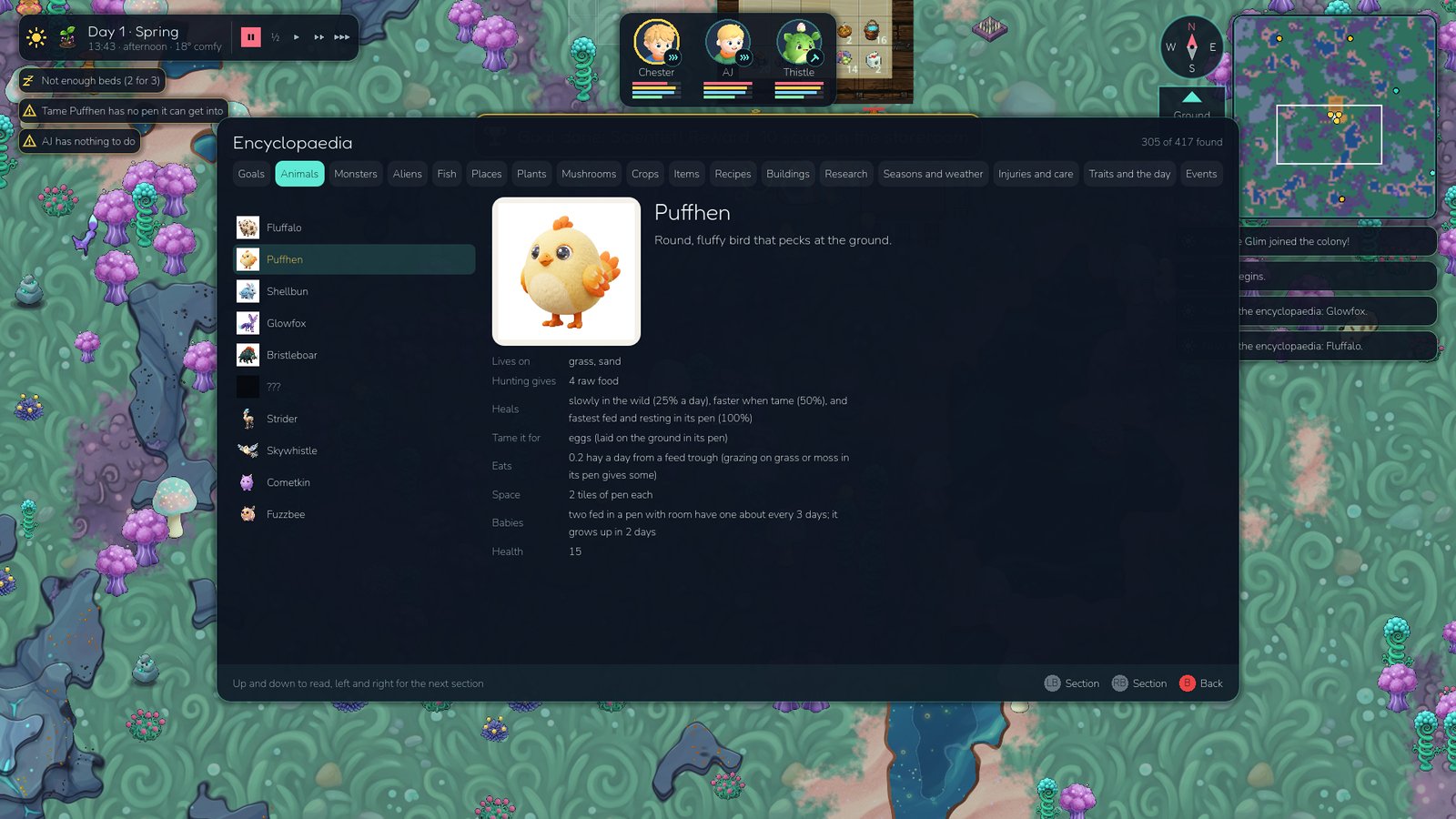
The game's encyclopaedia, as a web page: animals, monsters, the aliens, fish, plants, crops, items, recipes, buildings, research, seasons and weather, health, traits and events: over 430 entries, each with a picture and the facts the game uses.
Open the encyclopaediaUnder the hood
How it's made
Godot 4
Written in GDScript with almost everything in data files, so new animals, crops, recipes and weather are a few lines each.
Pictures and 3D
Plants, items, buildings, the title picture and every icon are AI-generated pictures (Meshy); Chester, AJ, the aliens and the animals are 3D models turned into sprite sheets, all in the same chunky toy style. Doors, sandbags, wires and the sky effects are drawn in code.
Tested on every change
An automated test plays through the game's rules (over 1,700 checks), and preview scenes take the screenshots on this page.
Update log
What's new in each test version
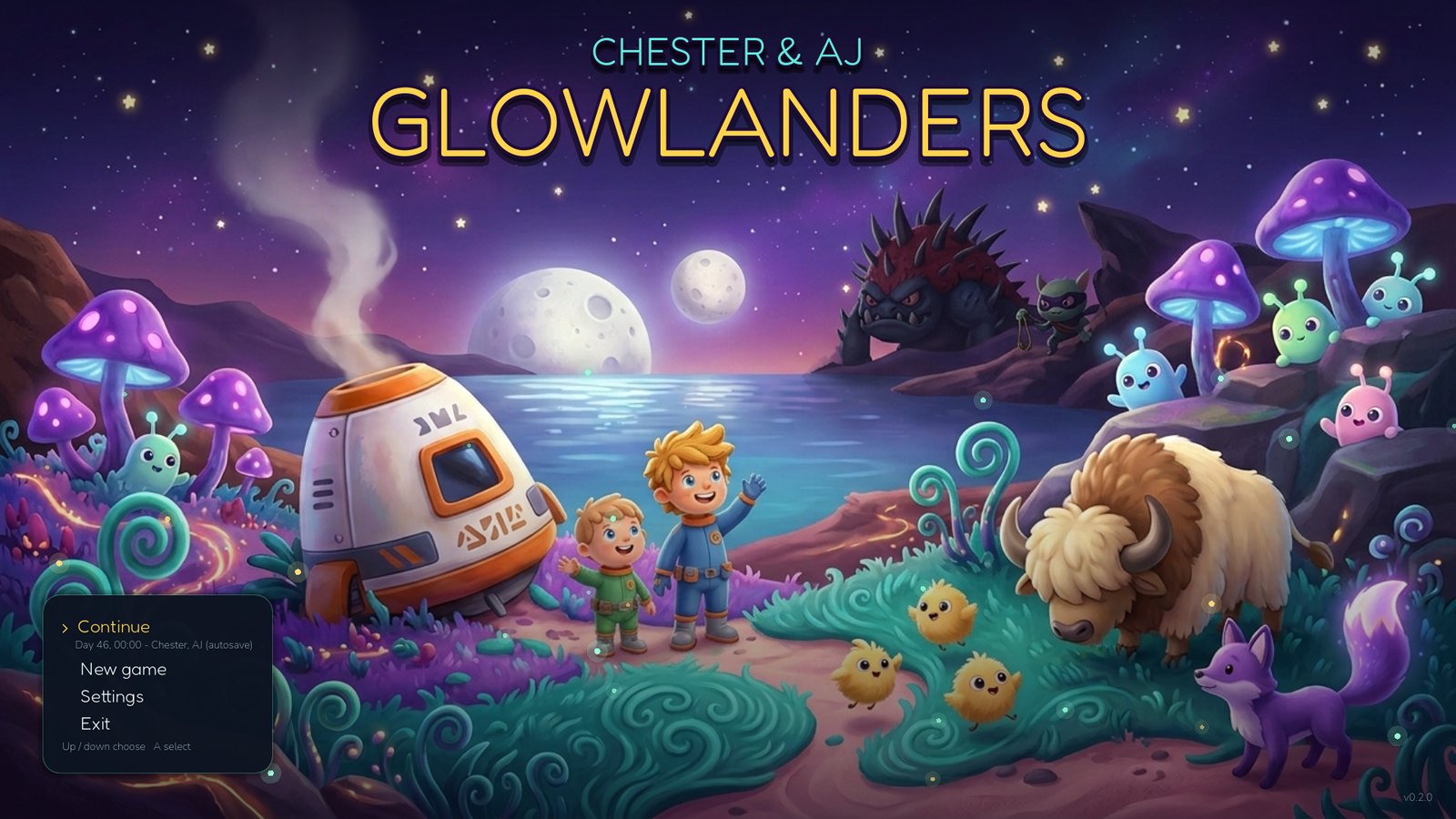
For invited testers: the version number is in the corner of the game's title screen. Please mention it when you report anything. (The game was called Crash Landing up to version 0.2.0.)
0.7.0: The fighting update
- Raids are an event now: raiders gather at the edge of the map with a warning (for every colony, longer with the night watch), you get a Raiders coming! card to ring the bell or go and look, a red strip counts them in and then counts how many are still fighting, and a report card at the end says who came, who fought best, who was hurt and what they left behind.
- Longer fights you can see: monsters are tougher but hit softer, so a fight lasts half a minute to a minute without being more dangerous. Hits flash, beaten monsters flop over and fade in a puff, big brutes rear up before they swing, and fast forward waits until the raid's over.
- Your part in it: switch each colonist between fighter and not (non-fighters take cover indoors), Get that one! on a raider, Rally fighters here on any tile, and posted fighters go after a raider wrecking a building or stealing.
- Knocked down, not chased off: beaten Glim scavengers and Rustbacks sit down dazed. Send them home, have a doctor patch them up first (they may send thanks, and Rustbacks may come back to trade), ask a Glim to stay and join you, or leave them. Kindness means fewer raids for a while. Some scavengers really steal from your store and run for it.
- Smarter raids: big packs have a named leader with a crown (beat it and the rest run), come in two waves, head for the middle of the colony, and colonists spread out instead of all piling on one.
- Fight music and sounds: new raid music, different sounds for each weapon and monster, and a moment of slow motion at the first blow and the last.
- Also: the build marker shows green for docks and boats over the water, and mine carts meeting on a line wait their turn instead of passing through each other.
0.6.1: Smoother play and fixes
- No more freezes: a trader or raiders arriving by sea, or the first midnight after loading, could stop the game for a second or two. They're gone, and a slow-frame log now notes anything that takes over half a second.
- Defending: colonists told to hold a spot with a hand weapon step out to fight monsters within 4 tiles and come back, and the alarm bell sends fighters to the defence posts on the side the raid is coming from.
- Water and power: water taps fill buckets to keep in stock like a well, pipes with a tap keep a few buckets back for drinking, conduit goes through walls and under pen fences, batteries have a charge dial, and goo generators only burn goo for the power that's needed, so the goo lasts much longer.
- Food is harder to come by: crops, wild berry bushes and hayweed give about a third less.
- Also: a strange egg says how long it has to hatch and if it's too cold, the colonists' portraits scroll when there are lots of them, and a Skywhistle on a treehouse perch can be tamed and sits properly on the perch.
0.6.0: The Coasts update
- Islands: the planet now has island chains out in the ocean, and you can start on one, with sea on every side, a few islets offshore and fewer trees (driftwood washes up each morning instead). The planet's squares are a quarter the size, so there's far more to explore, and Ripplers turn up more often by the sea.
- On the water: ferries across water you can't walk round, floating pontoons on deep water with anchors, a lighthouse that burns blubber or wood and watches the sea, and a shipyard that builds a sea-going boat for expeditions across the sea.
- The sea fights back: sea swells that knock people off docks and smash boats, shore monsters that come in on the swell, the Tidemaw that rises under boats far out, raiders arriving by boat, and icebergs in a long hard cold.
- Sea animals: eight swimmers to hunt or tame with fish, kept in sea pens with a sea gate, and sea guards that defend the shore and sink raider boats.
- The map: the New game planet is a globe you can spin, and the map table is an old explorer's chart with ink sea monsters, the planet's great peak and volcano, and the places you've found drawn in.
- Around camp: a compost heap to throw away spare food and hay, haulers who carry building materials and carry a strange egg into a heated room, Mushroom lore that works out every mushroom, a small quality mark on piles, loads that start paused, and lots of fixes (builders finding wood, water in troughs not counting as stock, alerts while paused).
0.5.1: Coasts and trade envoys
- Coasts: start on a coastal region and the sea is on the map where the planet has it, with a sandy beach and shallows that shelve gently out to deep water. In a Frostfen winter only the shallows freeze.
- Building over water: stilt platforms go out over the shallows a tile at a time, and walls, furniture and roofs go on them for a house on stilts. Docks and bridges can run on from them over deep water, bridges have handrails, and boats tie up beside a platform.
- Falling in: someone on a treehouse or zip line that comes down over water, on ice that melts or on a platform that burns goes in with a splash, gets carried along, climbs out soaked and dries off by a fire. What they carried washes up further along.
- Sea fish: the sea has eight alien fish of its own, from the common Shoalsilver to the deep-sea Brinejaw and the stinging Glimmerjelly at night, with one for each land's coast, plus a crab boil.
- Trade envoys: send a team to trade at a village you've found. When they get there the game pauses for a trading window with that village's goods and tame animals, priced by what its land has plenty of or lacks. What they buy has to fit in what they can carry home, and finds on other trips now fill spare room too, so a wagon is worth taking.
- Also: a Pause on danger setting, centred item pictures, and smaller fixes.
0.5.0: Expeditions
- A planet to start on: New game shows the whole world as a painted map, with coasts, rivers and three lands, and you pick the region your colony lands in. Rivers now run through the start maps too, with bridges.
- Expeditions: research Cartography and build a map table (M, or the new More wheel on the left stick) to send teams off the map. They scout regions, then go back to the places they found: ruins, crash sites, villages to trade with, raider camps to clear, natural wonders and animal grounds.
- Packing: food, water (in buckets or new waterskins), camp bedrolls and tents, healing, clothes for the weather, backpacks, mounts with saddle bags and wagons, all against how much the team can carry. Things happen on the way (raiders, getting lost, shortcuts, old stashes), and a story card tells you how it went when they get home.
- The radio mast hears village chatter and distress calls to follow up, brings news of teams that are away, and can call them home early.
- Also: alien fish in every land (river fish, the Leapscale run, the Rimepike stew), every animal can be tamed with its chance shown, animal shelters, hardy healleaf that grows in every land for medkits, and hints in keyboard and mouse words.
0.4.0: The Emberdunes
- A third land to start in: the Emberdunes, a hot desert of dunes, cracked clay, salt flats and oases, with volcanoes that erupt, lava that flows and cools to rock, sandstorms, heat waves and rain that makes the desert bloom.
- Its own animals, plants and crops, two new kinds of alien (Dusklings who work through the night and Kilnbacks who hardly feel the heat), its own finds, and its own monsters: Cinder skitters and Slag crawlers out of the lava, and the Burrowmaw that comes under the sand in a sandstorm.
- Building in the desert: dig clay and salt (once, or again and again), fire bricks at the kiln for brick walls, floors and an oven, clay food pots, clay pot hives for sunwasps, salted food, silk awnings for shade and spine traps.
- Heat everywhere: colonists overheat, get heat exhaustion and can collapse with heatstroke, so they keep to the shade and take a siesta. Bulkars suffer in the sun, Sproutlings love it. Colonists now carry anyone knocked out in the heat or cold to safety, and go to a friend who's fading before anything else.
- Also: a Research button (T) on the key bar, a Recent messages button, research unlocks from level I, wild herds breed back up, faster play on big maps, and many fixes.
0.3.3: Fire
- Wood and plants can burn. Fires start from lightning, a stove or kiln with something burnable right beside it, a wire sparking in the rain or on an overloaded network, or dry grass in a heat wave, and spread tile by tile until rain, snow or water puts them out. Stone, paths and ditches are firebreaks.
- Colonists with Firefighting on drop what they're doing for a fire by the camp, throw buckets of water (soaked ground hardly catches) or beat it out by hand, walk round the flames, and can get burned. Do this now sends someone to one further out.
- At night a fire touching something built gets them out of bed, and ringing the alarm bell with a fire by the camp is a fire alarm. Danger alerts pause the game so there's time to look.
- Burned trees go black and fall to stumps that give charcoal, then a sapling grows back; ash washes away in the rain. Set alight clears ground on purpose, and the charcoal kiln makes charcoal from wood. Flames, smoke, a glow at night and a crackle, plus Fire and Burnt stump pages in the encyclopaedia.
0.3.2: Playtest fixes
- Recent messages (L, or click a message) keeps every message and alert with the time, and a visitor's arrival says what kind they are.
- Your own animals are safer: a tame animal's card asks before hunting it, a hunt box skips them, and if one dies you're told what did it. A click on a creature standing on something built asks which you mean.
- Bulkars don't overheat in fur coats, nobody bathes in a hot spring before it's found, and colonists don't warm up by a fire when they're already hot.
- Easier to use: Shift+Tab, more than one door after drawing a room, Take down on a workstation, recipe cards you can click to add, a steady research tree, trait tooltips, flags for minimap markers, and fixes for fake rocks by the camp and saplings that looked full grown.
0.3.1: Mothkeeping and blue crystal
- In Frostfen, Beekeeping is now Mothkeeping, studied with wax from wild frostmoth cocoons (Frostfen has no honey), and it unlocks the moth house and candles.
- The Teal Grasslands have thin blue crystal seams deep in the mountains, so Crystal working and the crystal spear and sword don't need a trader there.
0.3.0: The Frostfen update
- 0.3 marks Frostfen, the second land. Hay now grows in the cold (hayweed keeps going down to -6°), animals graze in the cold when the grass isn't snowed over, and Frostfen starts with hay, so tamed animals stay fed.
- Cancelling a sow takes that tile out of the field, research cards show how much of each sample you have, and the speed keys work with a menu open.
- Try one of a stack of picked mushrooms from its own menu, and rope edging can be cancelled and sent for with Do this now from anywhere on the cap.
0.2.13: Playtest fixes
- Trades ask before they go through ("Buy 1 medkit for 12 coins?"), so a stray press doesn't spend your coins.
- On the keyboard and mouse the screens show your keys (R / Tab, not LB / RB), the speed keys show by the clock, and menus always take a click.
- Try a mushroom works on a stack of picked ones nobody has tried yet, Do this now can send someone up a lookout rock, and Frostfen traders come with a Driftmoose.
- Glowmoths keep to lights out in the open on mild nights, not fires indoors.
0.2.12: Frostfen, the cold land
- A second land to start in: Frostfen, with its own snowy grounds and trees, frozen lakes to walk on and fish through, the aurora, blizzards, icy-blue mountains, Frostbulbs that grow in the cold, a frozen beast and a hot spring to find, and a start camp ready for the cold.
- Its own animals and monsters: Woollox, Pouchlings, Ploughtusks, Driftmooses (whose shed antlers make crystal spears and swords), a Hearthound pet, frostmoths, Rimewolves, Icemites, Frostbrutes and the Blizzard stalker.
- A first-winter balance pass in both lands: a roomier start storeroom, repairs for anything damaged in a raid, colonists keeping indoors on freezing nights, new alerts for stuck research and freezing bedrooms, and more medkits to start.
- A Mac version, as well as Windows and Linux.
0.2.11: Hats and direct sun
- Hats: the tailor makes a straw sun hat and a woolly hat, and colonists pick one for the season, as they do with their clothes. Every kind wears them, facing every way, and they show on the colonist card.
- Direct sun: out under a clear sky it feels hotter, most at midday. A roof, a tarp or a nearby tree helps, and a sun hat keeps most of it off, so heatstroke mostly hits whoever works outside at noon.
0.2.10: Glowmoths, silk and heatstroke
- Glowmoths flutter round lamps, fires and glowing lanternblooms after dark. A moth frame gathers their silk for cool silk shirts, and colonists can catch them in a jar for a moth lamp.
- Heat now goes by how it feels in what they're wearing: a fur coat in a heat wave brings on heatstroke, a silk shirt keeps them cool, and they change clothes with the seasons.
- Four new bonus research topics: Sturdy building, Animal care, Snow shoes and Insulation.
- Ladders reach right on to the ledge they climb, nights are properly dark again with smooth edges, floors stay inside walls, and animals no longer get stuck in water.
0.2.9: Snow, cold snaps, heat waves and an air conditioner
- Cold snaps and heat waves: now and then a bitter cold spell in autumn or winter, or a scorching spell in summer, with frost round the edges of the screen or a heat shimmer.
- Snow: on freezing days rain falls as snow. It settles on open ground, slows walking, buries the grass so animals need hay, and melts when it warms up. Colonists tread paths in it, and use them.
- Air conditioner: an electric unit that warms or cools its room to the temperature you set. The further off the room is, the more power it uses, and it only works in a room with a roof.
- Smaller Puffhens, conduit that lights right up to what it powers, and no more stalls on big maps when the zones view switches on.
0.2.8: Smooth ground edges, baths, swimming and boats
- Smooth ground edges: grass, moss and sand blend along a wavy line, ponds have rounded, wavy shores with their earth banks, and mountains are rounded shapes with curved cliffs and a soft shadow. It can be turned off in Settings if the game runs slowly.
- Baths: colonists sit in the tub up to their chest instead of standing beside it, and a hot bath steams round them.
- Swimming Ripplers stay upright, facing the way they're going, with soft water over them from the waist down.
- Rowing boats point the way they're being rowed.
0.2.7: Wind turbines and conduit
- Wind turbines: a propeller on a pole that makes power day and night, the most in a storm, hardly any in fog, and more up on a treehouse cap.
- Conduit: power wires, goo pipes and water pipes are now one thing to build. Its yellow, green and blue strands light up along the way something's flowing (power, glowgoo or water) and stay grey where it's empty.
- Goo storage tanks show how full they are on a little dial, like a fuel gauge.
- Buildings stand in the middle of their tile, two of the same thing are the same size, and baths no longer show a bucket in front.
0.2.6: Jumping between menus
- In the build menu, the orders menu, the stock list or a colonist's card, the button for another one goes straight to it, and the zones button closes the menu and shows the zones.
0.2.5: Moving things
- Move it: press A on a bed, a workbench, a lamp or most other furniture and pick where it should go. A builder takes it down and puts it up there, with nothing lost: no new materials, the same quality, and a bed stays the same colonist's.
- In the build menu, the orders button jumps straight to the orders menu, and back again.
0.2.4: Keyboard with the mouse
- Pressing keys no longer takes the game out of mouse play: on the map the arrow keys and WASD always move the view, and the pointer picks the tile.
- The view stops at the map's edge, so turning back moves it straight away.
- In a window, edge scrolling carries on when the pointer slips just outside the window.
- Nothing on the edge tiles shows past the edge of the map any more.
- New game screen: each choice sits on a soft patch instead of between < and >, and the arrows that change it are bigger.
0.2.3: Menus with the mouse
- Pointing at a menu line only highlights it: long menus no longer race away under the pointer. They scroll when the highlight reaches the top or bottom, or with the mouse wheel.
- Arrow keys and WASD move the view when you play with the mouse (Shift for faster).
- The encyclopaedia keeps the same size from page to page; a long page scrolls inside it.
0.2.2: Mouse and icon fixes
- A new game starts with the camera on the colony when you play with the mouse (it used to start in the map's corner).
- The title menu only follows the pointer: no more racing down the list near the bottom.
- The game has its own icon on the window, the taskbar and the exe.
- ] and [ look up and down a level, as well as Page Up and Page Down.
- Smoother compass and level arrows by the minimap.
0.2.1: Glowlanders
- A new name: Chester & AJ: Glowlanders (it was Crash Landing). Saves and settings carry on as before.
- Mouse and keyboard: in full screen the pointer stays in the game, so scrolling at the screen's edge works with a second monitor beside it, and edge scrolling is faster, speeding up the longer you hold it.
- Escape on the map opens the game menu.
- The ladder hatch up top is a proper hole in the floor, and a pulled-up ladder drops for your own people as they climb, then rolls back up.
- A hint to pull the ladder up when raiders come.
- Planting a giant mushroom: LB and RB pick the size of its cap.
- Boulders only stand alone now: rock touching other rock is part of the mountain.
- Encyclopaedia: every alien has a proper picture, the glass roof has one too, and the carpets are one page with every colour.
Fixed
- A second explorer's pack turned up in the crash pod's locker when AJ arrived with one.
- The title menu jumped about under the mouse, making Exit hard to click.
- The Capling's and Rippler's faces in the colonist bar were drawn too far away.
0.2.0: Treehouses
- Giant mushrooms in groves on every new map. Climb one with a rope ladder and build a treehouse on its cap: a wooden deck, rope edging round the rim, beds, lamps, workbenches and turrets.
- Rope bridges between caps, zip lines for a quick way down, and a winch to lift whole piles up and down.
- Wires and pipes run up the stalk, so power, glowgoo and water reach the treehouse.
- Pull the ladder up when raiders come. Raiders hack at the stalk instead, and if it falls, the treehouse comes down with it.
- Shooting from up top reaches further and hits more often, and the cap's rim gives cover.
- Grow your own giant mushrooms from spores. A glow storm shakes a spore off every grown one.
- Build a perch and tame a Skywhistle, a flying friend that clears the mist and shrieks when raiders are coming.
- Two new aliens: the Capling, who climbs stalks and loves a treehouse bed, and the Rippler, who swims out to fish where nobody else can.
- Optional start with your bedroom up a treehouse.
- Runs much more smoothly on big maps and with lots of colonists, with fewer short freezes.
Fixed
- The play data question on the title screen showed no Yes and No, so pressing A said yes unseen. If you said yes by accident, switch it off in Settings.
- A flight stick or other odd device plugged in kept switching the game to controller.
- The "Not enough beds" alert didn't count beds up in treehouses.
Old saves still load, but only new maps have giant mushrooms.
0.1.3: Fixes and tweaks from tester feedback
- Haulers are smarter: never more than storage has room for, things out in the rain first, part stacks tidied into full ones.
- Colonists pick their next job by how far they'd walk, so no more long way round a mountain to mine.
- What gets eaten: their favourite first, then prepared dishes about to go off, raw food last. Start, What to eat keeps a food back (like honey) unless someone's starving.
- Storage quick picks for things that keep (fine outside) and things that go off or get damaged.
- Cancel all of one kind of order at once, or drag a box to cancel more.
- Mark places on the minimap, and wild hives and glowgoo seeps show there once seen.
- Start, Recent messages, and messages stay up longer.
- Full screen (Settings, or F11) and a Controls setting: automatic, controller only, or mouse and keyboard.
- Every map has animals for hides and fur, and traders come more often, sometimes with a tame animal to sell.
- Bits of the ship come home as one crate. Mined ore stays by the seam. The weather changes less often.
- The storybook says who found things and where. Scouts carry their pack where you can see it, and exploring is fun, not boring.
Fixed
- On the Who does what screen, a colony of one had its row cut off.
- The colonist card opened on Stay in bed, so one stray press put them to bed.
- The build menu changed size from tab to tab.
- A puffhen could get stuck inside a newly built door.
- A hauler could pick up a pile with nowhere to take it and walk about carrying it.
- A nudged mouse flipped the game out of controller mode, and the click back into the game window did something on the map.
- The "things left out are getting damaged" warning nagged about slow rust on scrap.
- A crashed bit of the ship left spidery marks that looked like cracks; now it's one burnt groove that fades.
0.1.2: Things to find out in the wild
- Special places hidden in the mist on every new map: a lookout rock, a hidden thicket, a scrap of treasure map, bits of the ship, a crystal hollow and creature dens.
- Spotting any part of one uncovers the whole place, with a message, a pin on the minimap, a page under Places in the encyclopaedia and a mood boost for whoever found it.
- A new crop, Lanternblooms, unlocked by gathering one from a hidden thicket. A grown field glows softly at night, and the petals sell well.
- The lantern-petal lamp: a warm light made from 3 petals and 2 wood, with no fuel or power. Crops grow by it at night.
- Baby animals are twice as easy to tame.
- Colonists leave a sleeping Thornback alone and walk round it. Scouts keep well clear and run home from one that's awake.
- A scout always sets off with a full pack: sent from out in the wild, they walk home to fill it first. It takes cooked meals before raw food, and water buckets for the flask.
- The scout menus say what the pack will hold, and warn when the stores are too low to fill it.
- A scout's spirits lift when they uncover new land, to make up for cold nights camping out.
- Sleeping out, colonists lie down on their bedroll (or a bed of leaves without one).
- Old saves load, but only a new game has finds.
Fixed
- Colonists woke up in the middle of the night once they were rested and did chores in the dark. They now sleep until morning, and have a bite to eat and a drink before bed so hunger doesn't wake them. If something does get them up, they go back to bed.
- A scout sent out again on their way home with an empty pack turned straight back.
- The A button on a bit of the ship or a map scrap said "Harvest" instead of Salvage or Pick up.
0.1.1: Fog of war and exploring
- Fog of war: the map starts under a mist, apart from the land round the crash. Animals, bushes, seams, nests and crates out there are hidden until someone sees them. A new-game option, on to start with.
- Colonists uncover the map round them as they go; the minimap and the cursor card follow what's been seen.
- Scouting: A on the fog to send someone to look round that spot (about 22 tiles all round), or send them north, south, east or west from their card to the nearest unexplored patch that way. They come home by themselves: at bedtime without a pack, or when the pack's food or water runs out, they're hurt or it's all seen.
- A compass next to the minimap.
- The explorer's pack: the second hero brings one on day 2. A scout wearing it camps out with its bedroll, and food and a water flask that last about 3 days. Make more at the tailor's bench (4 cloth, 2 hide).
- Saves from 0.1.0 still load, with the whole map known.
0.1.0: First test build
- The first build for testers, on Windows and Linux.
- The whole game up to the ending: building, research, farming, animals, seasons, raids, the beacon and the flight home.
- Mine carts, wooden track, service yards with bedrolls and tents.
- The version number on the title screen.
Not publicly available
Glowlanders is a family project, made for two boys and their sofa, so there is no public version to play. The boys' other game, Chester & AJs' QUEST, has its own page.